Hijnen Nicole M, Elevelt Aaldert, Pikkemaat Jeroen, Bos Clemens, Bartels Lambertus W, Grüll Holger
Biomedical NMR, Department of Biomedical Engineering, Eindhoven University of Technology, High Tech Campus 11.p 261, Eindhoven, 5656 AE, the Netherlands.
Department of Minimally Invasive Healthcare, Philips Research Eindhoven, Eindhoven, 5656 AE, the Netherlands.
J Ther Ultrasound. 2013 Jun 4;1:8. doi: 10.1186/2050-5736-1-8. eCollection 2013.
Proton resonance frequency shift (PRFS) magnetic resonance (MR) thermometry exploits the local magnetic field changes induced by the temperature dependence of the electron screening constant of water protons. Any other local magnetic field changes will therefore translate into incorrect temperature readings and need to be considered accordingly. Here, we investigated the susceptibility changes induced by the inflow and presence of a paramagnetic MR contrast agent and their implications on PRFS thermometry.
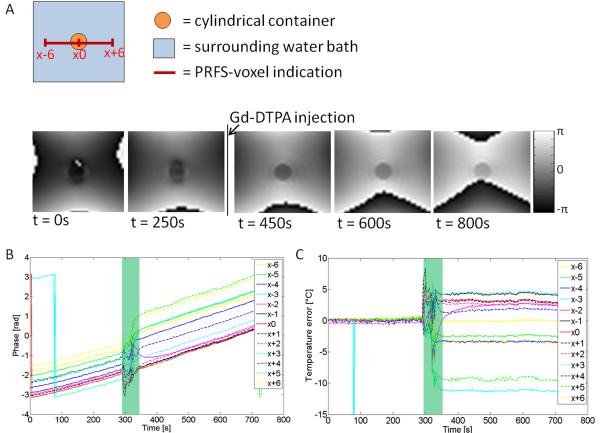
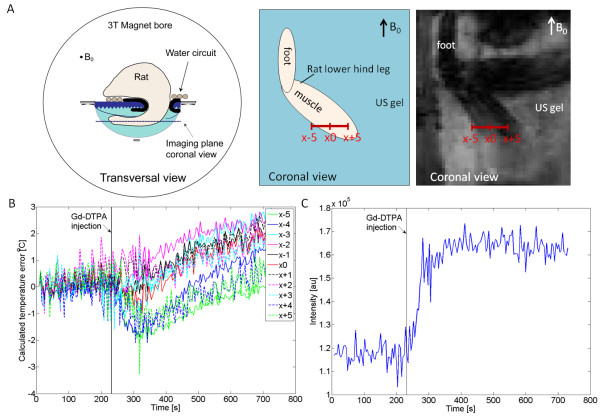
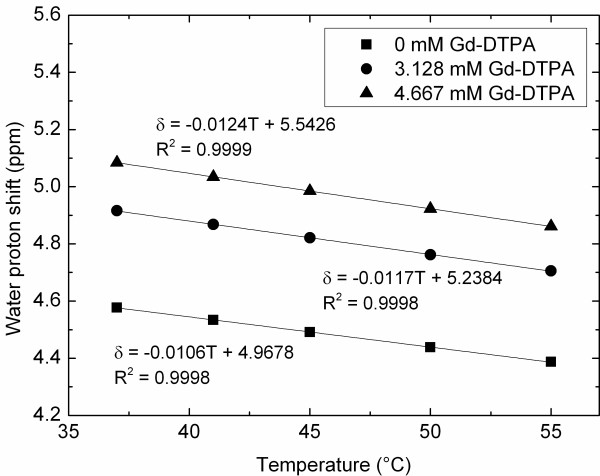
Phantom measurements were performed to demonstrate the effect of sudden gadopentetate dimeglumine (Gd-DTPA) inflow on the phase shift measured using a PRFS thermometry sequence on a clinical 3 T magnetic resonance-guided high-intensity focused ultrasound (MR-HIFU) system. By proton nuclear magnetic resonance spectroscopy, the temperature dependence of the Gd-DTPA susceptibility was measured, as well as the effect of liposomal encapsulation and release on the bulk magnetic susceptibility of Gd-DTPA. In vivo studies were carried out to measure the temperature error induced in a rat hind leg muscle upon intravenous Gd-DTPA injection.
The phantom study showed a significant phase shift inside the phantom of 0.6 ± 0.2 radians (mean ± standard deviation) upon Gd-DTPA injection (1.0 mM, clinically relevant amount). A Gd-DTPA-induced magnetic susceptibility shift of ΔχGd-DTPA = 0.109 ppm/mM was measured in a cylinder parallel to the main magnetic field at 37°C. The temperature dependence of the susceptibility shift showed dΔχGd-DTPA/dT = -0.00038 ± 0.00008 ppm/mM/°C. No additional susceptibility effect was measured upon Gd release from paramagnetic liposomes. In vivo, intravenous Gd-DTPA injection resulted in a perceived temperature change of 2.0°C ± 0.1°C at the center of the hind leg muscle.
The use of a paramagnetic MR contrast agent prior to MR-HIFU treatment may influence the accuracy of the PRFS MR thermometry. Depending on the treatment workflow, Gd-induced temperature errors ranging between -4°C and +3°C can be expected. Longer waiting time between contrast agent injection and treatment, as well as shortening the ablation duration by increasing the sonication power, will minimize the Gd influence. Compensation for the phase changes induced by the changing Gd presence is difficult as the magnetic field changes are arising nonlocally in the surroundings of the susceptibility change.
质子共振频率偏移(PRFS)磁共振(MR)测温法利用了水质子电子屏蔽常数随温度变化所引起的局部磁场变化。因此,任何其他局部磁场变化都将转化为错误的温度读数,需要相应地予以考虑。在此,我们研究了顺磁性MR造影剂的流入和存在所引起的磁化率变化及其对PRFS测温法的影响。
进行了体模测量,以证明在临床3T磁共振引导高强度聚焦超声(MR-HIFU)系统上,突然注入钆喷酸葡胺(Gd-DTPA)对使用PRFS测温序列测量的相移的影响。通过质子核磁共振波谱法,测量了Gd-DTPA磁化率的温度依赖性,以及脂质体包裹和释放对Gd-DTPA体磁化率的影响。进行了体内研究,以测量静脉注射Gd-DTPA后大鼠后腿肌肉中引起的温度误差。
体模研究显示,注入Gd-DTPA(1.0 mM,临床相关剂量)后,体模内出现了显著的相移,为0.6±0.2弧度(平均值±标准差)。在37°C下,在与主磁场平行的圆柱体中测得Gd-DTPA引起的磁化率偏移为ΔχGd-DTPA = 0.109 ppm/mM。磁化率偏移的温度依赖性显示dΔχGd-DTPA/dT = -0.00038±0.00008 ppm/mM/°C。顺磁性脂质体释放Gd后未测得额外的磁化率效应。在体内,静脉注射Gd-DTPA导致后腿肌肉中心的感知温度变化为2.0°C±0.1°C。
在MR-HIFU治疗前使用顺磁性MR造影剂可能会影响PRFS MR测温法的准确性。根据治疗流程,预计Gd引起的温度误差在-4°C至+3°C之间。在造影剂注射和治疗之间延长等待时间,以及通过提高超声功率缩短消融持续时间,将使Gd的影响最小化。由于磁化率变化周围的磁场变化是非局部产生的,因此很难补偿由Gd存在变化引起的相位变化。