Rogers Erin S, Fu Steven S, Krebs Paul, Noorbaloochi Siamak, Nugent Sean M, Rao Radha, Schlede Carolyn, Sherman Scott E
VA New York Harbor Healthcare System, 423 East 23rd Street, New York, NY 10010, USA.
BMC Public Health. 2014 Dec 17;14:1294. doi: 10.1186/1471-2458-14-1294.
Persons with a mental health diagnosis have high rates of tobacco use and face numerous barriers to cessation including high levels of nicotine dependence, low rates of tobacco treatment referrals from mental health providers, and limited availability of tobacco treatment targeted to their needs. This manuscript describes the rationale and methods of a clinical trial with the following aims: 1) Compare the reach and efficacy of a proactive telephone-based tobacco cessation program for Veterans Health Administration (VHA) mental health clinic patients to VHA usual care and 2) Model longitudinal associations between baseline patient characteristics and long-term abstinence.
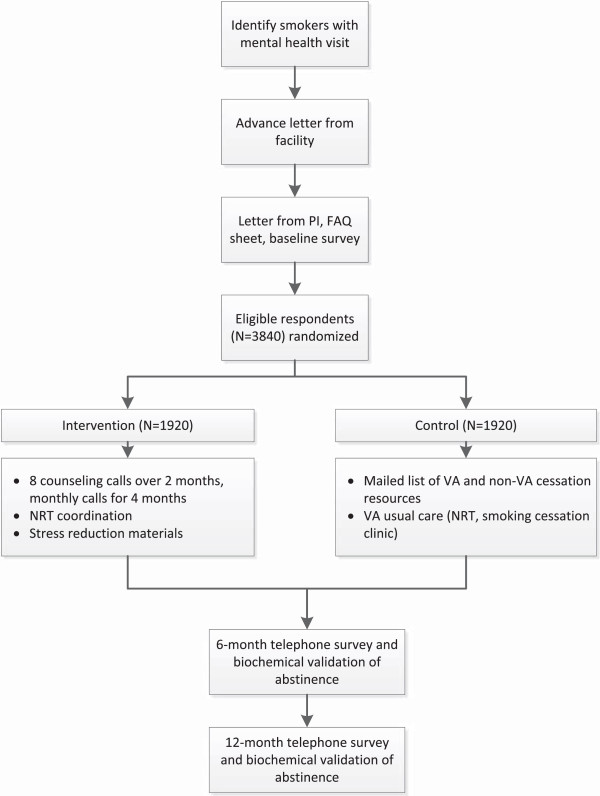
METHODS/DESIGN: We will use the electronic medical record to identify patients across four VHA healthcare facilities who have a clinical reminder code indicating current tobacco use in the past six months and who have had a mental health clinic visit in the past 12 months. We will send each patient an introductory letter and baseline survey. Survey respondents (N = 3840) will be randomized in a 1:1 fashion to intervention or control. Control participants will receive VHA usual care. Intervention participants will receive proactive motivational telephone outreach to offer tobacco treatment. Intervention participants interested in treatment will receive eight weeks of nicotine replacement therapy plus eight sessions of specialized telephone counseling over two months, followed by monthly maintenance counseling for four months. We will conduct telephone surveys with participants at six and 12 months to assess study outcomes. We will collect a mailed saliva sample from patients reporting 7-day abstinence on the telephone surveys. The primary outcome will be cotinine-validated abstinence at 12-month follow-up.
Mental health patients are a high-risk smoking population with significant barriers to cessation. This study will evaluate the efficacy of a program that proactively reaches out to smokers with a mental health treatment history to engage them into telephone cessation counseling targeted to the needs of mental health patients.
Clinicaltrials.gov: NCT01737281 (registered November 5, 2012).
患有精神疾病的人群吸烟率很高,并且在戒烟方面面临诸多障碍,包括尼古丁高度依赖、精神健康服务提供者对烟草治疗的转诊率低,以及针对其需求的烟草治疗服务有限。本手稿描述了一项临床试验的基本原理和方法,其目标如下:1)比较针对退伍军人健康管理局(VHA)心理健康门诊患者的基于电话的主动戒烟项目与VHA常规护理的覆盖范围和效果;2)建立基线患者特征与长期戒烟之间的纵向关联模型。
方法/设计:我们将使用电子病历识别四个VHA医疗保健机构中符合以下条件的患者:有临床提醒代码表明在过去六个月内当前吸烟,且在过去12个月内曾就诊于心理健康门诊。我们将向每位患者发送一封介绍信和一份基线调查问卷。参与调查的受访者(N = 3840)将以1:1的比例随机分为干预组或对照组。对照组参与者将接受VHA常规护理。干预组参与者将接受主动的动机性电话外展服务,以提供烟草治疗。对治疗感兴趣的干预组参与者将接受为期八周的尼古丁替代疗法,外加在两个月内进行八次专门的电话咨询,随后在四个月内每月进行一次维持咨询。我们将在六个月和十二个月时对参与者进行电话调查,以评估研究结果。我们将从在电话调查中报告已戒烟7天的患者那里收集邮寄的唾液样本。主要结局将是在12个月随访时经可替宁验证的戒烟情况。
心理健康患者是吸烟的高危人群,在戒烟方面存在重大障碍。本研究将评估一个项目的效果,该项目主动联系有心理健康治疗史的吸烟者,使他们参与针对心理健康患者需求的电话戒烟咨询。
Clinicaltrials.gov:NCT01737281(2012年11月5日注册)。