Ding Lili, Kurowski Brad G, He Hua, Alexander Eileen S, Mersha Tesfaye B, Fardo David W, Zhang Xue, Pilipenko Valentina V, Kottyan Leah, Martin Lisa J
Department of Pediatrics, Cincinnati Children's Hospital Medical Center, 3333 Burnet Avenue, Cincinnati, OH 45229, USA ; Department of Pediatrics, University of Cincinnati College of Medicine, 3235 Eden Avenue,Cincinnati, OH 45267, USA.
Department of Pediatrics, Cincinnati Children's Hospital Medical Center, 3333 Burnet Avenue, Cincinnati, OH 45229, USA.
BMC Proc. 2014 Jun 17;8(Suppl 1):S69. doi: 10.1186/1753-6561-8-S1-S69. eCollection 2014.
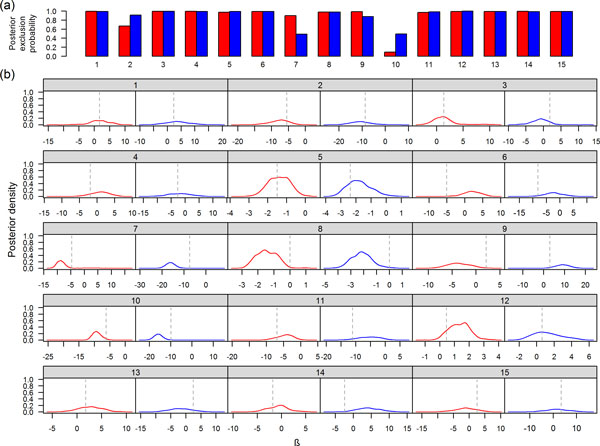
Genetic studies often collect data on multiple traits. Most genetic association analyses, however, consider traits separately and ignore potential correlation among traits, partially because of difficulties in statistical modeling of multivariate outcomes. When multiple traits are measured in a pedigree longitudinally, additional challenges arise because in addition to correlation between traits, a trait is often correlated with its own measures over time and with measurements of other family members. We developed a Bayesian model for analysis of bivariate quantitative traits measured longitudinally in family genetic studies. For a given trait, family-specific and subject-specific random effects account for correlation among family members and repeated measures, respectively. Correlation between traits is introduced by incorporating multivariate random effects and allowing time-specific trait residuals to correlate as in seemingly unrelated regressions. The proposed model can examine multiple single-nucleotide variations simultaneously, as well as incorporate familyspecific, subject-specific, or time-varying covariates. Bayesian multiplicity technique is used to effectively control false positives. Genetic Analysis Workshop 18 simulated data illustrate the proposed approach's applicability in modeling longitudinal multivariate outcomes in family genetic association studies.
基因研究常常收集多种性状的数据。然而,大多数基因关联分析都是分别考虑性状,而忽略了性状之间潜在的相关性,部分原因是多变量结果的统计建模存在困难。当在一个家系中对多个性状进行纵向测量时,会出现更多挑战,因为除了性状之间的相关性外,一个性状通常还与其自身不同时间的测量值以及其他家庭成员的测量值相关。我们开发了一种贝叶斯模型,用于分析在家族基因研究中纵向测量的双变量定量性状。对于给定的性状,家族特异性和个体特异性随机效应分别解释了家庭成员之间的相关性和重复测量的相关性。通过纳入多变量随机效应并允许特定时间的性状残差如在看似不相关回归中那样相关,引入了性状之间的相关性。所提出的模型可以同时检验多个单核苷酸变异,还能纳入家族特异性、个体特异性或随时间变化的协变量。贝叶斯多重性技术用于有效控制假阳性。遗传分析研讨会18的模拟数据说明了所提出方法在家族基因关联研究中对纵向多变量结果建模的适用性。