Iturriaga Rodrigo, Andrade David C, Del Rio Rodrigo
Laboratorio de Neurobiología, Departamento de Fisiología, Facultad de Ciencias Biológicas, Pontificia Universidad Católica de Chile Santiago, Chile.
Laboratory of Cardiorespiratory Control, Center of Biomedical Research, Universidad Autónoma de Chile Santiago, Chile.
Front Physiol. 2014 Dec 2;5:468. doi: 10.3389/fphys.2014.00468. eCollection 2014.
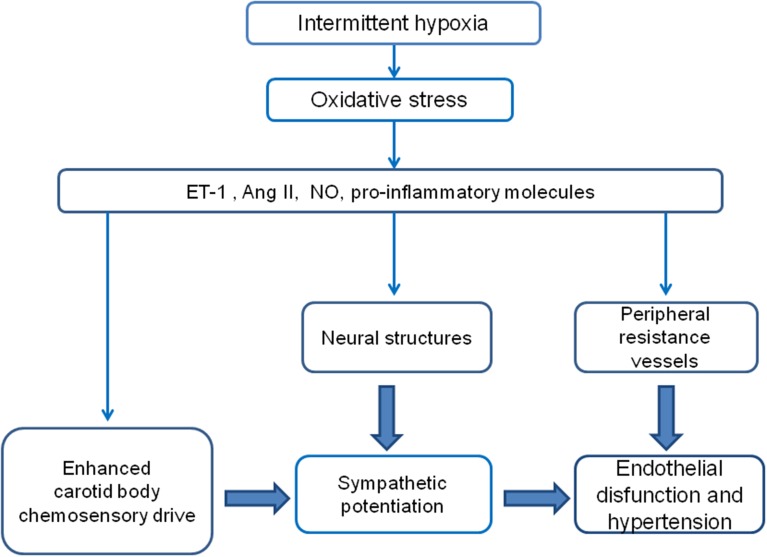
The carotid body (CB) plays a main role in the maintenance of the oxygen homeostasis. The hypoxic stimulation of the CB increases the chemosensory discharge, which in turn elicits reflex sympathetic, cardiovascular, and ventilatory adjustments. An exacerbate carotid chemosensory activity has been associated with human sympathetic-mediated diseases such as hypertension, insulin resistance, heart failure, and obstructive sleep apnea (OSA). Indeed, the CB chemosensory discharge becomes tonically hypereactive in experimental models of OSA and heart failure. Chronic intermittent hypoxia (CIH), a main feature of OSA, enhances CB chemosensory baseline discharges in normoxia and in response to hypoxia, inducing sympathetic overactivity and hypertension. Oxidative stress, increased levels of ET-1, Angiotensin II and pro-inflammatory cytokines, along with a reduced production of NO in the CB, have been associated with the enhanced carotid chemosensory activity. In this review, we will discuss new evidence supporting a main role for the CB chemoreceptor in the autonomic and cardiorespiratory alterations induced by intermittent hypoxia, as well as the molecular mechanisms involved in the CB chemosensory potentiation.
颈动脉体(CB)在维持氧稳态中起主要作用。CB的低氧刺激会增加化学感受性放电,进而引发反射性交感神经、心血管和通气调节。颈动脉化学感受性活动加剧与人类交感神经介导的疾病有关,如高血压、胰岛素抵抗、心力衰竭和阻塞性睡眠呼吸暂停(OSA)。事实上,在OSA和心力衰竭的实验模型中,CB化学感受性放电会呈持续性高反应性。慢性间歇性缺氧(CIH)是OSA的一个主要特征,它会增强CB在常氧和低氧反应时的化学感受性基线放电,导致交感神经活动亢进和高血压。氧化应激、内皮素-1、血管紧张素II和促炎细胞因子水平升高,以及CB中一氧化氮产生减少,都与颈动脉化学感受性活动增强有关。在这篇综述中,我们将讨论新的证据,这些证据支持CB化学感受器在间歇性缺氧诱导的自主神经和心肺改变中起主要作用,以及CB化学感受性增强所涉及的分子机制。