Barzel Benjamin, Weir Jacquelyn M, Meikle Peter J, Burke Sandra L, Armitage James A, Head Geoffrey A
Neuropharmacology Laboratory, BakerIDI Heart and Diabetes Institute Melbourne, VIC, Australia ; Department of Anatomy and Developmental Biology, Monash University Melbourne, VIC, Australia.
Neuropharmacology Laboratory, BakerIDI Heart and Diabetes Institute Melbourne, VIC, Australia.
Front Physiol. 2014 Dec 2;5:469. doi: 10.3389/fphys.2014.00469. eCollection 2014.
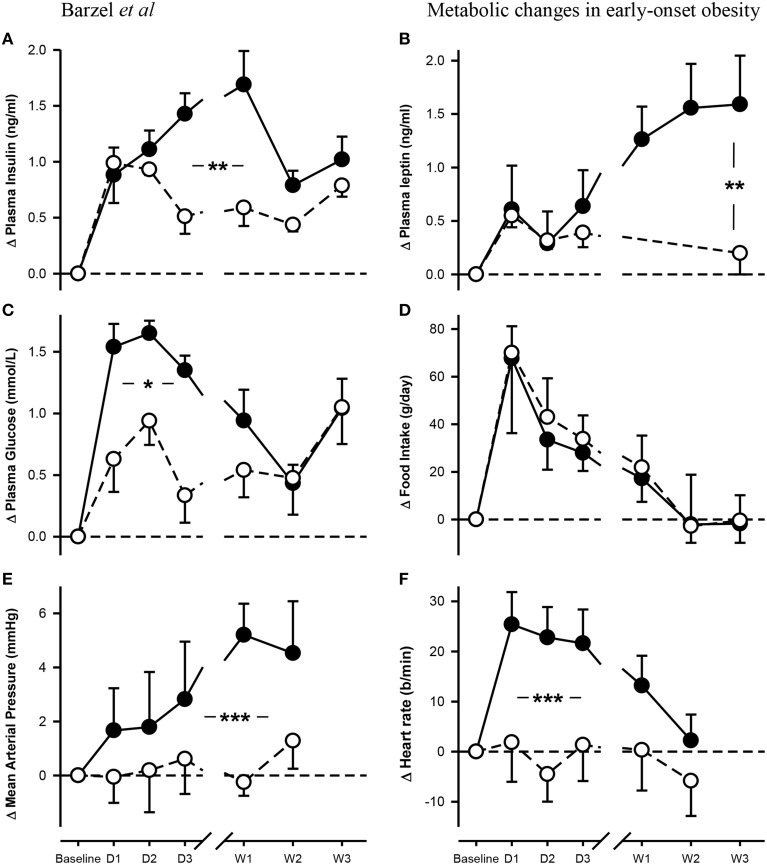
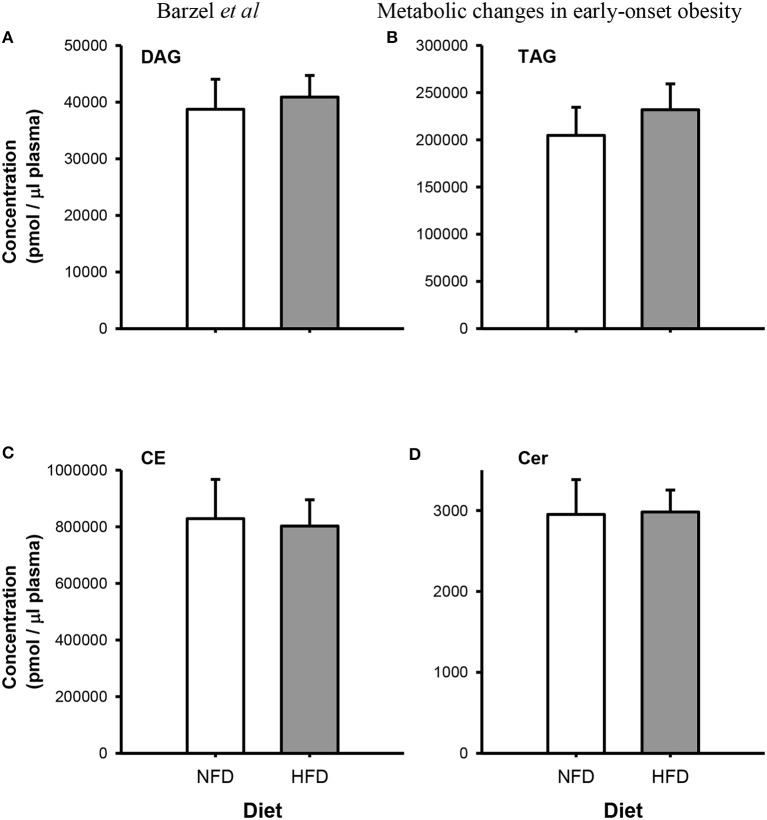
Although the association between obesity and hypertension is well-known, the underlying mechanism remains elusive. Previously, we have shown that 3 week fat feeding in rabbits produces greater visceral adiposity, hypertension, tachycardia and elevated renal sympathetic nerve activity (RSNA) compared to rabbits on a normal diet. Because hyperinsulinaemia, hyperleptinemia, and dyslipidaemia are independent cardiovascular risk factors associated with hypertension we compared plasma insulin, leptin, and lipid profiles in male New Zealand White rabbits fed a normal fat diet (NFD 4.3% fat, n = 11) or high fat diet (HFD 13.4% fat, n = 13) at days 1, 2, 3 and weeks 1, 2, 3 of the diet. Plasma concentrations of diacylglyceride (DG), triacylglyceride (TG), ceramide and cholesteryl esters (CE) were obtained after analysis by liquid chromatography mass spectrometry. Plasma insulin and glucose increased within the first 3 days of the diet in HFD rabbits (P < 0.05) and remained elevated at week 1 (P < 0.05). Blood pressure and heart rate (HR) followed a similar pattern. By contrast, in both groups, plasma leptin levels remained unchanged during the first few days (P > 0.05), increasing by week 3 in fat fed animals alone (P < 0.05). Concentrations of total DG, TG, CE, and Ceramide at week 3 did not differ between groups (P > 0.05). Our data show plasma insulin increases rapidly following consumption of a HFD and suggests that it may play a role in the rapid rise of blood pressure. Dyslipidaemia does not appear to contribute to the hypertension in this animal model.
尽管肥胖与高血压之间的关联已广为人知,但其潜在机制仍不清楚。此前,我们已经表明,与正常饮食的兔子相比,给兔子喂食3周高脂肪食物会使其内脏脂肪增多、血压升高、心率加快以及肾交感神经活动(RSNA)增强。由于高胰岛素血症、高瘦素血症和血脂异常是与高血压相关的独立心血管危险因素,因此我们比较了雄性新西兰白兔在喂食正常脂肪饮食(NFD,脂肪含量4.3%,n = 11)或高脂肪饮食(HFD,脂肪含量13.4%,n = 13)1天、2天、3天以及第1周、第2周、第3周时的血浆胰岛素、瘦素和血脂水平。通过液相色谱质谱分析获得二酰甘油(DG)、三酰甘油(TG)、神经酰胺和胆固醇酯(CE)的血浆浓度。HFD组兔子在饮食的前3天内血浆胰岛素和葡萄糖水平升高(P < 0.05),并在第1周时仍保持升高(P < 0.05)。血压和心率(HR)呈现类似模式。相比之下,两组在最初几天血浆瘦素水平均未发生变化(P > 0.05),仅在高脂肪喂养动物中第3周时升高(P < 0.05)。第3周时两组的总DG、TG、CE和神经酰胺浓度无差异(P > 0.05)。我们的数据表明,食用HFD后血浆胰岛素迅速升高,并提示其可能在血压快速升高过程中发挥作用。在这个动物模型中,血脂异常似乎并未导致高血压。