Department of Marine Ecology, Royal Netherlands Institute for Sea Research (NIOZ), 1790 AB Den Burg, P.O. Box 59, Texel, The Netherlands.
Computational Geo-Ecology, Institute for Biodiversity and Ecosystem Dynamics (IBED), University of Amsterdam, P.O. Box 94248, 1090 GE Amsterdam, The Netherlands.
Mov Ecol. 2014 Mar 28;2(1):6. doi: 10.1186/2051-3933-2-6. eCollection 2014.
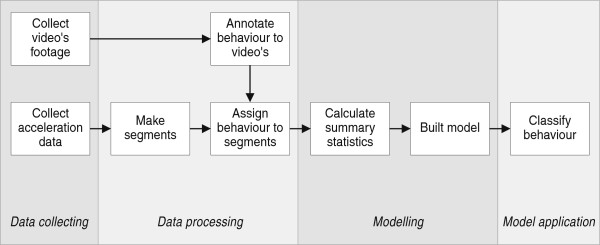
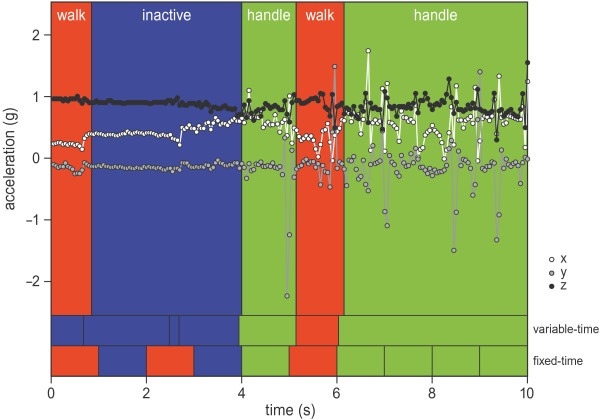
Animal-borne accelerometers measure body orientation and movement and can thus be used to classify animal behaviour. To univocally and automatically analyse the large volume of data generated, we need classification models. An important step in the process of classification is the segmentation of acceleration data, i.e. the assignment of the boundaries between different behavioural classes in a time series. So far, analysts have worked with fixed-time segments, but this may weaken the strength of the derived classification models because transitions of behaviour do not necessarily coincide with boundaries of the segments. Here we develop random forest automated supervised classification models either built on variable-time segments generated with a so-called 'change-point model', or on fixed-time segments, and compare for eight behavioural classes the classification performance. The approach makes use of acceleration data measured in eight free-ranging crab plovers Dromas ardeola.
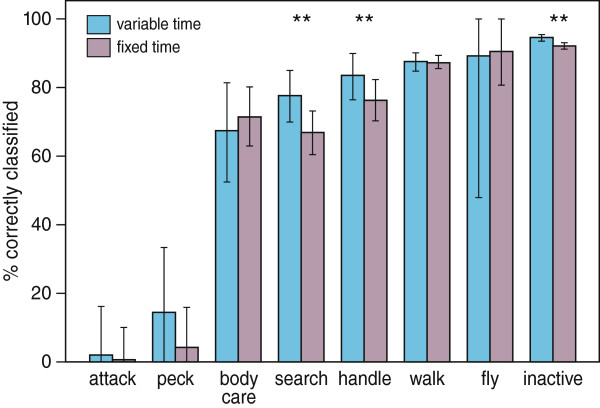
Useful classification was achieved by both the variable-time and fixed-time approach for flying (89% vs. 91%, respectively), walking (88% vs. 87%) and body care (68% vs. 72%). By using the variable-time segment approach, significant gains in classification performance were obtained for inactive behaviours (95% vs. 92%) and for two major foraging activities, i.e. handling (84% vs. 77%) and searching (78% vs. 67%). Attacking a prey and pecking were never accurately classified by either method.
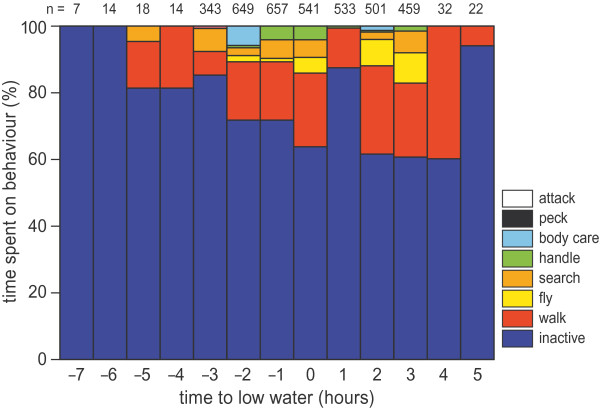
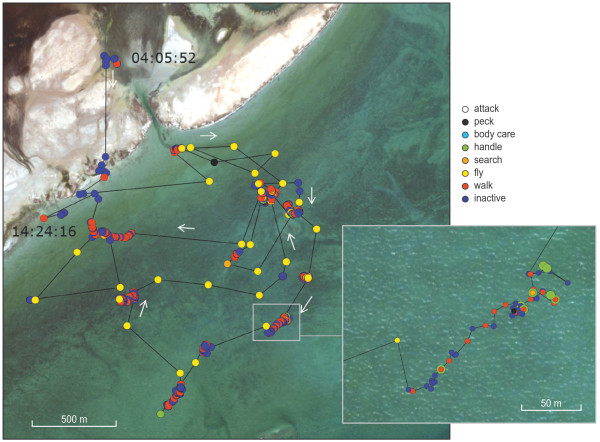
Acceleration-based behavioural classification can be optimized using a variable-time segmentation approach. After implementing variable-time segments to our sample data, we achieved useful levels of classification performance for almost all behavioural classes. This enables behaviour, including motion, to be set in known spatial contexts, and the measurement of behavioural time-budgets of free-living birds with unprecedented coverage and precision. The methods developed here can be easily adopted in other studies, but we emphasize that for each species and set of questions, the presented string of work steps should be run through.
动物携带的加速度计可测量身体的方向和运动,因此可用于对动物行为进行分类。为了统一且自动地分析生成的大量数据,我们需要分类模型。在分类过程中,一个重要步骤是对加速度数据进行分割,即将时间序列中的不同行为类别的边界分配给不同行为类别。到目前为止,分析人员一直使用固定时间片段,但这可能会削弱所得到的分类模型的强度,因为行为的转变不一定与片段的边界重合。在这里,我们开发了随机森林自动监督分类模型,这些模型是基于使用所谓的“变化点模型”生成的可变时间片段构建的,或者是基于固定时间片段构建的,并针对 8 种行为类比较了这两种分类模型的性能。该方法利用在 8 只自由活动的红腹滨鹬(Dromas ardeola)身上测量的加速度数据。
对于飞行(分别为 89%和 91%)、行走(88%和 87%)和身体护理(68%和 72%),两种方法都实现了有用的分类。通过使用可变时间片段方法,在不活动行为(95%比 92%)和两种主要觅食活动(即处理(84%比 77%)和搜索(78%比 67%)方面,分类性能得到了显著提高。通过这两种方法都从未准确地对攻击猎物和啄食进行分类。
可以使用可变时间分段方法来优化基于加速度的行为分类。在将可变时间片段应用于我们的样本数据后,我们几乎对所有行为类别的分类性能都达到了有用的水平。这使得行为(包括运动)可以在已知的空间背景下进行设置,并以前所未有的覆盖范围和精度测量自由生活鸟类的行为时间预算。这里开发的方法可以很容易地应用于其他研究,但我们强调,对于每个物种和问题集,都应该运行所提出的工作步骤序列。