Mahalik Shubhashree, Sharma Ashish K, Mukherjee Krishna J
School of Biotechnology, Jawaharlal Nehru University, New Delhi, 110067, India.
Microb Cell Fact. 2014 Dec 19;13:177. doi: 10.1186/s12934-014-0177-1.
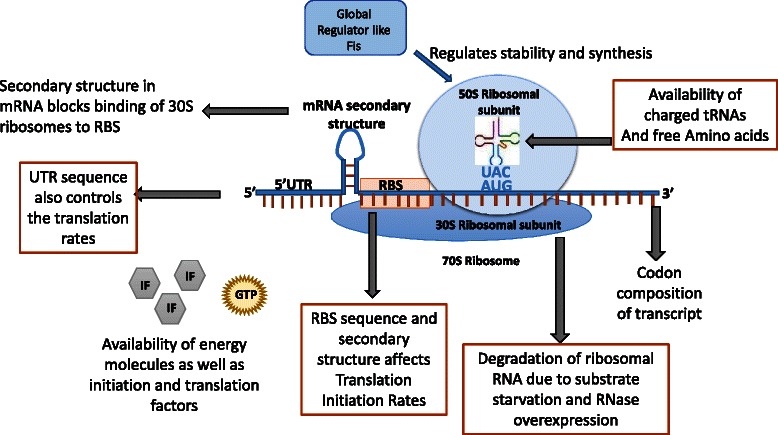
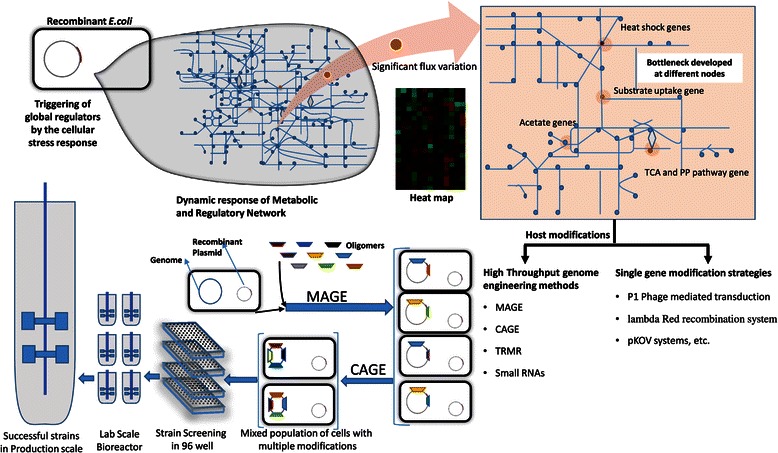
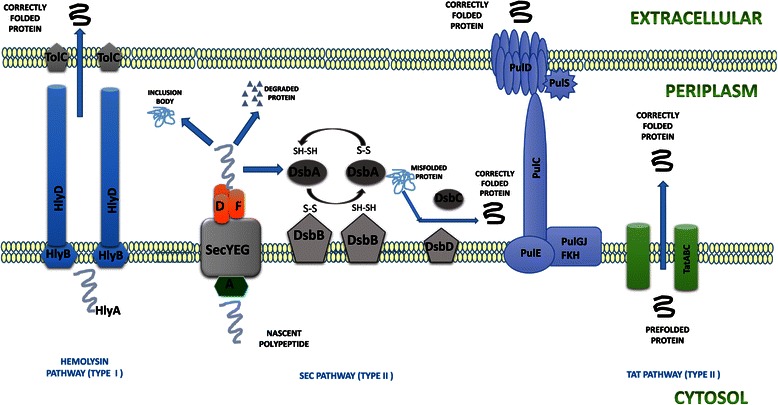
A metabolic engineering perspective which views recombinant protein expression as a multistep pathway allows us to move beyond vector design and identify the downstream rate limiting steps in expression. In E.coli these are typically at the translational level and the supply of precursors in the form of energy, amino acids and nucleotides. Further recombinant protein production triggers a global cellular stress response which feedback inhibits both growth and product formation. Countering this requires a system level analysis followed by a rational host cell engineering to sustain expression for longer time periods. Another strategy to increase protein yields could be to divert the metabolic flux away from biomass formation and towards recombinant protein production. This would require a growth stoppage mechanism which does not affect the metabolic activity of the cell or the transcriptional or translational efficiencies. Finally cells have to be designed for efficient export to prevent buildup of proteins inside the cytoplasm and also simplify downstream processing. The rational and the high throughput strategies that can be used for the construction of such improved host cell platforms for recombinant protein expression is the focus of this review.
代谢工程视角将重组蛋白表达视为一个多步骤途径,使我们能够超越载体设计,识别表达过程中下游的限速步骤。在大肠杆菌中,这些限速步骤通常处于翻译水平以及能量、氨基酸和核苷酸形式的前体供应方面。进一步的重组蛋白生产会引发全局细胞应激反应,该反应会反馈抑制生长和产物形成。应对这一问题需要进行系统水平分析,随后进行合理的宿主细胞工程改造,以维持更长时间的表达。提高蛋白质产量的另一种策略可能是将代谢通量从生物质形成转移到重组蛋白生产上。这将需要一种不影响细胞代谢活性或转录或翻译效率的生长停滞机制。最后,必须设计细胞以实现高效输出,以防止蛋白质在细胞质内积累,并简化下游加工过程。可用于构建此类用于重组蛋白表达的改进宿主细胞平台的合理策略和高通量策略是本综述的重点。