Marston Louise, Nazareth Irwin, Petersen Irene, Walters Kate, Osborn David P J
Research Department of Primary Care and Population Health, University College London, London, UK.
Division of Psychiatry, University College London, London, UK Camden and Islington NHS Foundation Trust, London, UK.
BMJ Open. 2014 Dec 18;4(12):e006135. doi: 10.1136/bmjopen-2014-006135.
To examine the recorded indication for antipsychotic prescriptions in UK primary care.
Cohort study.
Primary care.
Individuals prescribed antipsychotics between 2007 and 2011.
The proportion of individuals prescribed antipsychotics with a diagnosis of (1) psychosis and bipolar disorder, (2) other diagnoses including depression, anxiety and dementia and (3) none of these diagnoses.
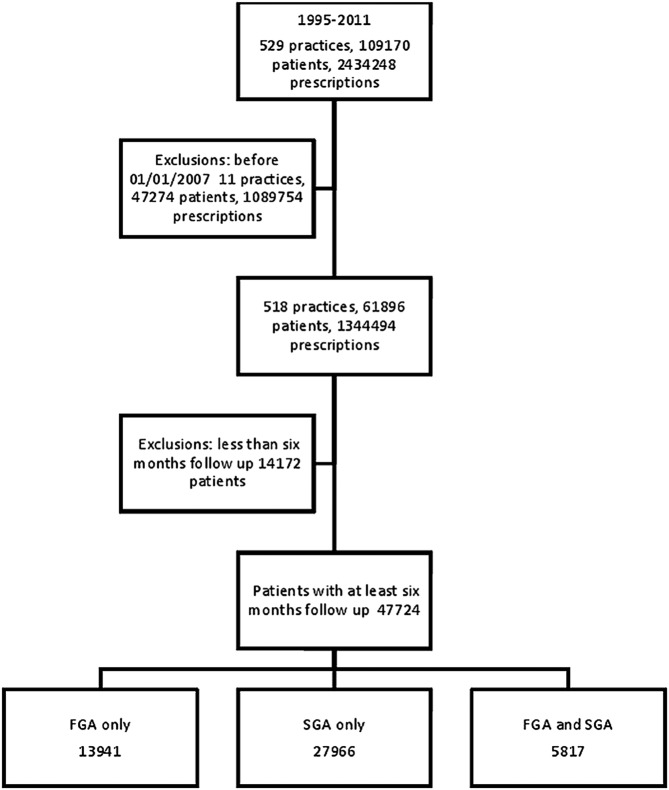
We identified 47,724 individuals prescribed antipsychotic agents. 13,941 received first-generation agents and 27,966 received second-generation agents. The rates of prescribing were higher in females (incidence rate ratio (IRR) 1.092 (95% CI 1.088 to 1.095), older people (80+ vs 40-49; IRR 2.234 (2.222 to 2.246)) and in those from the most deprived areas (most deprived vs least deprived IRR 3.487 (3.567 to 3.606). Of those receiving first-generation antipsychotics, less than 50% had a diagnosis of psychosis/bipolar disorder. For the second-generation agents, the numbers ranged from 4824 (36%) for quetiapine to 7094 (62%) for olanzapine. In patients without psychosis/bipolar disorder, common diagnoses included anxiety, depression, dementia, sleep and personality disorders. For example, in risperidone users, 14% had an anxiety code, 22% depression, 12% dementia, 11% sleep disorder and 4% personality disorder. The median daily doses and duration of treatment were greater in those with schizophrenia (eg, risperidone median daily dose 4 mg; IQR 2-6: median duration 1.2 years) than in those with non-psychotic/bipolar disorders such as depression or anxiety (eg, risperidone 1 mg; IQR 1-2: 0.6 years). A relatively large proportion (between 6% and 17%) of people receiving individual antipsychotics had none of the diagnoses stated above.
In UK primary care, a large proportion of people prescribed antipsychotics have no record of psychotic or bipolar disorder. They are often older people with conditions including dementia, non-psychotic depression, anxiety and sleep disorders.
研究英国初级医疗中抗精神病药物处方的记录适应证。
队列研究。
初级医疗。
2007年至2011年间开具抗精神病药物处方的个体。
开具抗精神病药物处方且诊断为(1)精神分裂症和双相情感障碍,(2)包括抑郁症、焦虑症和痴呆症在内的其他诊断,以及(3)无上述任何诊断的个体比例。
我们确定了47724名开具抗精神病药物的个体。13941人接受第一代药物治疗,27966人接受第二代药物治疗。女性(发病率比(IRR)1.092(95%CI 1.088至1.095))、老年人(80岁及以上与40至49岁相比;IRR 2.234(2.222至2.246))以及最贫困地区的人群(最贫困与最不贫困相比IRR 3.487(3.567至3.606))的处方率更高。在接受第一代抗精神病药物治疗的患者中,不到50%被诊断为精神分裂症/双相情感障碍。对于第二代药物,这一数字从喹硫平的4824例(36%)到奥氮平的7094例(62%)不等。在没有精神分裂症/双相情感障碍的患者中,常见诊断包括焦虑症、抑郁症、痴呆症、睡眠障碍和人格障碍。例如,在使用利培酮的患者中,14%有焦虑症编码,22%有抑郁症,12%有痴呆症,11%有睡眠障碍,4%有人格障碍。精神分裂症患者的每日中位剂量和治疗持续时间(例如,利培酮每日中位剂量4mg;四分位间距2 - 6:中位持续时间1.2年)高于患有非精神病性/双相情感障碍(如抑郁症或焦虑症)的患者(例如,利培酮1mg;四分位间距1 - 2:0.6年)。接受个体抗精神病药物治疗的人群中,有相对较大比例(6%至17%)没有上述任何诊断。
在英国初级医疗中,开具抗精神病药物处方的人群中很大一部分没有精神分裂症或双相情感障碍的记录。他们通常是患有痴呆症、非精神病性抑郁症、焦虑症和睡眠障碍等疾病的老年人。