Vlassakov Kamen V, Kissin Igor
Department of Anesthesiology, Perioperative and Pain Medicine, Brigham and Women's Hospital, Harvard Medical School, Boston, MA, USA.
Drug Des Devel Ther. 2014 Dec 9;8:2463-73. doi: 10.2147/DDDT.S73862. eCollection 2014.
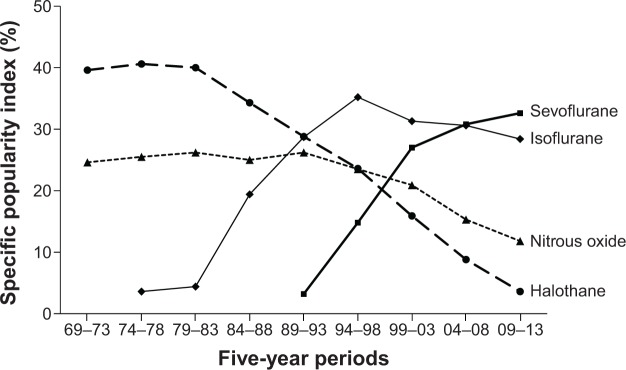
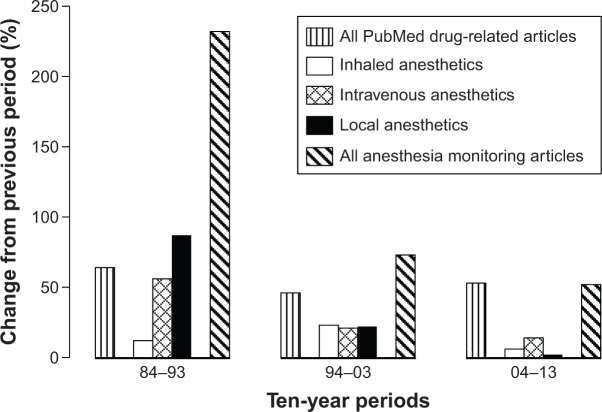
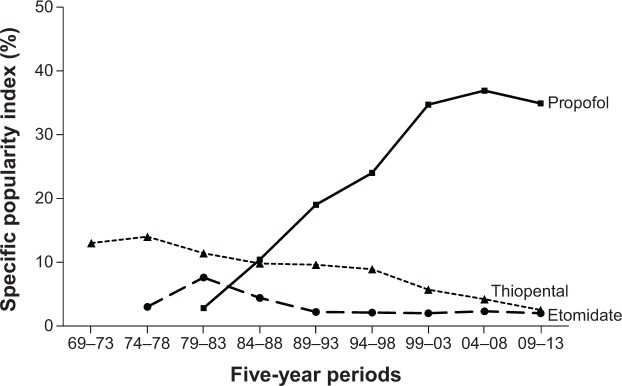
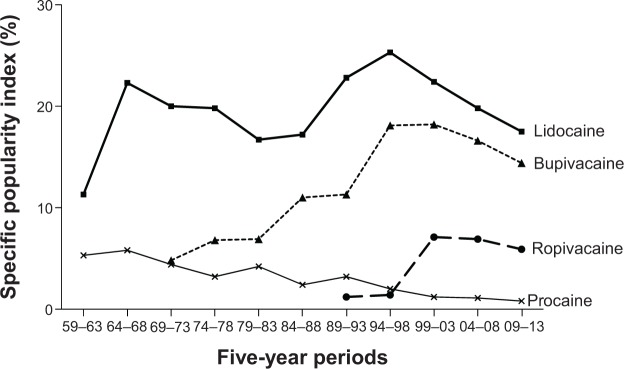
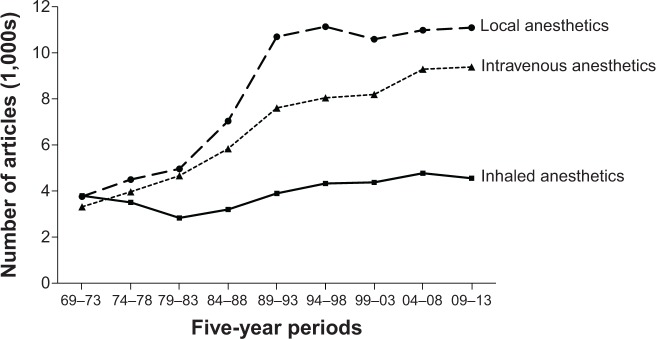
The aim of this study was to assess progress in the field of anesthetic drugs over the past 30 years using scientometric indices: popularity indices (general and specific), representing the proportion of articles on a drug relative to all articles in the field of anesthetics (general index) or the subfield of a specific class of anesthetics (specific index); index of change, representing the degree of growth in publications on a topic from one period to the next; index of expectations, representing the ratio of the number of articles on a topic in the top 20 journals relative to the number of articles in all (>5,000) biomedical journals covered by PubMed; and index of ultimate success, representing a publication outcome when a new drug takes the place of a common drug previously used for the same purpose. Publications on 58 topics were assessed during six 5-year periods from 1984 to 2013. Our analysis showed that during 2009-2013, out of seven anesthetics with a high general popularity index (≥2.0), only two were introduced after 1980, ie, the inhaled anesthetic sevoflurane and the local anesthetic ropivacaine; however, only sevoflurane had a high index of expectations (12.1). Among anesthetic adjuncts, in 2009-2013, only one agent, sugammadex, had both an extremely high index of change (>100) and a high index of expectations (25.0), reflecting the novelty of its mechanism of action. The index of ultimate success was positive with three anesthetics, ie, lidocaine, isoflurane, and propofol, all of which were introduced much longer than 30 years ago. For the past 30 years, there were no new anesthetics that have produced changes in scientometric indices indicating real progress.
本研究的目的是使用科学计量指标评估过去30年麻醉药物领域的进展:知名度指标(一般和特定),表示关于一种药物的文章占麻醉领域所有文章(一般指标)或特定类别的麻醉子领域文章的比例(特定指标);变化指标,表示一个主题从一个时期到下一个时期出版物的增长程度;期望指标,表示前20种期刊上关于一个主题的文章数量与PubMed涵盖的所有(>5000种)生物医学期刊上的文章数量之比;以及最终成功指标,表示一种新药取代先前用于相同目的的常用药物时的出版结果。在1984年至2013年的六个5年期间评估了关于58个主题的出版物。我们的分析表明,在2009 - 2013年期间,在七种一般知名度指标较高(≥2.0)的麻醉剂中,只有两种是1980年以后引入的,即吸入麻醉剂七氟烷和局部麻醉剂罗哌卡因;然而,只有七氟烷有较高的期望指标(12.1)。在麻醉辅助药物中,在2009 - 2013年期间,只有一种药物,即舒更葡糖钠,同时具有极高的变化指标(>100)和较高的期望指标(25.0),这反映了其作用机制的新颖性。三种麻醉剂,即利多卡因、异氟烷和丙泊酚的最终成功指标为正,所有这些药物的引入时间都比30年前长得多。在过去30年中,没有新的麻醉剂在科学计量指标上产生表明真正进展的变化。