Vlassakov Kamen V, Kissin Igor
Department of Anesthesiology, Perioperative and Pain Medicine, Brigham and Women's Hospital, Harvard Medical School, Boston, MA, USA.
Drug Des Devel Ther. 2015 May 11;9:2599-608. doi: 10.2147/DDDT.S81013. eCollection 2015.
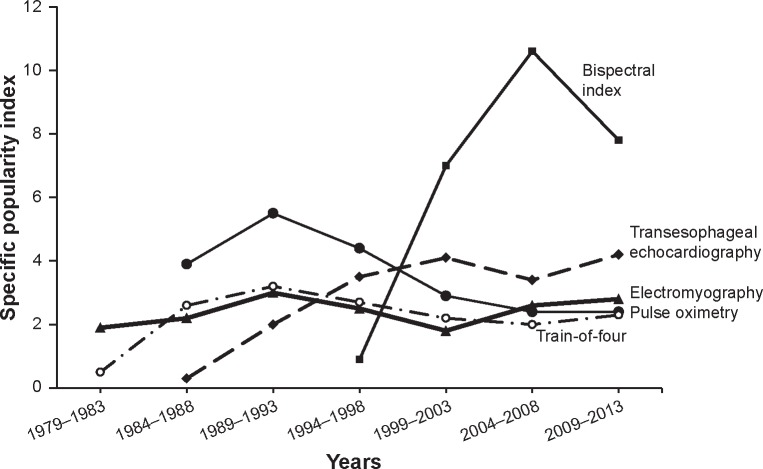
The aim of this study was to assess progress in the field of anesthesia monitoring over the past 40 years using scientometric analysis. The following scientometric indexes were used: popularity indexes (general and specific), representing the proportion of articles on either a topic relative to all articles in the field of anesthetics (general popularity index, GPI) or the subfield of anesthesia monitoring (specific popularity index, SPI); index of change (IC), representing the degree of growth in publications on a topic from one period to the next; and index of expectations (IE), representing the ratio of the number of articles on a topic in the top 20 journals relative to the number of articles in all (>5,000) biomedical journals covered by PubMed. Publications on 33 anesthesia-monitoring topics were assessed. Our analysis showed that over the past 40 years, the rate of rise in the number of articles on anesthesia monitoring was exponential, with an increase of more than eleven-fold, from 296 articles over the 5-year period 1974-1978 to 3,394 articles for 2009-2013. This rise profoundly exceeded the rate of rise of the number of articles on general anesthetics. The difference was especially evident with the comparison of the related GPIs: stable growth of the GPI for anesthesia monitoring vs constant decline in the GPI for general anesthetics. By the 2009-2013 period, among specific monitoring topics introduced after 1980, the SPI index had a meaningful magnitude (≥1.5) in 9 of 24 topics: Bispectral Index (7.8), Transesophageal Echocardiography (4.2), Electromyography (2.8), Pulse Oximetry (2.4), Entropy (2.3), Train-of-four (2.3), Capnography (1.9), Pulse Contour (1.9), and Electrical Nerve Stimulation for neuromuscular monitoring (1.6). Only one of these topics (Pulse Contour) demonstrated (in 2009-2013) high values for both IC and IE indexes (76 and 16.9, respectively), indicating significant recent progress. We suggest that rapid growth in the field of anesthetic monitoring was one of the most important developments to compensate for the intrinsically low margins of safety of anesthetic agents.
本研究旨在通过科学计量分析评估过去40年麻醉监测领域的进展。使用了以下科学计量指标:流行度指标(一般和特定),表示关于某一主题的文章占麻醉学领域所有文章(一般流行度指标,GPI)或麻醉监测子领域(特定流行度指标,SPI)的比例;变化指数(IC),表示一个主题在不同时期出版物的增长程度;以及期望指数(IE),表示某一主题在前20种期刊上的文章数量与PubMed涵盖的所有(>5000种)生物医学期刊上的文章数量之比。对33个麻醉监测主题的出版物进行了评估。我们的分析表明,在过去40年中,麻醉监测文章数量的增长速度呈指数级,增长超过11倍,从1974 - 1978年5年期间的296篇文章增加到2009 - 2013年的3394篇文章。这种增长远远超过了全身麻醉文章数量的增长速度。通过比较相关的GPI可以明显看出差异:麻醉监测的GPI稳步增长,而全身麻醉的GPI持续下降。到2009 - 2013年期间,在1980年后引入的特定监测主题中,SPI指数在24个主题中的9个主题中具有有意义的数值(≥1.5):脑电双频指数(7.8)、经食管超声心动图(4.2)、肌电图(2.8)、脉搏血氧饱和度测定(2.4)、熵(2.3)、四个成串刺激(2.3)、二氧化碳监测(1.9)、脉搏轮廓分析(1.9)以及用于神经肌肉监测的电神经刺激(1.6)。这些主题中只有一个(脉搏轮廓分析)在2009 - 2013年期间同时显示出较高的IC和IE指数值(分别为76和16.9),表明近期有显著进展。我们认为麻醉监测领域的快速发展是弥补麻醉药物固有低安全边际的最重要进展之一。