Orouji Elias, Ziegler Birgit, Umansky Viktor, Gebhardt Christoffer, Utikal Jochen
From the Skin Cancer Unit (EO, VU, CG, JU), German Cancer Research Center (DKFZ), Heidelberg; and Department of Dermatology, Venereology and Allergology (EO, BZ, VU, CG, JU), University Medical Center Mannheim, Ruprecht-Karl University of Heidelberg, Mannheim, Germany.
Medicine (Baltimore). 2014 Dec;93(28):e161. doi: 10.1097/MD.0000000000000161.
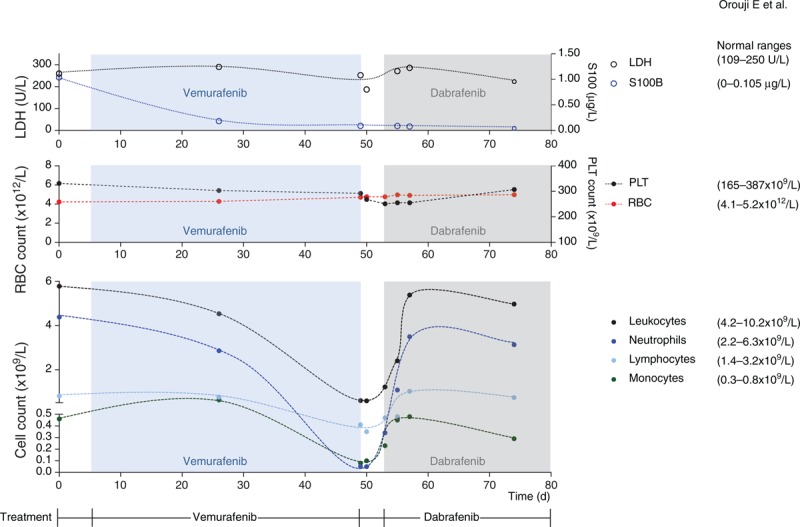
Recent advances in melanoma therapy have influenced the management of metastatic patients. Inhibitors of the BRAF/MEK/ERK signaling cascade have been proven highly effective in the metastatic disease although displaying different side effects. Here, we report a patient with BRAF V600E-mutated stage IV melanoma who developed a severe leukopenia upon targeted therapy with the BRAF inhibitor vemurafenib. Interestingly, the immediate therapeutic switch to a different BRAF inhibitor 'dabrafenib? had no negative influence on the leukocyte count. This case supports recent studies, which showed a differential influence of different BRAF inhibitors on patients' leukocytes despite similar clinical efficacy in melanoma.
黑色素瘤治疗的最新进展已经影响了转移性患者的管理。BRAF/MEK/ERK信号级联抑制剂已被证明在转移性疾病中非常有效,尽管会表现出不同的副作用。在此,我们报告一名BRAF V600E突变的IV期黑色素瘤患者,其在接受BRAF抑制剂维莫非尼靶向治疗时出现了严重的白细胞减少。有趣的是,立即改用另一种BRAF抑制剂达拉非尼进行治疗,对白细胞计数没有负面影响。该病例支持了最近的研究,这些研究表明,尽管不同的BRAF抑制剂在黑色素瘤治疗中具有相似的临床疗效,但它们对患者白细胞的影响存在差异。