Diouara Abou Abdallah Malick, Ndiaye Halimatou Diop, Guindo Ibrehima, Bangoura Nestor, Cissé Mohamed, Edmond Tchiakpe, Bougoudogo Flabou, Mboup Souleymame, Peeters Martine, Ayouba Ahidjo, Kane Ndèye Coumba Touré
Laboratoire de Bactériologie Virologie CHU Aristide Le Dantec, Université Cheikh Anta Diop de Dakar, Dakar, Sénégal.
Service de Bactériologie-Virologie Institut, National de Recherche en Santé Publique (INRSP) de Bamako, Bamako, Mali.
J Int AIDS Soc. 2014 Dec 18;17(1):19315. doi: 10.7448/IAS.17.1.19315. eCollection 2014.
Access to antiretroviral treatment (ART) becomes more and more effective in resource-limited settings (RLS). However, this global effort would be even more profitable if the access to laboratory services especially in decentralized settings was strengthened. We report the virological outcome and HIV-1 drug resistance in three West African countries using dried blood spots (DBS) samples.
We included HIV-1-infected adults on ART ≥6 months and followed up in capital cities and decentralized sites in Senegal, Mali and Guinea-Conakry. Patients were consecutively enrolled and DBS were collected in field conditions and kept at ambient temperature before transfer to the reference laboratory. Viral load (VL) was quantified using the NucliSENS EasyQ HIV-1 v1.2. Genotyping of HIV-1 pol gene was performed using in-house protocol.
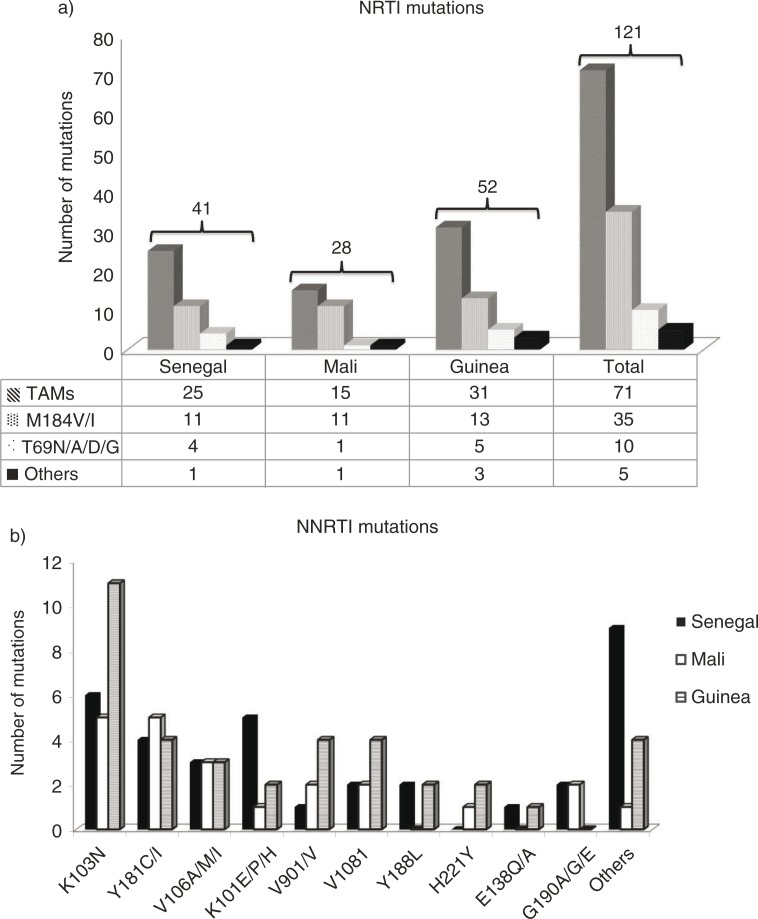
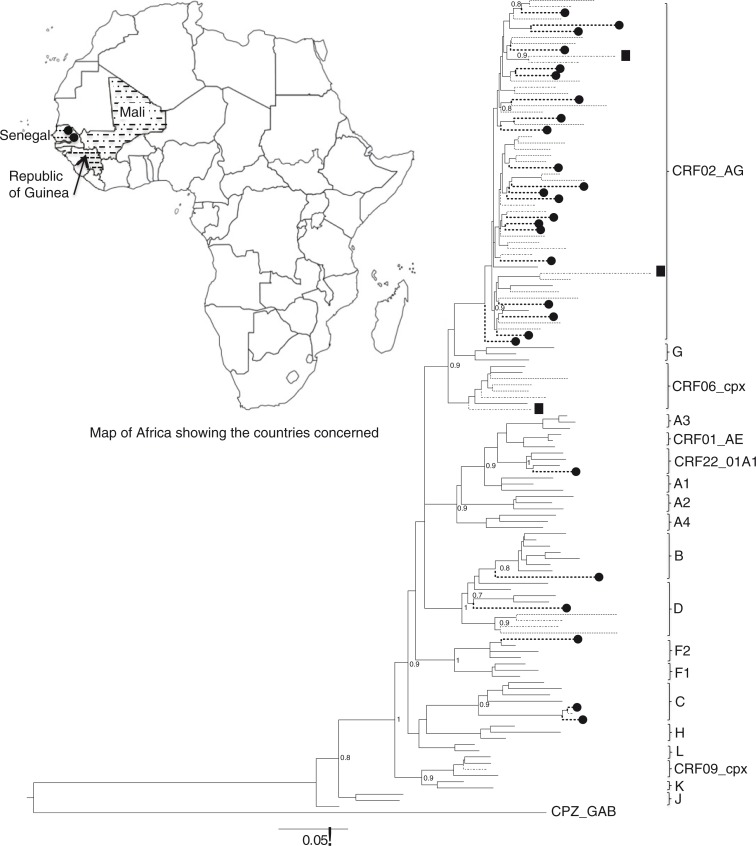
Of the 407 participants, 119, 152 and 136 were from Senegal, Mali and Guinea-Conakry, respectively. The median treatment duration was 36 months [IQR: 6-136]. Virological failure (VF) (VL≥3log10 copies/mL) was observed in 26% (95% confidence interval (CI), 18-35; n=31), 11% (95% CI, 6-17; n=16) and 24% (95% CI, 17-32; n=33) of patients in Senegal, Mali and Guinea-Conakry, respectively (p=0.001). Of samples presenting VL≥3log10 copies/mL (n=80), 70 were successfully genotyped. At least one drug resistance mutation (DRM) was detected in the following proportions: 70% (95% CI, 50-86; n=19), 93% (95% CI, 68-100; n=14) and 68% (95% CI, 48-84; n=19) in Senegal, Mali and Guinea-Conakry, respectively (p=0.22). Twenty-six per cent (26%; 95% CI, 16-38; n=18) of patients in VF harboured wild-type viruses, which is likely indicative of weak adherence. Phylogenetic analysis showed the predominance of CRF02_AG subtype (73%; 95% CI, 61-83; n=51).
We describe the ART outcome in capital and rural settings of Senegal, Mali and Guinea-Conakry. Our results in all of the three countries highlight the need to reinforce the ART adherence in order to minimize the occurrence of drug resistance. In addition, these findings provide additional evidence that the use of DBS as a sampling support could assist virological monitoring of patients on ART in remote areas.
在资源有限的环境中,抗逆转录病毒治疗(ART)的可及性变得越来越有效。然而,如果能加强实验室服务的可及性,特别是在分散地区,这项全球努力将更有成效。我们报告了使用干血斑(DBS)样本在三个西非国家的病毒学结果和HIV-1耐药情况。
我们纳入了接受ART治疗≥6个月的HIV-1感染成人,并在塞内加尔、马里和几内亚科纳克里的首都及分散地区进行随访。患者连续入组,在现场条件下采集DBS样本,并在转移至参考实验室之前保存在环境温度下。使用NucliSENS EasyQ HIV-1 v1.2对病毒载量(VL)进行定量。使用内部方案对HIV-1 pol基因进行基因分型。
407名参与者中,分别有119名、152名和136名来自塞内加尔、马里和几内亚科纳克里。治疗持续时间的中位数为36个月[四分位间距:6 - 136]。在塞内加尔、马里和几内亚科纳克里,分别有26%(95%置信区间(CI),18 - 35;n = 31)、11%(95% CI,6 - 17;n = 16)和24%(95% CI,17 - 32;n = 33)的患者出现病毒学失败(VF)(VL≥3log10拷贝/mL)(p = 0.001)。在VL≥3log10拷贝/mL的样本(n = 80)中,70个成功进行了基因分型。在以下比例中检测到至少一种耐药突变(DRM):塞内加尔为70%(95% CI,50 - 86;n = 19),马里为93%(95% CI,68 - 100;n = 14),几内亚科纳克里为68%(95% CI,48 - 84;n = 19)(p = 0.22)。VF患者中有26%(95% CI,16 - 38;n = 18)携带野生型病毒,这可能表明依从性较差。系统发育分析显示CRF02_AG亚型占主导(73%;95% CI,61 - 83;n = 51)。
我们描述了塞内加尔、马里和几内亚科纳克里首都及农村地区的ART治疗结果。我们在所有这三个国家的结果强调了加强ART依从性以尽量减少耐药性发生的必要性。此外,这些发现提供了额外的证据,表明使用DBS作为采样支持可以辅助对偏远地区接受ART治疗的患者进行病毒学监测。