Ishida Kasumi, Matsuo Junji, Yamamoto Yoshimasa, Yamaguchi Hiroyuki
Department of Medical Laboratory Science, Faculty of Health Sciences, Hokkaido University, Sapporo, Hokkaido, 060-0812, Japan.
Research Fellow of Japan Society for the Promotion of Science, Tokyo, 102-0083, Japan.
BMC Microbiol. 2014 Dec 21;14:330. doi: 10.1186/s12866-014-0330-3.
Pathogenic chlamydiae are obligate intracellular pathogens and have adapted successfully to human cells, causing sexually transmitted diseases or pneumonia. Chlamydial outer protein N (CopN) is likely a critical effector protein secreted by the type III secretion system in chlamydiae, which manipulates host cells. However, the mechanisms of its action remain to be clarified. In this work, we aimed to identify previously unidentified CopN effector target in host cells.
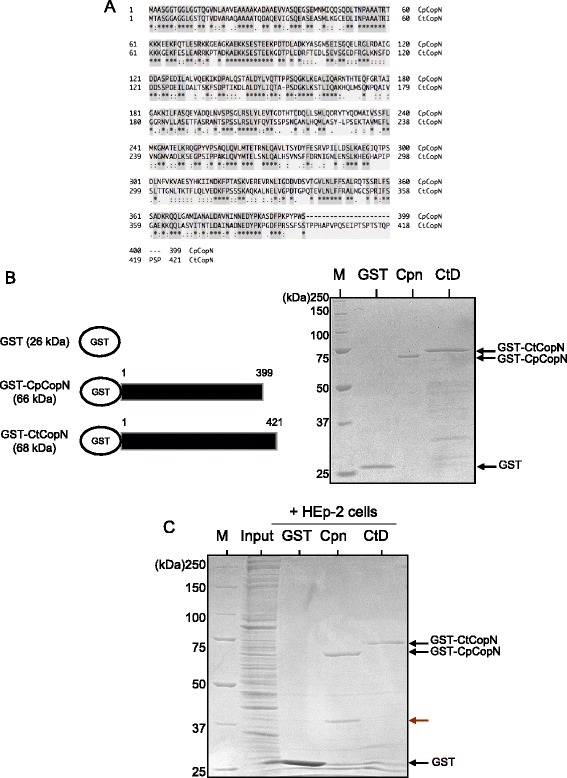
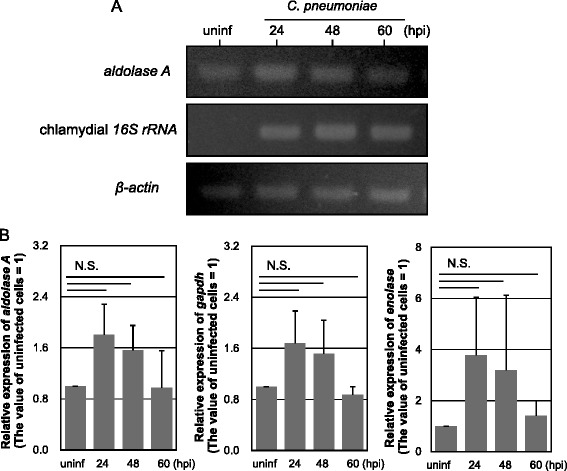
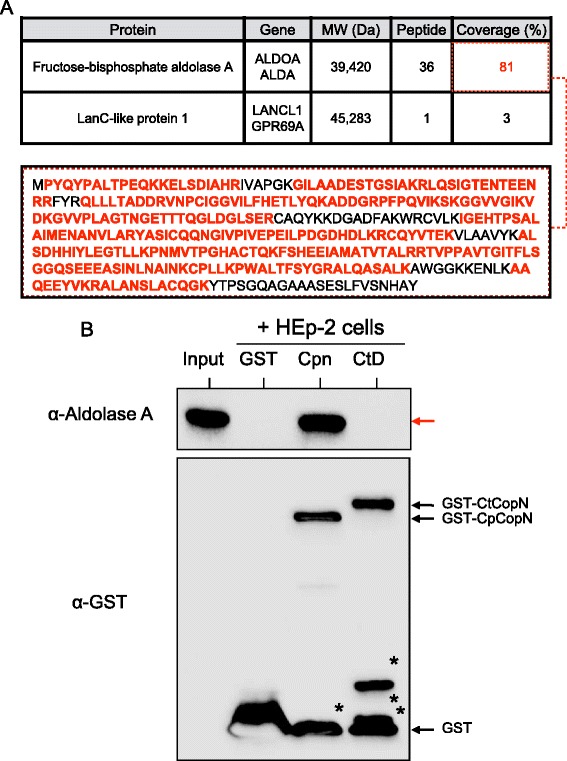
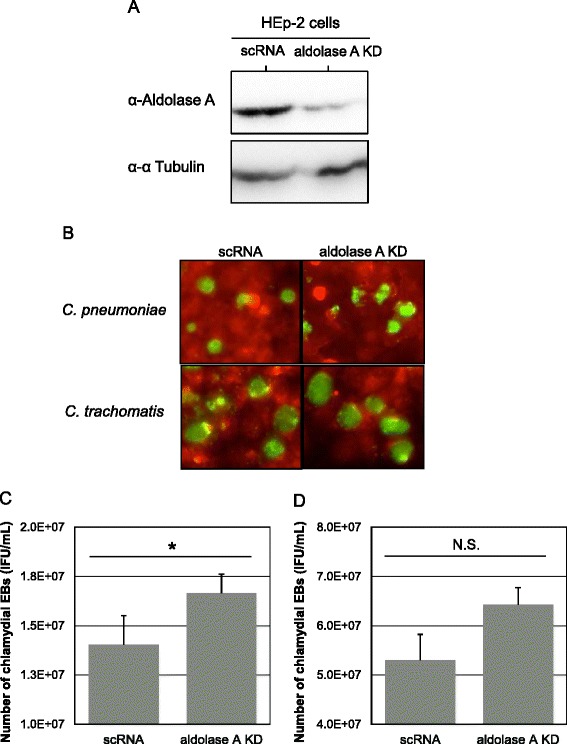
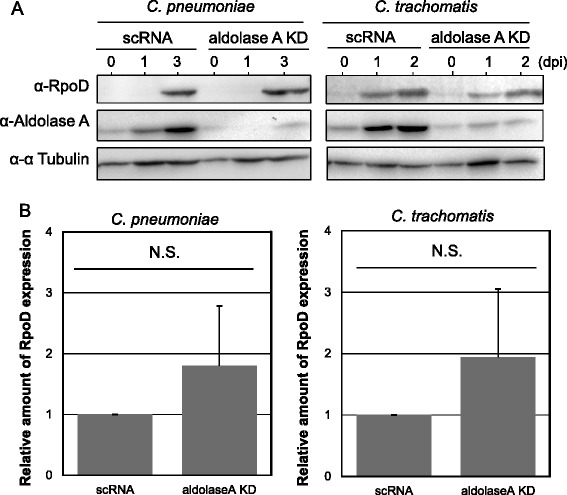
We first performed a pull-down assay with recombinant glutathione S-transferase (GST) fusion CopN proteins (GST-CpCopN: Chlamydia pneumoniae TW183, GST-CtCopN: Chlamydia trachomatis D/UW-3/CX) as "bait" and soluble lysates obtained from human immortal epithelial HEp-2 cells as "prey", followed by SDS-PAGE with mass spectroscopy (MS). We found that a host cell protein specifically bound to GST-CpCopN, but not GST-CtCopN. MS revealed the host protein to be fructose bisphosphate aldolase A (aldolase A), which plays a key role in glycolytic metabolism. We also confirmed the role of aldolase A in chlamydia-infected HEp-2 cells by using two distinct experiments for gene knockdown with an siRNA specific to aldolase A transcripts, and for assessment of glycolytic enzyme gene expression levels. As a result, both the numbers of chlamydial inclusion-forming units and RpoD transcripts were increased in the chlamydia-infected aldolase A knockdown cells, as compared with the wild-type HEp-2 cells. Meanwhile, chlamydial infection tended to enhance expression of aldolase A.
We discovered that one of the C. pneumoniae CopN targets is the glycolytic enzyme aldolase A. Sequestering aldolase A may be beneficial to bacterial growth in infected host cells.
致病性衣原体是专性细胞内病原体,已成功适应人类细胞,可引起性传播疾病或肺炎。衣原体外膜蛋白N(CopN)可能是衣原体Ⅲ型分泌系统分泌的一种关键效应蛋白,可操控宿主细胞。然而,其作用机制仍有待阐明。在本研究中,我们旨在鉴定宿主细胞中此前未被识别的CopN效应蛋白靶点。
我们首先进行了一项下拉实验,以重组谷胱甘肽S-转移酶(GST)融合CopN蛋白(GST-CpCopN:肺炎衣原体TW183,GST-CtCopN:沙眼衣原体D/UW-3/CX)作为“诱饵”,以从人永生化上皮HEp-2细胞中获得可溶性裂解物作为“猎物”,随后进行SDS-PAGE和质谱分析(MS)。我们发现一种宿主细胞蛋白与GST-CpCopN特异性结合,但不与GST-CtCopN结合。MS显示该宿主蛋白为果糖二磷酸醛缩酶A(醛缩酶A),其在糖酵解代谢中起关键作用。我们还通过针对醛缩酶A转录本的特异性siRNA进行基因敲低的两个不同实验以及评估糖酵解酶基因表达水平,证实了醛缩酶A在衣原体感染的HEp-2细胞中的作用。结果,与野生型HEp-2细胞相比,衣原体感染的醛缩酶A敲低细胞中衣原体包涵体形成单位数量和RpoD转录本均增加。同时,衣原体感染倾向于增强醛缩酶A的表达。
我们发现肺炎衣原体CopN的一个靶点是糖酵解酶醛缩酶A。隔离醛缩酶A可能有利于细菌在感染的宿主细胞中生长。