Bogoni Juliano A, Hernández Malva I M
Programa de Pós-Graduação em Ecologia, Departamento de Ecologia e Zoologia, Universidade Federal de Santa Catarina, Florianópolis, SC 88040-900, Brazil
Programa de Pós-Graduação em Ecologia, Departamento de Ecologia e Zoologia, Universidade Federal de Santa Catarina, Florianópolis, SC 88040-900, Brazil.
J Insect Sci. 2014 Jan 1;14. doi: 10.1093/jisesa/ieu161. Print 2014.
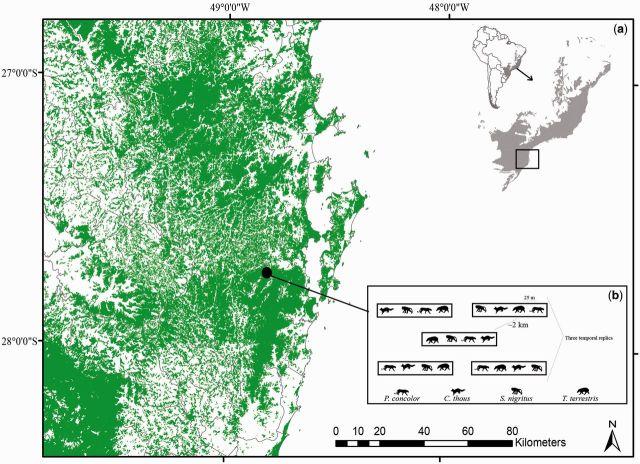
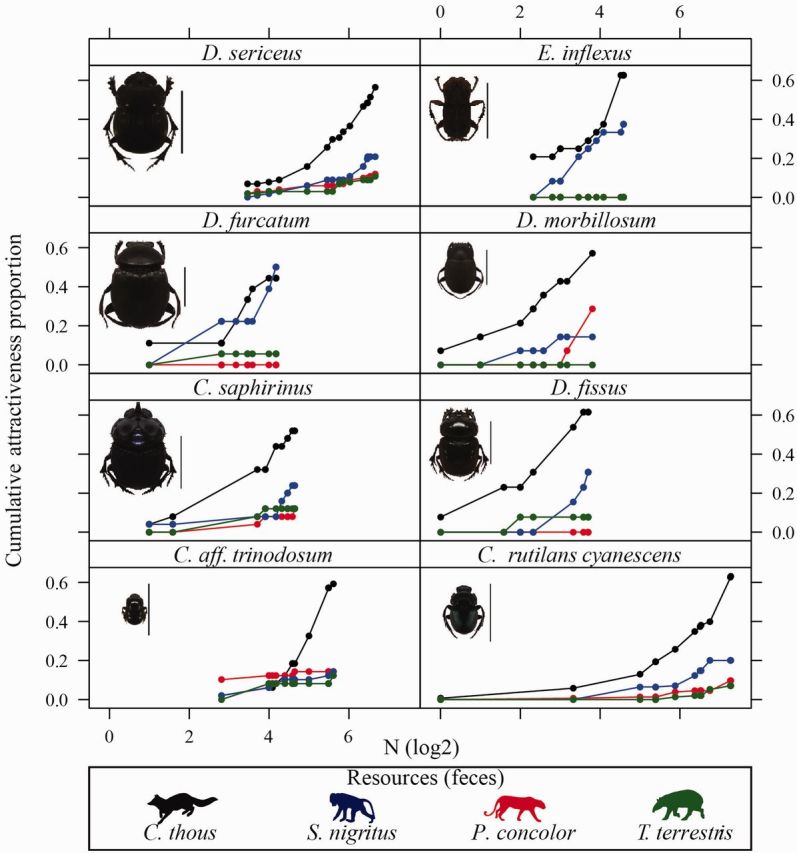
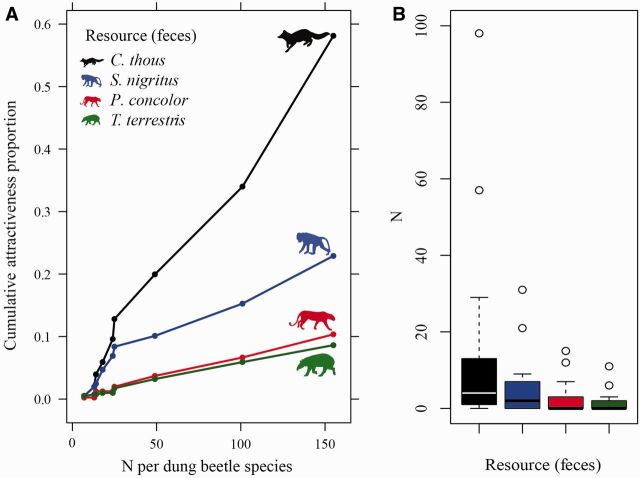
Mammal feces are the primary food and nesting resource for the majority of dung beetle species, and larval development depends on the quantity and quality of that resource. Physiological necessities, competitive interactions, and resource sharing are common and suggest that dung beetles may show preferences for feces of greater nutritional quality, which may in turn impact beetle assemblages and community structure. This study investigated whether attractiveness of dung beetles to different resource (feces) types varies depending on mammal trophic guild and associated nutritional content. This study was conducted in Atlantic Forest fragments in the Parque Estadual da Serra do Tabuleiro, Santa Catarina, Brazil. To evaluate attractiveness, the feces of the carnivore Puma concolor, the omnivores Cerdocyon thous and Sapajus nigritus, and the herbivore Tapirus terrestris were utilized as bait. Dung was collected from zoo animals fed a standard diet. Sampling was performed in triplicate in five areas in the summer of 2013. Four pitfall traps were established in each area, and each trap was baited with one type of mammal feces. Food preference of the species was analyzed by calculating Rodgers' index for cafeteria-type experiments. In total, 426 individuals from 17 species were collected. Rodgers' index showed that omnivorous mammal feces (C. thous) were most attractive to all dung beetle species, although it is known that dung beetles are commonly opportunistic with respect to search for and allocation of food resources. These results suggest that mammal loss could alter competitive interactions between dung beetles.
哺乳动物的粪便对于大多数蜣螂物种来说是主要的食物和筑巢资源,幼虫的发育取决于该资源的数量和质量。生理需求、竞争相互作用和资源共享很常见,这表明蜣螂可能会偏好营养质量更高的粪便,这反过来可能会影响甲虫群落和群落结构。本研究调查了蜣螂对不同资源(粪便)类型的吸引力是否因哺乳动物的营养类群和相关营养成分而异。本研究在巴西圣卡塔琳娜州塔布勒罗山国家公园的大西洋森林片段中进行。为了评估吸引力,将食肉动物美洲狮、杂食动物食蟹狐和黑冠松鼠猴以及食草动物南美貘的粪便用作诱饵。粪便采集自喂食标准饮食的动物园动物。2013年夏季在五个区域进行了三次重复采样。每个区域设置了四个陷阱,每个陷阱用一种哺乳动物粪便作为诱饵。通过计算自助餐厅式实验的罗杰斯指数来分析物种的食物偏好。总共收集了来自17个物种的426只个体。罗杰斯指数表明,杂食性哺乳动物粪便(食蟹狐)对所有蜣螂物种最具吸引力,尽管已知蜣螂在寻找和分配食物资源方面通常是机会主义的。这些结果表明,哺乳动物数量的减少可能会改变蜣螂之间的竞争相互作用。