Dong Hongquan, Zhang Xiang, Qian Yanning
Department of Anesthesiology, First Affiliated Hospital of Nanjing Medical University, Nanjing, Jiangsu, China (mainland).
Med Sci Monit Basic Res. 2014 Dec 21;20:200-6. doi: 10.12659/MSMBR.893093.
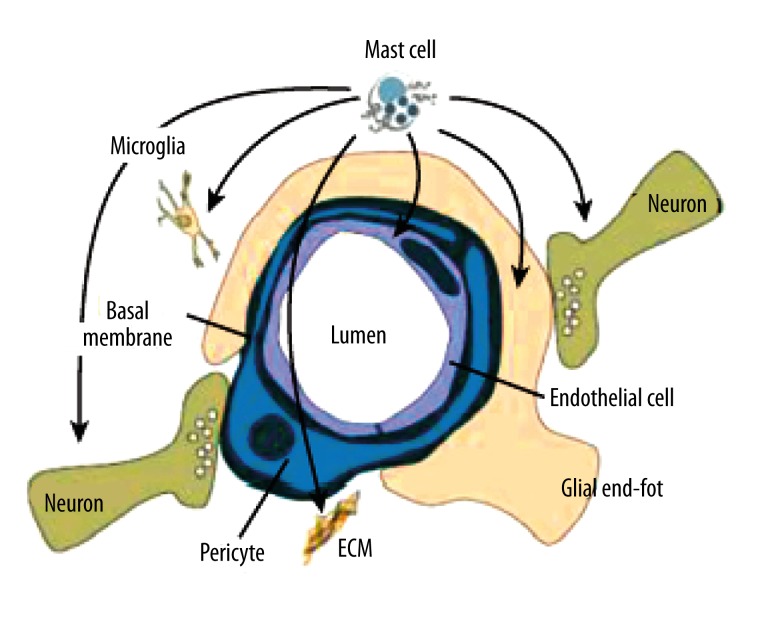
It has been determined that there is extensive communication between the immune system and the central nervous system (CNS). Proinflammatory cytokines play a key role in this communication. There is an emerging realization that glia and microglia, in particular, (which are the brain's resident macrophages), are an important source of inflammatory mediators and may have fundamental roles in CNS disorders. Microglia respond also to proinflammatory signals released from other non-neuronal cells, principally those of immune origin, such as mast cells. Mast cells reside in the CNS and are capable of migrating across the blood-brain barrier (BBB) in situations where the barrier is compromised as a result of CNS pathology. Mast cells are both sensors and effectors in communication among nervous, vascular, and immune systems. In the brain, they reside on the brain side of the BBB, and interact with astrocytes, microglia, and blood vessels via their neuroactive stored and newly synthesized chemicals. They are first responders, acting as catalysts and recruiters to initiate, amplify, and prolong other immune and nervous responses upon activation. Mast cells both promote deleterious outcomes in brain function and contribute to normative behavioral functioning, particularly cognition and emotion. Mast cells may play a key role in treating systemic inflammation or blockade of signaling pathways from the periphery to the brain.
现已确定免疫系统与中枢神经系统(CNS)之间存在广泛的交流。促炎细胞因子在这种交流中起关键作用。人们逐渐认识到,尤其是神经胶质细胞和小胶质细胞(它们是大脑中的常驻巨噬细胞),是炎症介质的重要来源,并且可能在中枢神经系统疾病中发挥重要作用。小胶质细胞也对其他非神经元细胞释放的促炎信号作出反应,主要是那些免疫来源的细胞,如肥大细胞。肥大细胞存在于中枢神经系统中,并且在因中枢神经系统病理导致血脑屏障(BBB)受损的情况下能够穿过血脑屏障迁移。肥大细胞在神经、血管和免疫系统之间的交流中既是传感器又是效应器。在大脑中,它们位于血脑屏障的脑侧,并通过其储存的神经活性物质和新合成的化学物质与星形胶质细胞、小胶质细胞和血管相互作用。它们是第一反应者,在激活后作为催化剂和招募者来启动、放大和延长其他免疫和神经反应。肥大细胞既促进脑功能的有害结果,又有助于规范行为功能,特别是认知和情绪。肥大细胞可能在治疗全身性炎症或阻断从外周到大脑的信号通路中起关键作用。