Yan Peng, Dong Pingshuan, Li Zhijuan, Cheng Jianxin
Department of Cardiology, First Affiliated Hospital, Henan Science and Technology University, Luoyang, Henan, China (mainland).
Med Sci Monit. 2014 Dec 21;20:2753-8. doi: 10.12659/MSM.891049.
It is unclear whether statin agents provide clinical benefit in preventing the relapse of atrial fibrillation (AF) after electrical cardioversion (EC). The purpose of this study was to assess the effect of statin agents on the recurrence of AF after EC by conducting a meta-analysis of randomized controlled trials (RCTs).
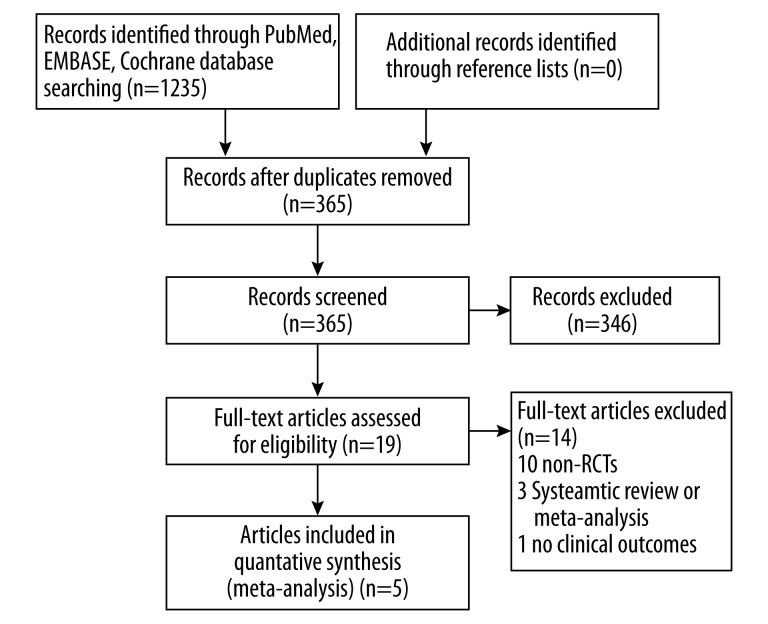
We conducted a systematic literature search of Medline, EMBASE, ISI Web of Science, and Cochrane databases. RCTs comparing clinical endpoint of the recurrence of AF associated with statin administration vs. no statin treatment (placebo or conventional medical therapy) in patients with AF after EC were eligible. Combined results are presented as risk ratios (RRs) with 95% confidence intervals (CIs).
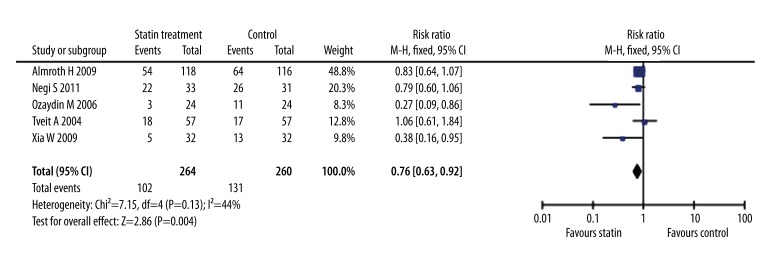
A total of 5 trials with 524 patients were available for analysis. The pooling analysis showed that statin agents significantly reduced the recurrence of AF after EC compared with no statin treatment (RR=0.76, 95% CI 0.63-0.92; p=0.004; I2=44%). The beneficial effect was shown both in AF subjects receiving atorvastatin or rosuvastatin treatment (atorvastatin 80 mg: RR=0.82, p=0.05; atorvastatin 10 mg: RR=0.27, p=0.03; rosuvastatin: RR=0.38, p=0.04) and in younger patients (<65 years; RR=0.58, p=0.0005). Furthermore, the benefit of statin agents on preventing AF recurrence after EC was demonstrated within 3-month follow-up (p=0.03), and the clinical benefit seemed likely to remain until no less than 12 months after EC (p=0.05).
Based on the currently available data, administration of statin agents, especially atorvastatin or rosuvastatin, is beneficial in lowering the frequency of AF recurrence after EC.
目前尚不清楚他汀类药物在预防电复律(EC)后房颤(AF)复发方面是否具有临床益处。本研究的目的是通过对随机对照试验(RCT)进行荟萃分析,评估他汀类药物对EC后AF复发的影响。
我们对Medline、EMBASE、ISI Web of Science和Cochrane数据库进行了系统的文献检索。符合条件的RCT为比较EC后房颤患者服用他汀类药物与未服用他汀类药物治疗(安慰剂或传统药物治疗)相关的房颤复发临床终点。合并结果以风险比(RRs)及95%置信区间(CIs)表示。
共有5项试验、524例患者可供分析。汇总分析显示,与未服用他汀类药物治疗相比,他汀类药物显著降低了EC后房颤的复发率(RR=0.76,95%CI 0.63-0.92;p=0.004;I2=44%)。在接受阿托伐他汀或瑞舒伐他汀治疗的房颤患者中(阿托伐他汀80mg:RR=0.82,p=0.05;阿托伐他汀10mg:RR=0.27,p=0.03;瑞舒伐他汀:RR=0.38,p=0.04)以及年轻患者(<65岁;RR=0.58,p=0.0005)中均显示出有益效果。此外,他汀类药物在预防EC后房颤复发方面的益处可在3个月随访期内得到证实(p=0.03),且临床益处似乎可能持续至EC后不少于12个月(p=0.05)。
基于目前可得的数据,服用他汀类药物,尤其是阿托伐他汀或瑞舒伐他汀,有利于降低EC后房颤的复发频率。