Preciado Paulina, Snijders Tom A B, Burk William J, Stattin Håkan, Kerr Margaret
University of Oxford, Department of Statistics, 1 South Parks Road Oxford, OX1 3TG, United Kingdom.
University of Oxford and University of Groningen, Nuffield College, New Road Oxford, OX1 1NF, United Kingdom.
Soc Networks. 2012 Jan 1;34(1):18-31. doi: 10.1016/j.socnet.2011.01.002.
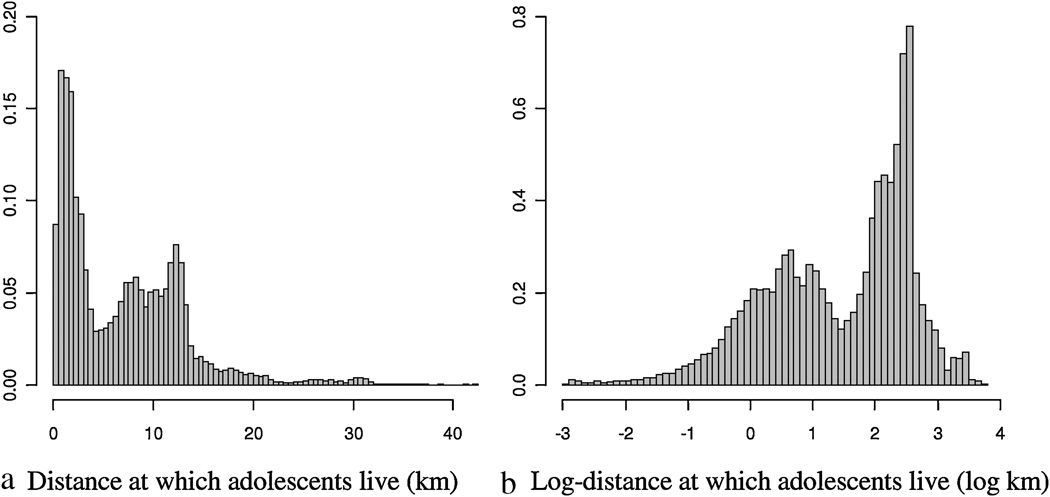
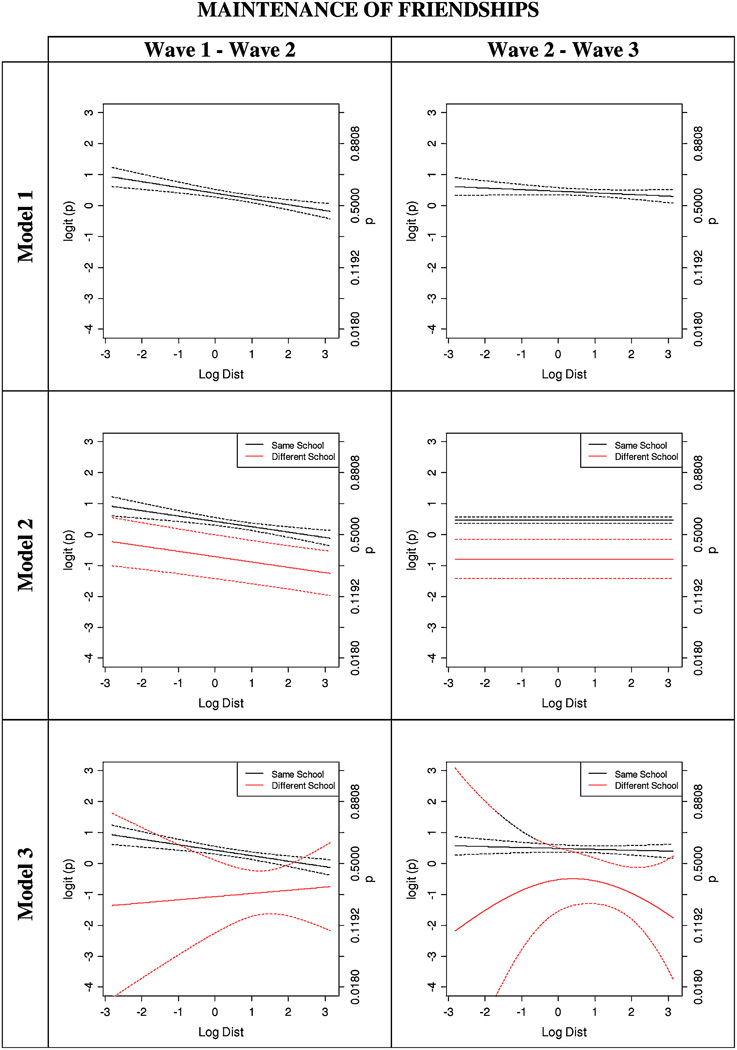
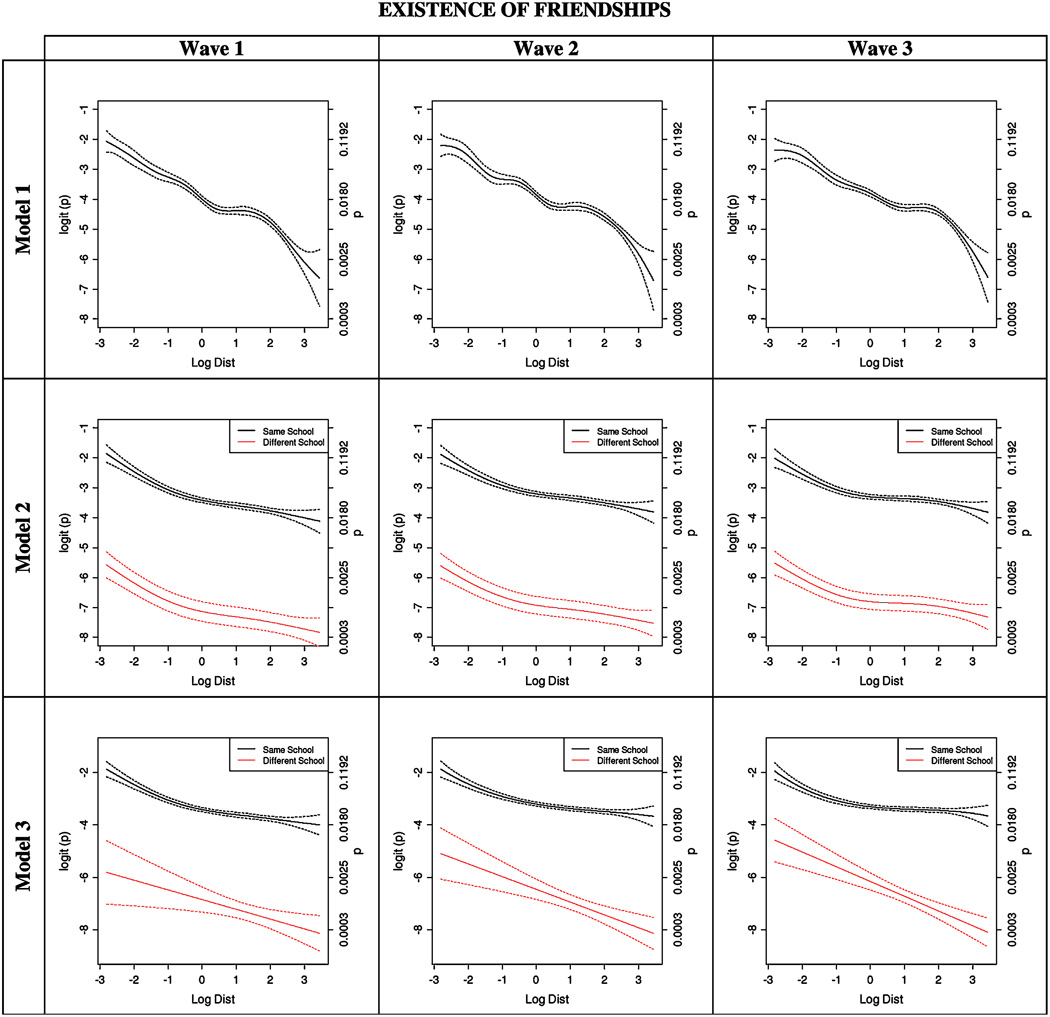
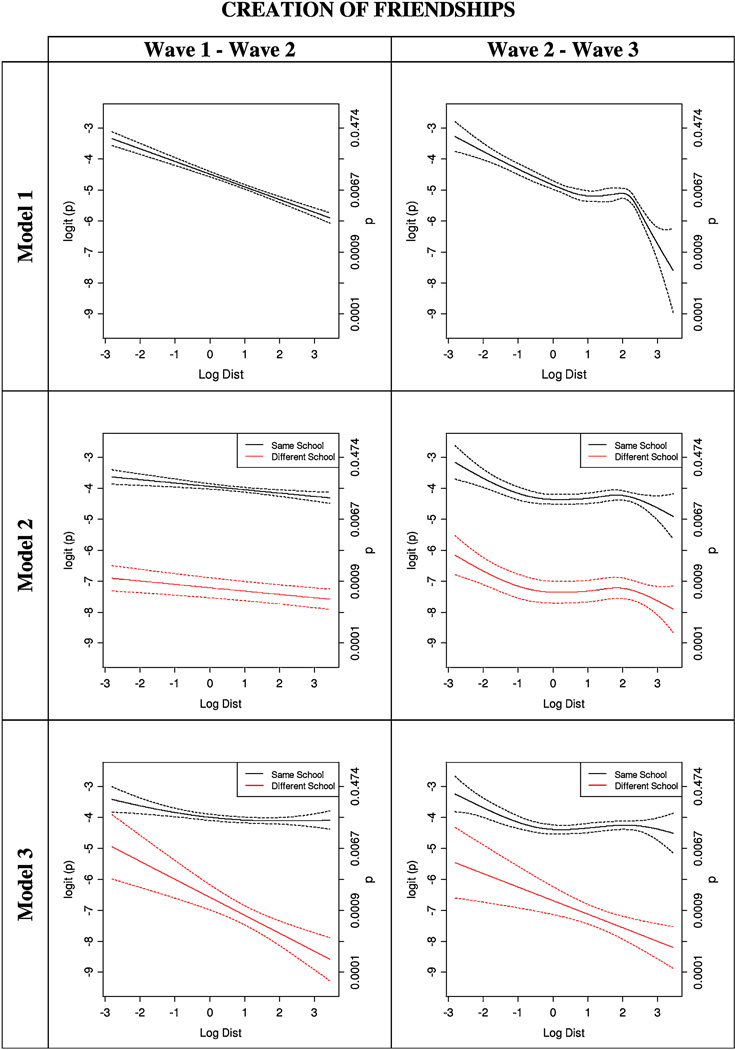
Geographic proximity is a determinant factor of friendship. Friendship datasets that include detailed geographic information are scarce, and when this information is available, the dependence of friendship on distance is often modelled by pre-specified parametric functions or derived from theory without further empirical assessment. This paper aims to give a detailed representation of the association between distance and the likelihood of friendship existence and friendship dynamics, and how this is modified by a few basic social and individual factors. The data employed is a three-wave network of 336 adolescents living in a small Swedish town, for whom information has been collected on their household locations. The analysis is a three-step process that combines 1) nonparametric logistic regressions to unravel the overall functional form of the dependence of friendship on distance, without assuming it has a particular strength or shape; 2) parametric logistic regressions to construct suitable transformations of distance that can be employed in 3) stochastic models for longitudinal network data, to assess how distance, individual covariates, and network structure shape adolescent friendship dynamics. It was found that the log-odds of friendship existence and friendship dynamics decrease smoothly with the logarithm of distance. For adolescents in different schools the dependence is linear, and stronger than for adolescents in the same school. Living nearby accounts, in this dataset, for an aspect of friendship dynamics that is not explicitly modelled by network structure or by individual covariates. In particular, the estimated distance effect is not correlated with reciprocity or transitivity effects.
地理 proximity 是友谊的一个决定性因素。包含详细地理信息的友谊数据集很少见,而且当有这些信息时,友谊对距离的依赖性通常由预先指定的参数函数建模,或者从理论推导得出,而没有进一步的实证评估。本文旨在详细描述距离与友谊存在的可能性以及友谊动态之间的关联,以及这是如何被一些基本的社会和个人因素所改变的。所使用的数据是一个由居住在瑞典一个小镇的336名青少年组成的三波网络,已经收集了他们家庭住址的信息。分析是一个三步过程,包括:1)非参数逻辑回归,以揭示友谊对距离依赖性的整体函数形式,而不假设其具有特定的强度或形状;2)参数逻辑回归,以构建距离的合适变换,可用于3)纵向网络数据的随机模型,以评估距离、个体协变量和网络结构如何塑造青少年友谊动态。研究发现,友谊存在和友谊动态的对数优势随着距离的对数而平稳下降。对于不同学校的青少年,这种依赖性是线性的,并且比同一学校的青少年更强。在这个数据集中,居住在附近解释了友谊动态的一个方面,而这方面并没有通过网络结构或个体协变量明确建模。特别是,估计的距离效应与互惠或传递效应不相关。