McKenzie Zofi, Kendall Michaela, Mackay Rose-Marie, Tetley Teresa D, Morgan Cliff, Griffiths Mark, Clark Howard W, Madsen Jens
Child Health, Clinical and Experimental Sciences, Faculty of Medicine, University of Southampton, Southampton General Hospital, Southampton SO16 6YD, UK.
Child Health, Clinical and Experimental Sciences, Faculty of Medicine, University of Southampton, Southampton General Hospital, Southampton SO16 6YD, UK School of Metallurgy and Materials, University of Birmingham, Birmingham B15 2TT, UK.
Philos Trans R Soc Lond B Biol Sci. 2015 Feb 5;370(1661):20140049. doi: 10.1098/rstb.2014.0049.
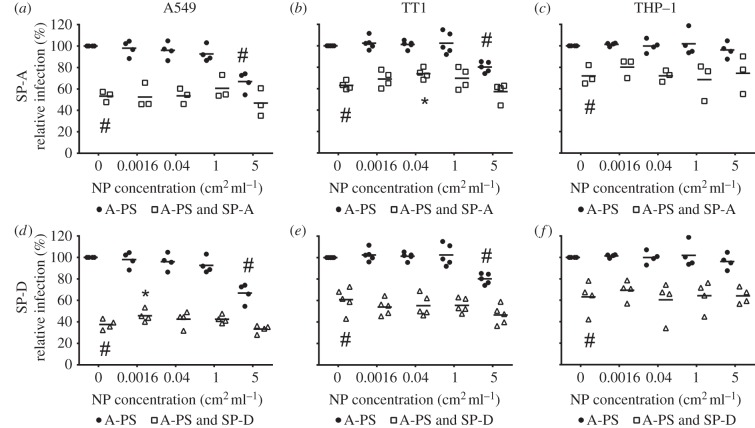
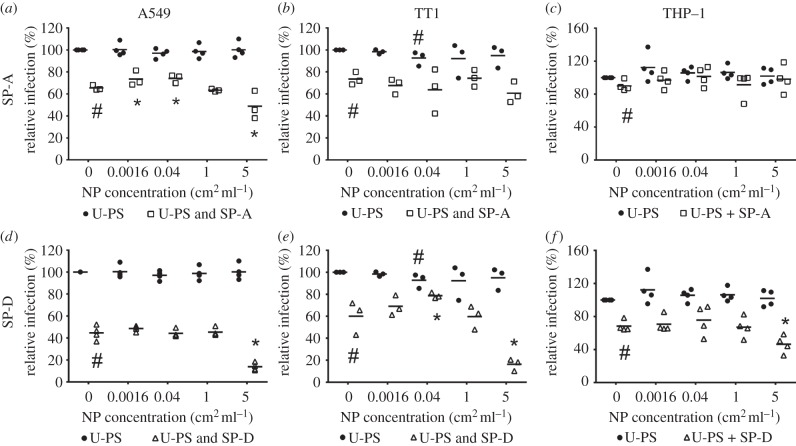
Numerous epidemiological and toxicological studies have indicated that respiratory infections are exacerbated following enhanced exposure to airborne particulates. Surfactant protein A (SP-A) and SP-D form an important part of the innate immune response in the lung and can interact with nanoparticles to modulate the cellular uptake of these particles. We hypothesize that this interaction will also affect the ability of these proteins to combat infections. TT1, A549 and differentiated THP-1 cells, representing the predominant cell types found in the alveolus namely alveolar type I (ATI) epithelial cells, ATII cells and macrophages, were used to examine the effect of two model nanoparticles, 100 nm amine modified (A-PS) and unmodified polystyrene (U-PS), on the ability of SP-A and SP-D to neutralize influenza A infections in vitro. Pre-incubation of low concentrations of U-PS with SP-A resulted in a reduction of SP-A anti-influenza activity in A549 cells, whereas at higher concentrations there was an increase in SP-A antiviral activity. This differential pattern of U-PS concentration on surfactant protein mediated protection against IAV was also shown with SP-D in TT1 cells. On the other hand, low concentrations of A-PS particles resulted in a reduction of SP-A activity in TT1 cells and a reduction in SP-D activity in A549 cells. These results indicate that nanoparticles can modulate the ability of SP-A and SP-D to combat viral challenges. Furthermore, the nanoparticle concentration, surface chemistry and cell type under investigation are important factors in determining the extent of these modulations.
众多流行病学和毒理学研究表明,暴露于空气中的颗粒物增加后,呼吸道感染会加剧。表面活性蛋白A(SP-A)和表面活性蛋白D构成肺部固有免疫反应的重要部分,并且可以与纳米颗粒相互作用,调节这些颗粒的细胞摄取。我们推测这种相互作用也会影响这些蛋白质对抗感染的能力。TT1、A549和分化的THP-1细胞分别代表肺泡中主要的细胞类型,即I型肺泡(ATI)上皮细胞、II型肺泡细胞和巨噬细胞,用于检测两种模型纳米颗粒,即100纳米胺修饰的(A-PS)和未修饰的聚苯乙烯(U-PS),对SP-A和SP-D在体外中和甲型流感感染能力的影响。低浓度的U-PS与SP-A预孵育会导致A549细胞中SP-A抗流感活性降低,而在较高浓度下,SP-A抗病毒活性会增加。TT1细胞中的SP-D也显示出U-PS浓度对表面活性蛋白介导的抗IAV保护作用的这种差异模式。另一方面,低浓度的A-PS颗粒会导致TT1细胞中SP-A活性降低以及A549细胞中SP-D活性降低。这些结果表明,纳米颗粒可以调节SP-A和SP-D对抗病毒挑战的能力。此外,所研究的纳米颗粒浓度、表面化学性质和细胞类型是决定这些调节程度的重要因素。