• 文献检索
  • 文档翻译
  • 深度研究
  • 学术资讯
  • Suppr Zotero 插件Zotero 插件
  • 邀请有礼
  • 套餐&价格
  • 历史记录
应用&插件
Suppr Zotero 插件Zotero 插件浏览器插件Mac 客户端Windows 客户端微信小程序
定价
高级版会员购买积分包购买API积分包
服务
文献检索文档翻译深度研究API 文档MCP 服务
关于我们
关于 Suppr公司介绍联系我们用户协议隐私条款
关注我们

Suppr 超能文献

核心技术专利:CN118964589B侵权必究
粤ICP备2023148730 号-1Suppr @ 2026

文献检索

告别复杂PubMed语法,用中文像聊天一样搜索,搜遍4000万医学文献。AI智能推荐,让科研检索更轻松。

立即免费搜索

文件翻译

保留排版,准确专业,支持PDF/Word/PPT等文件格式,支持 12+语言互译。

免费翻译文档

深度研究

AI帮你快速写综述,25分钟生成高质量综述,智能提取关键信息,辅助科研写作。

立即免费体验

肺表面活性剂蛋白和脂质的相互作用使巨噬细胞能够清除纳米颗粒。

The interplay of lung surfactant proteins and lipids assimilates the macrophage clearance of nanoparticles.

机构信息

Department of Biopharmaceutics and Pharmaceutical Technology, Saarland University, Saarbrücken, Germany.

出版信息

PLoS One. 2012;7(7):e40775. doi: 10.1371/journal.pone.0040775. Epub 2012 Jul 10.

DOI:10.1371/journal.pone.0040775
PMID:22802970
原文链接:https://pmc.ncbi.nlm.nih.gov/articles/PMC3393659/
Abstract

The peripheral lungs are a potential entrance portal for nanoparticles into the human body due to their large surface area. The fact that nanoparticles can be deposited in the alveolar region of the lungs is of interest for pulmonary drug delivery strategies and is of equal importance for toxicological considerations. Therefore, a detailed understanding of nanoparticle interaction with the structures of this largest and most sensitive part of the lungs is important for both nanomedicine and nanotoxicology. Astonishingly, there is still little known about the bio-nano interactions that occur after nanoparticle deposition in the alveoli. In this study, we compared the effects of surfactant-associated protein A (SP-A) and D (SP-D) on the clearance of magnetite nanoparticles (mNP) with either more hydrophilic (starch) or hydrophobic (phosphatidylcholine) surface modification by an alveolar macrophage (AM) cell line (MH-S) using flow cytometry and confocal microscopy. Both proteins enhanced the AM uptake of mNP compared with pristine nanoparticles; for the hydrophilic ST-mNP, this effect was strongest with SP-D, whereas for the hydrophobic PL-mNP it was most pronounced with SP-A. Using gel electrophoretic and dynamic light scattering methods, we were able to demonstrate that the observed cellular effects were related to protein adsorption and to protein-mediated interference with the colloidal stability. Next, we investigated the influence of various surfactant lipids on nanoparticle uptake by AM because lipids are the major surfactant component. Synthetic surfactant lipid and isolated native surfactant preparations significantly modulated the effects exerted by SP-A and SP-D, respectively, resulting in comparable levels of macrophage interaction for both hydrophilic and hydrophobic nanoparticles. Our findings suggest that because of the interplay of both surfactant lipids and proteins, the AM clearance of nanoparticles is essentially the same, regardless of different intrinsic surface properties.

摘要

由于其较大的表面积,外围肺部是纳米粒子进入人体的潜在入口。纳米粒子可以沉积在肺部的肺泡区域,这对于肺部药物输送策略很重要,并且对于毒理学考虑也同样重要。因此,详细了解纳米粒子与肺部这个最大和最敏感部分的结构之间的相互作用对于纳米医学和纳米毒理学都很重要。令人惊讶的是,对于肺泡中纳米粒子沉积后发生的生物-纳米相互作用,我们仍然知之甚少。在这项研究中,我们使用流式细胞术和共聚焦显微镜比较了表面活性剂相关蛋白 A (SP-A) 和 D (SP-D) 对具有不同亲水性(淀粉)或疏水性(磷脂酰胆碱)表面修饰的磁铁矿纳米颗粒(mNP)清除作用的影响,肺泡巨噬细胞(AM)细胞系(MH-S)。与原始纳米颗粒相比,这两种蛋白质都增强了 AM 对 mNP 的摄取;对于亲水性 ST-mNP,这种作用在 SP-D 中最强,而对于疏水性 PL-mNP,在 SP-A 中最为明显。使用凝胶电泳和动态光散射方法,我们能够证明观察到的细胞效应与蛋白质吸附和蛋白质介导的胶体稳定性干扰有关。接下来,我们研究了各种表面活性剂脂质对 AM 摄取纳米颗粒的影响,因为脂质是主要的表面活性剂成分。合成表面活性剂脂质和分离的天然表面活性剂制剂分别显著调节了 SP-A 和 SP-D 所产生的作用,导致亲水性和疏水性纳米颗粒的巨噬细胞相互作用水平相当。我们的发现表明,由于表面活性剂脂质和蛋白质的相互作用,AM 对纳米颗粒的清除基本相同,而与不同的固有表面特性无关。
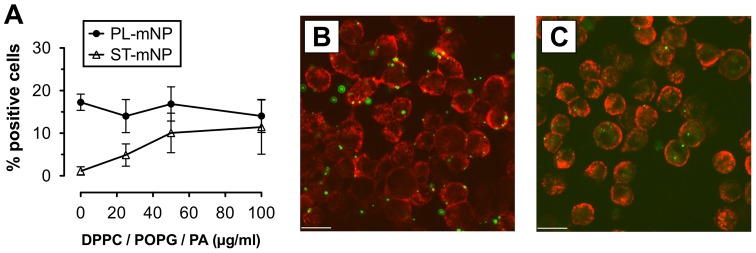
https://cdn.ncbi.nlm.nih.gov/pmc/blobs/fbe0/3393659/7d1701d4bdfb/pone.0040775.g008.jpg
https://cdn.ncbi.nlm.nih.gov/pmc/blobs/fbe0/3393659/397dd1436876/pone.0040775.g001.jpg
https://cdn.ncbi.nlm.nih.gov/pmc/blobs/fbe0/3393659/df5551add52e/pone.0040775.g002.jpg
https://cdn.ncbi.nlm.nih.gov/pmc/blobs/fbe0/3393659/d6141f94b90b/pone.0040775.g003.jpg
https://cdn.ncbi.nlm.nih.gov/pmc/blobs/fbe0/3393659/cfa3cddd0194/pone.0040775.g004.jpg
https://cdn.ncbi.nlm.nih.gov/pmc/blobs/fbe0/3393659/b2fe867b5d63/pone.0040775.g005.jpg
https://cdn.ncbi.nlm.nih.gov/pmc/blobs/fbe0/3393659/c5338658788a/pone.0040775.g006.jpg
https://cdn.ncbi.nlm.nih.gov/pmc/blobs/fbe0/3393659/6f20878309c6/pone.0040775.g007.jpg
https://cdn.ncbi.nlm.nih.gov/pmc/blobs/fbe0/3393659/7d1701d4bdfb/pone.0040775.g008.jpg
https://cdn.ncbi.nlm.nih.gov/pmc/blobs/fbe0/3393659/397dd1436876/pone.0040775.g001.jpg
https://cdn.ncbi.nlm.nih.gov/pmc/blobs/fbe0/3393659/df5551add52e/pone.0040775.g002.jpg
https://cdn.ncbi.nlm.nih.gov/pmc/blobs/fbe0/3393659/d6141f94b90b/pone.0040775.g003.jpg
https://cdn.ncbi.nlm.nih.gov/pmc/blobs/fbe0/3393659/cfa3cddd0194/pone.0040775.g004.jpg
https://cdn.ncbi.nlm.nih.gov/pmc/blobs/fbe0/3393659/b2fe867b5d63/pone.0040775.g005.jpg
https://cdn.ncbi.nlm.nih.gov/pmc/blobs/fbe0/3393659/c5338658788a/pone.0040775.g006.jpg
https://cdn.ncbi.nlm.nih.gov/pmc/blobs/fbe0/3393659/6f20878309c6/pone.0040775.g007.jpg
https://cdn.ncbi.nlm.nih.gov/pmc/blobs/fbe0/3393659/7d1701d4bdfb/pone.0040775.g008.jpg

相似文献

1
The interplay of lung surfactant proteins and lipids assimilates the macrophage clearance of nanoparticles.肺表面活性剂蛋白和脂质的相互作用使巨噬细胞能够清除纳米颗粒。
PLoS One. 2012;7(7):e40775. doi: 10.1371/journal.pone.0040775. Epub 2012 Jul 10.
2
Uptake of nanoparticles by alveolar macrophages is triggered by surfactant protein A.肺泡巨噬细胞对纳米颗粒的摄取是由表面活性剂蛋白 A 触发的。
Nanomedicine. 2011 Dec;7(6):690-3. doi: 10.1016/j.nano.2011.07.009. Epub 2011 Aug 10.
3
SP-D counteracts GM-CSF-mediated increase of granuloma formation by alveolar macrophages in lysinuric protein intolerance.表面活性剂蛋白-D 可拮抗赖氨酸尿蛋白不耐受症中肺泡巨噬细胞 GM-CSF 介导的肉芽肿形成增加。
Orphanet J Rare Dis. 2009 Dec 23;4:29. doi: 10.1186/1750-1172-4-29.
4
Pulmonary surfactant protein A augments the phagocytosis of Streptococcus pneumoniae by alveolar macrophages through a casein kinase 2-dependent increase of cell surface localization of scavenger receptor A.肺表面活性物质蛋白A通过酪蛋白激酶2依赖性增加清道夫受体A的细胞表面定位,增强肺泡巨噬细胞对肺炎链球菌的吞噬作用。
J Biol Chem. 2004 May 14;279(20):21421-30. doi: 10.1074/jbc.M312490200. Epub 2004 Mar 1.
5
Nanoparticles modulate surfactant protein A and D mediated protection against influenza A infection in vitro.纳米颗粒在体外调节表面活性蛋白A和D介导的对甲型流感感染的保护作用。
Philos Trans R Soc Lond B Biol Sci. 2015 Feb 5;370(1661):20140049. doi: 10.1098/rstb.2014.0049.
6
Neither SP-A nor NH2-terminal domains of SP-A can substitute for SP-D in regulation of alveolar homeostasis.表面活性蛋白A(SP-A)及其氨基末端结构域均不能替代表面活性蛋白D(SP-D)在调节肺泡稳态中的作用。
Am J Physiol Lung Cell Mol Physiol. 2006 Aug;291(2):L181-90. doi: 10.1152/ajplung.00015.2006. Epub 2006 Feb 24.
7
Pulmonary Surfactant Protein A-Mediated Enrichment of Surface-Decorated Polymeric Nanoparticles in Alveolar Macrophages.肺泡巨噬细胞中肺表面活性蛋白A介导的表面修饰聚合物纳米颗粒富集
Mol Pharm. 2016 Dec 5;13(12):4168-4178. doi: 10.1021/acs.molpharmaceut.6b00773. Epub 2016 Nov 18.
8
Surfactant protein A (SP-A) inhibits agglomeration and macrophage uptake of toxic amine modified nanoparticles.表面活性蛋白 A(SP-A)可抑制有毒胺修饰纳米颗粒的聚集和巨噬细胞摄取。
Nanotoxicology. 2015;9(8):952-62. doi: 10.3109/17435390.2014.992487.
9
Surfactant protein D increases phagocytosis and aggregation of pollen-allergen starch granules.表面活性蛋白D可增强花粉过敏原淀粉颗粒的吞噬作用和聚集。
Am J Physiol Lung Cell Mol Physiol. 2005 Apr;288(4):L692-8. doi: 10.1152/ajplung.00362.2004. Epub 2004 Dec 10.
10
Lung remodeling in aging surfactant protein D deficient mice.衰老的表面活性蛋白D缺陷小鼠的肺重塑
Ann Anat. 2017 May;211:158-175. doi: 10.1016/j.aanat.2017.01.013. Epub 2017 Feb 7.

引用本文的文献

1
Macrophage variance: investigating how macrophage origin influences responses to soluble and physical cues with immortalized vs. primary cells in 2D and 3D culture.巨噬细胞差异:研究在二维和三维培养中,巨噬细胞起源如何通过永生化细胞与原代细胞影响对可溶性和物理信号的反应。
Front Biomater Sci. 2024;3. doi: 10.3389/fbiom.2024.1399448. Epub 2024 May 22.
2
Nanoparticle-Based Pulmonary Immune Engineering.基于纳米颗粒的肺部免疫工程
Annu Rev Chem Biomol Eng. 2025 Jun;16(1):249-270. doi: 10.1146/annurev-chembioeng-082223-105117. Epub 2025 Mar 12.
3
Discovery of peptides for ligand-mediated delivery of mRNA lipid nanoparticles to cystic fibrosis lung epithelia.

本文引用的文献

1
High-resolution investigation of nanoparticle interaction with a model pulmonary surfactant monolayer.高分辨率研究纳米颗粒与模型肺表面活性剂单层的相互作用。
ACS Nano. 2012 Feb 28;6(2):1677-87. doi: 10.1021/nn204657n. Epub 2012 Feb 8.
2
Mucociliary clearance of micro- and nanoparticles is independent of size, shape and charge--an ex vivo and in silico approach.微纳米颗粒的黏液纤毛清除与尺寸、形状和电荷无关——一种离体和计算方法。
J Control Release. 2012 Apr 10;159(1):128-34. doi: 10.1016/j.jconrel.2011.12.015. Epub 2011 Dec 29.
3
Uptake of nanoparticles by alveolar macrophages is triggered by surfactant protein A.
发现用于将mRNA脂质纳米颗粒通过配体介导递送至囊性纤维化肺上皮细胞的肽。
Mol Ther Nucleic Acids. 2024 Oct 28;35(4):102375. doi: 10.1016/j.omtn.2024.102375. eCollection 2024 Dec 10.
4
Understanding the role of biomolecular coronas in human exposure to nanomaterials.了解生物分子冠层在人类接触纳米材料中的作用。
Environ Sci Nano. 2024 Sep 9;11(11):4421-4448. doi: 10.1039/d4en00488d. eCollection 2024 Nov 7.
5
Mechanisms by Which Liposomes Improve Inhaled Drug Delivery for Alveolar Diseases.脂质体改善肺泡疾病吸入药物递送的机制。
Adv Nanobiomed Res. 2023 Mar;3(3):2200106. doi: 10.1002/anbr.202200106. Epub 2023 Jan 27.
6
Innovative Therapeutic Approaches Based on Nanotechnology for the Treatment and Management of Tuberculosis.基于纳米技术的结核病治疗和管理的创新治疗方法。
Int J Nanomedicine. 2023 Mar 8;18:1159-1191. doi: 10.2147/IJN.S364634. eCollection 2023.
7
Mechanisms and challenges of nanocarriers as non-viral vectors of therapeutic genes for enhanced pulmonary delivery.作为治疗基因的非病毒载体的纳米载体增强肺部递送的机制和挑战。
J Control Release. 2022 Dec;352:970-993. doi: 10.1016/j.jconrel.2022.10.061. Epub 2022 Nov 16.
8
Revealing the pulmonary surfactant corona on silica nanoparticles by cryo-transmission electron microscopy.通过冷冻透射电子显微镜揭示二氧化硅纳米颗粒上的肺表面活性物质冠层。
Nanoscale Adv. 2020 Jan 7;2(2):642-647. doi: 10.1039/c9na00779b. eCollection 2020 Feb 18.
9
Understanding the Significance of Sample Preparation in Studies of the Nanoparticle Metabolite Corona.理解纳米颗粒代谢物冠层研究中样品制备的重要性。
ACS Meas Sci Au. 2022 Jun 15;2(3):251-260. doi: 10.1021/acsmeasuresciau.2c00003. Epub 2022 Feb 24.
10
Pro-Apoptotic and Immunotherapeutic Effects of Carbon Nanotubes Functionalized with Recombinant Human Surfactant Protein D on Leukemic Cells.载有人重组表面活性蛋白 D 的碳纳米管对白血病细胞的促凋亡和免疫治疗作用。
Int J Mol Sci. 2021 Sep 28;22(19):10445. doi: 10.3390/ijms221910445.
肺泡巨噬细胞对纳米颗粒的摄取是由表面活性剂蛋白 A 触发的。
Nanomedicine. 2011 Dec;7(6):690-3. doi: 10.1016/j.nano.2011.07.009. Epub 2011 Aug 10.
4
The influence of pulmonary surfactant on nanoparticulate drug delivery systems.肺表面活性剂对纳米颗粒药物递送系统的影响。
Eur J Pharm Biopharm. 2011 Apr;77(3):350-2. doi: 10.1016/j.ejpb.2010.12.025. Epub 2010 Dec 31.
5
Interaction of metal oxide nanoparticles with lung surfactant protein A.金属氧化物纳米颗粒与肺表面活性蛋白 A 的相互作用。
Eur J Pharm Biopharm. 2011 Apr;77(3):376-83. doi: 10.1016/j.ejpb.2010.10.013. Epub 2010 Nov 5.
6
Review: Structural determinants of pattern recognition by lung collectins.综述:肺表面活性物质相关蛋白结构决定其模式识别功能。
Innate Immun. 2010 Jun;16(3):143-50. doi: 10.1177/1753425910368716. Epub 2010 Apr 27.
7
Deposition and biokinetics of inhaled nanoparticles.吸入纳米颗粒的沉积和生物动力学。
Part Fibre Toxicol. 2010 Jan 20;7:2. doi: 10.1186/1743-8977-7-2.
8
Update on macrophage clearance of inhaled micro- and nanoparticles.吸入性微纳米颗粒的巨噬细胞清除作用研究进展。
J Aerosol Med Pulm Drug Deliv. 2010 Aug;23(4):207-17. doi: 10.1089/jamp.2009.0797.
9
Nanoparticle interaction with model lung surfactant monolayers.纳米颗粒与模型肺表面活性剂单层的相互作用。
J R Soc Interface. 2010 Feb 6;7 Suppl 1(Suppl 1):S15-26. doi: 10.1098/rsif.2009.0329.focus. Epub 2009 Oct 21.
10
The effect of titanium dioxide nanoparticles on pulmonary surfactant function and ultrastructure.二氧化钛纳米颗粒对肺表面活性剂功能和超微结构的影响。
Respir Res. 2009 Sep 30;10(1):90. doi: 10.1186/1465-9921-10-90.