Ueno Norikiyo, Lodoen Melissa B, Hickey Graeme L, Robey Ellen A, Coombes Janine L
Department of Molecular Biology and Biochemistry and The Institute for Immunology, University of California, Irvine, CA, USA.
Department of Epidemiology and Population Health, Institute of Infection and Global Health, University of Liverpool, Liverpool, UK.
Immunol Cell Biol. 2015 May-Jun;93(5):508-13. doi: 10.1038/icb.2014.106. Epub 2014 Dec 23.
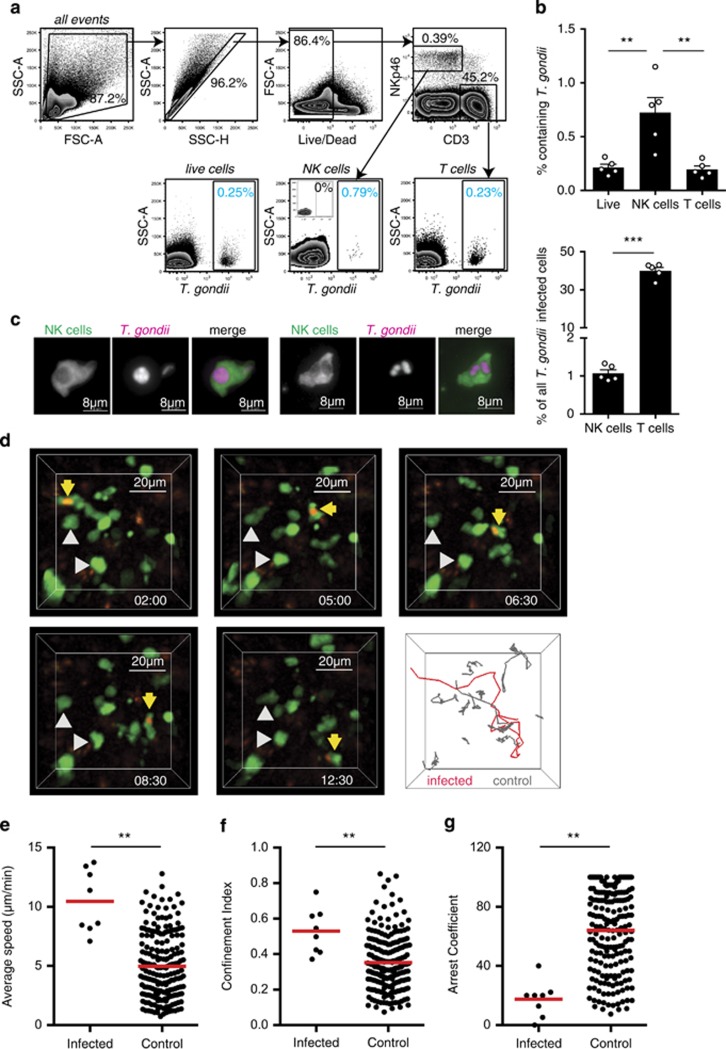
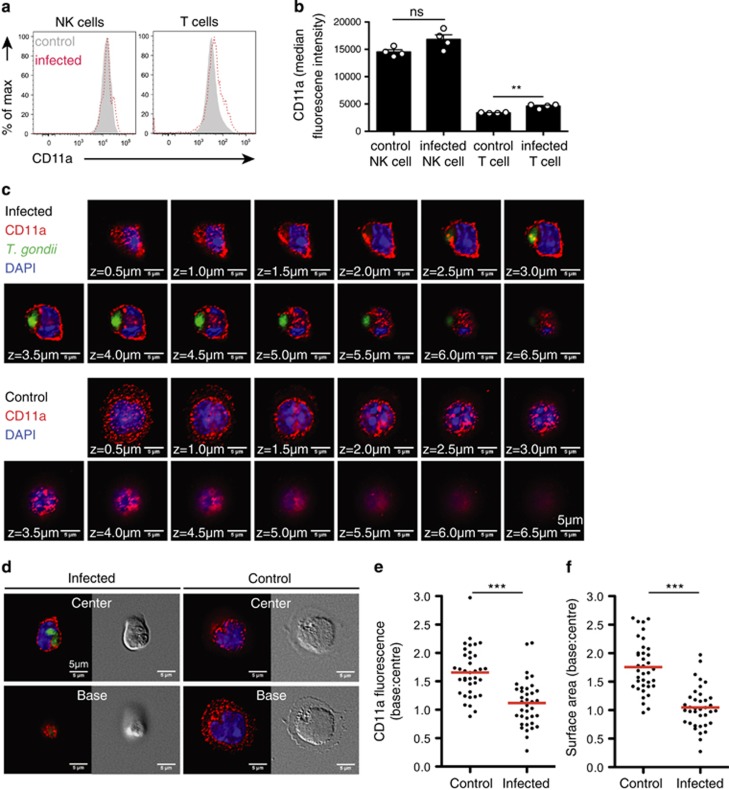
Toxoplasma gondii is a highly prevalent intracellular protozoan parasite that causes severe disease in congenitally infected or immunocompromised hosts. T. gondii is capable of invading immune cells and it has been suggested that the parasite harnesses the migratory pathways of these cells to spread through the body. Although in vitro evidence suggests that the parasite further enhances its spread by inducing a hypermotility phenotype in parasitized immune cells, in vivo evidence for this phenomenon is scarce. Here we use a physiologically relevant oral model of T. gondii infection, in conjunction with two-photon laser scanning microscopy, to address this issue. We found that a small proportion of natural killer (NK) cells in mesenteric lymph nodes contained parasites. Compared with uninfected 'bystander' NK cells, these infected NK cells showed faster, more directed and more persistent migratory behavior. Consistent with this, infected NK cells showed impaired spreading and clustering of the integrin, LFA-1, when exposed to plated ligands. Our results provide the first evidence for a hypermigratory phenotype in T. gondii-infected NK cells in vivo, providing an anatomical context for understanding how the parasite manipulates immune cell motility to spread through the host.
弓形虫是一种高度流行的细胞内原生动物寄生虫,可在先天性感染或免疫功能低下的宿主中引发严重疾病。弓形虫能够侵入免疫细胞,有人认为该寄生虫利用这些细胞的迁移途径在体内传播。尽管体外证据表明该寄生虫通过诱导被寄生免疫细胞出现超迁移表型来进一步促进其传播,但这一现象的体内证据却很少。在此,我们使用与双光子激光扫描显微镜相结合的弓形虫感染的生理相关口服模型来解决这一问题。我们发现,肠系膜淋巴结中的一小部分自然杀伤(NK)细胞含有寄生虫。与未感染的“旁观者”NK细胞相比,这些被感染的NK细胞表现出更快、更具方向性和更持久的迁移行为。与此一致的是,当暴露于平板配体时,被感染的NK细胞显示出整合素LFA-1的扩散和聚集受损。我们的结果首次为体内弓形虫感染的NK细胞中的超迁移表型提供了证据,为理解该寄生虫如何操纵免疫细胞运动以在宿主体内传播提供了解剖学背景。