Conway Mike
University of California San Diego, Department of Family and Preventive Medicine, La Jolla, CA, United States.
J Med Internet Res. 2014 Dec 22;16(12):e290. doi: 10.2196/jmir.3617.
The rise of social media and microblogging platforms in recent years, in conjunction with the development of techniques for the processing and analysis of "big data", has provided significant opportunities for public health surveillance using user-generated content. However, relatively little attention has been focused on developing ethically appropriate approaches to working with these new data sources.
Based on a review of the literature, this study seeks to develop a taxonomy of public health surveillance-related ethical concepts that emerge when using Twitter data, with a view to: (1) explicitly identifying a set of potential ethical issues and concerns that may arise when researchers work with Twitter data, and (2) providing a starting point for the formation of a set of best practices for public health surveillance through the development of an empirically derived taxonomy of ethical concepts.
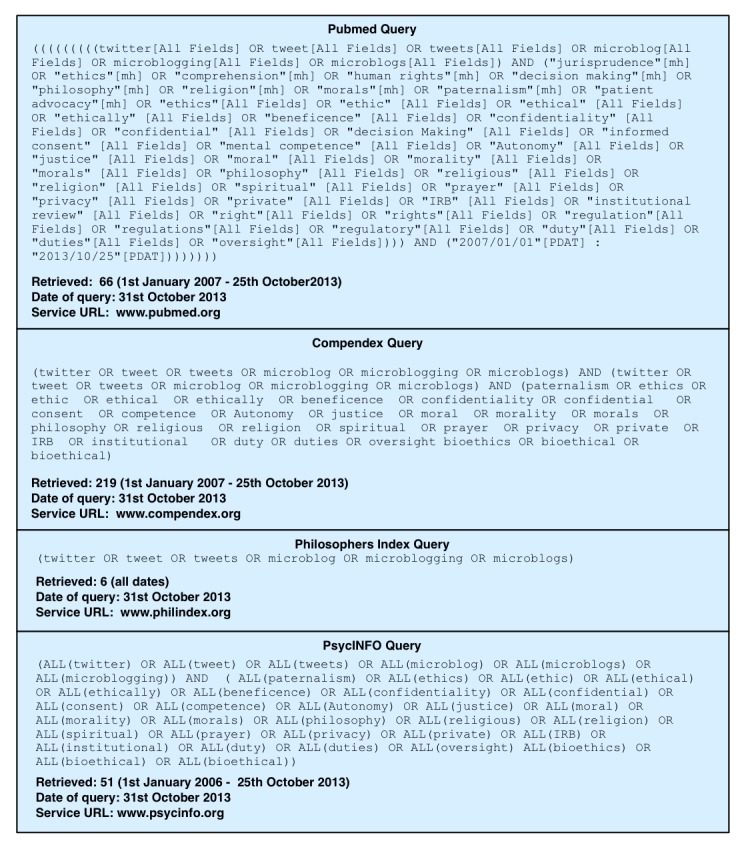
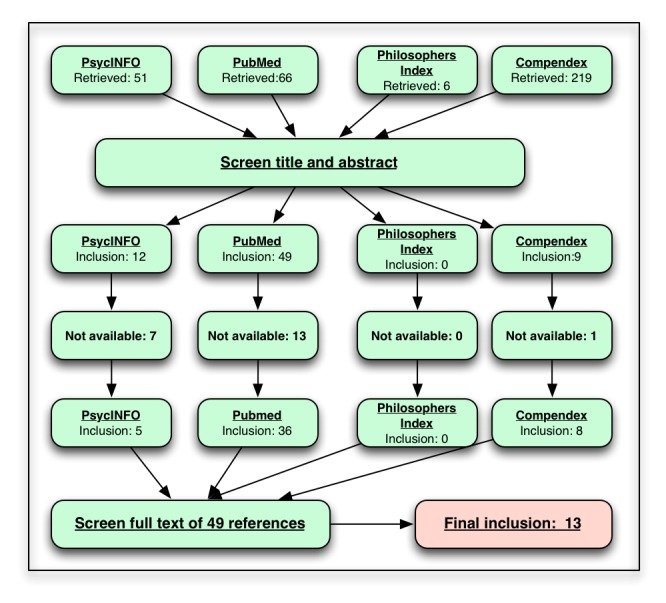
We searched Medline, Compendex, PsycINFO, and the Philosopher's Index using a set of keywords selected to identify Twitter-related research papers that reference ethical concepts. Our initial set of queries identified 342 references across the four bibliographic databases. We screened titles and abstracts of these references using our inclusion/exclusion criteria, eliminating duplicates and unavailable papers, until 49 references remained. We then read the full text of these 49 articles and discarded 36, resulting in a final inclusion set of 13 articles. Ethical concepts were then identified in each of these 13 articles. Finally, based on a close reading of the text, a taxonomy of ethical concepts was constructed based on ethical concepts discovered in the papers.
From these 13 articles, we iteratively generated a taxonomy of ethical concepts consisting of 10 top level categories: privacy, informed consent, ethical theory, institutional review board (IRB)/regulation, traditional research vs Twitter research, geographical information, researcher lurking, economic value of personal information, medical exceptionalism, and benefit of identifying socially harmful medical conditions.
In summary, based on a review of the literature, we present a provisional taxonomy of public health surveillance-related ethical concepts that emerge when using Twitter data.
近年来,社交媒体和微博平台的兴起,加之“大数据”处理与分析技术的发展,为利用用户生成内容进行公共卫生监测提供了重大机遇。然而,相对较少的注意力集中在开发符合伦理道德的方法来处理这些新数据源上。
基于文献综述,本研究旨在构建一个使用推特数据时出现的与公共卫生监测相关的伦理概念分类法,以期:(1)明确识别研究人员使用推特数据时可能出现的一系列潜在伦理问题和担忧;(2)通过开发基于实证得出的伦理概念分类法,为形成一套公共卫生监测最佳实践提供一个起点。
我们使用一组选定的关键词在医学数据库(Medline)、工程索引数据库(Compendex)、心理学文摘数据库(PsycINFO)和哲学索引数据库中进行搜索,以识别引用伦理概念的与推特相关的研究论文。我们最初的一组查询在这四个书目数据库中识别出342条参考文献。我们使用纳入/排除标准筛选这些参考文献的标题和摘要,消除重复和无法获取的论文,直到剩下49条参考文献。然后我们阅读这49篇文章的全文并舍弃36篇,最终纳入的文章集为13篇。随后在这13篇文章中的每一篇中识别伦理概念。最后,基于对文本的仔细阅读,根据论文中发现的伦理概念构建了一个伦理概念分类法。
从这13篇文章中,我们迭代生成了一个伦理概念分类法,由10个顶级类别组成:隐私、知情同意、伦理理论、机构审查委员会(IRB)/监管、传统研究与推特研究、地理信息、研究人员潜伏、个人信息的经济价值、医学例外主义以及识别社会有害医疗状况的益处。
总之,基于文献综述,我们呈现了一个使用推特数据时出现的与公共卫生监测相关的伦理概念临时分类法。