• 文献检索
  • 文档翻译
  • 深度研究
  • 学术资讯
  • Suppr Zotero 插件Zotero 插件
  • 邀请有礼
  • 套餐&价格
  • 历史记录
应用&插件
Suppr Zotero 插件Zotero 插件浏览器插件Mac 客户端Windows 客户端微信小程序
定价
高级版会员购买积分包购买API积分包
服务
文献检索文档翻译深度研究API 文档MCP 服务
关于我们
关于 Suppr公司介绍联系我们用户协议隐私条款
关注我们

Suppr 超能文献

核心技术专利:CN118964589B侵权必究
粤ICP备2023148730 号-1Suppr @ 2026

文献检索

告别复杂PubMed语法,用中文像聊天一样搜索,搜遍4000万医学文献。AI智能推荐,让科研检索更轻松。

立即免费搜索

文件翻译

保留排版,准确专业,支持PDF/Word/PPT等文件格式,支持 12+语言互译。

免费翻译文档

深度研究

AI帮你快速写综述,25分钟生成高质量综述,智能提取关键信息,辅助科研写作。

立即免费体验

推特上“天时地利”的健康传播:位置信息的价值与准确性

"Right time, right place" health communication on Twitter: value and accuracy of location information.

作者信息

Burton Scott H, Tanner Kesler W, Giraud-Carrier Christophe G, West Joshua H, Barnes Michael D

机构信息

Brigham Young University, Computational Health Science Research Group, Department of Computer Science, Provo, UT 84602, USA.

出版信息

J Med Internet Res. 2012 Nov 15;14(6):e156. doi: 10.2196/jmir.2121.

DOI:10.2196/jmir.2121
PMID:23154246
原文链接:https://pmc.ncbi.nlm.nih.gov/articles/PMC3510712/
Abstract

BACKGROUND

Twitter provides various types of location data, including exact Global Positioning System (GPS) coordinates, which could be used for infoveillance and infodemiology (ie, the study and monitoring of online health information), health communication, and interventions. Despite its potential, Twitter location information is not well understood or well documented, limiting its public health utility.

OBJECTIVE

The objective of this study was to document and describe the various types of location information available in Twitter. The different types of location data that can be ascertained from Twitter users are described. This information is key to informing future research on the availability, usability, and limitations of such location data.

METHODS

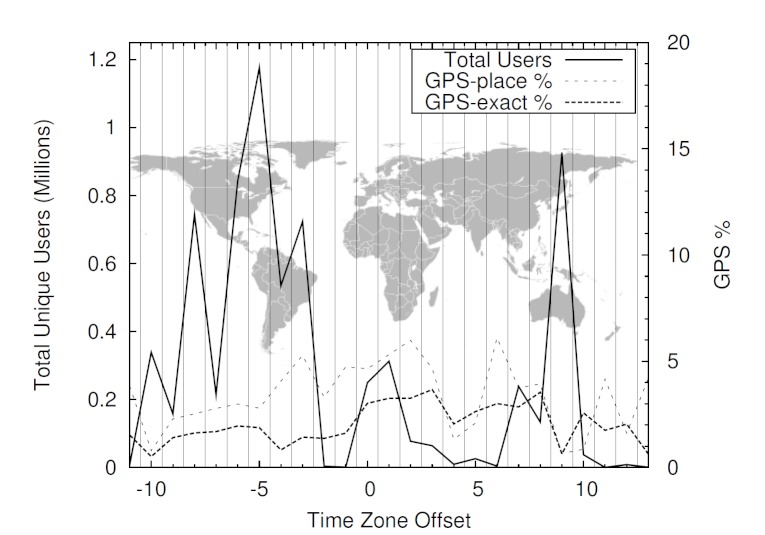
Location data was gathered directly from Twitter using its application programming interface (API). The maximum tweets allowed by Twitter were gathered (1% of the total tweets) over 2 separate weeks in October and November 2011. The final dataset consisted of 23.8 million tweets from 9.5 million unique users. Frequencies for each of the location options were calculated to determine the prevalence of the various location data options by region of the world, time zone, and state within the United States. Data from the US Census Bureau were also compiled to determine population proportions in each state, and Pearson correlation coefficients were used to compare each state's population with the number of Twitter users who enable the GPS location option.

RESULTS

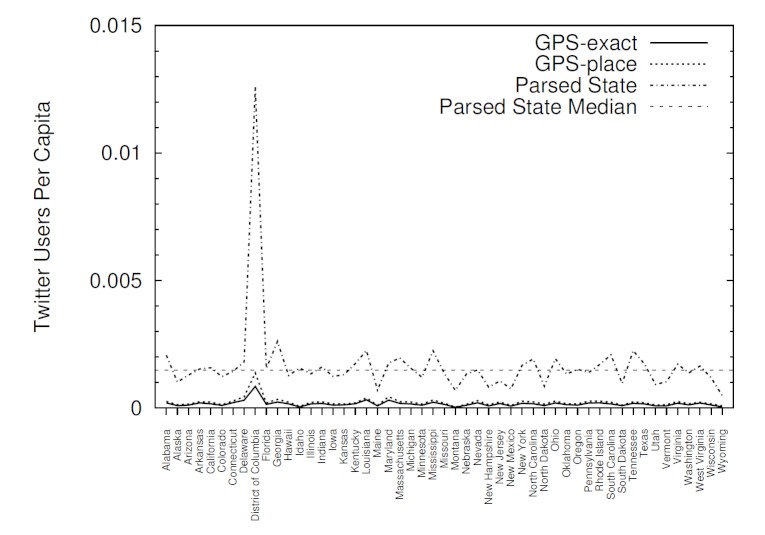
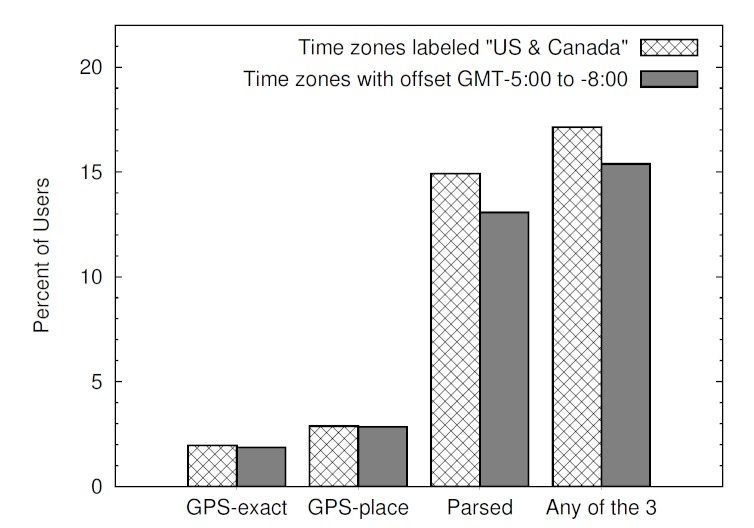
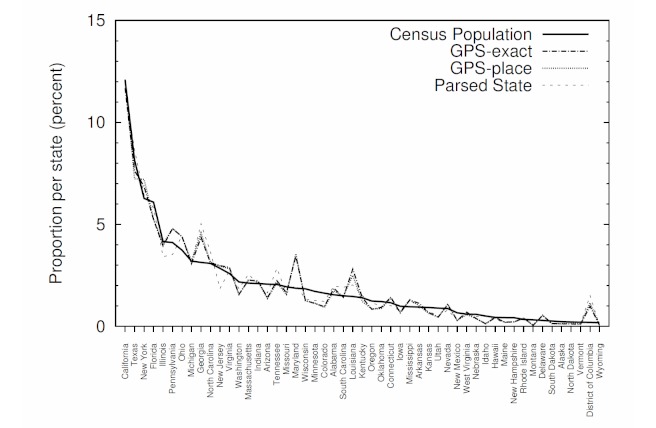
The GPS location data could be ascertained for 2.02% of tweets and 2.70% of unique users. Using a simple text-matching approach, 17.13% of user profiles in the 4 continental US time zones were able to be used to determine the user's city and state. Agreement between GPS data and data from the text-matching approach was high (87.69%). Furthermore, there was a significant correlation between the number of Twitter users per state and the 2010 US Census state populations (r ≥ 0.97, P < .001).

CONCLUSIONS

Health researchers exploring ways to use Twitter data for disease surveillance should be aware that the majority of tweets are not currently associated with an identifiable geographic location. Location can be identified for approximately 4 times the number of tweets using a straightforward text-matching process compared to using the GPS location information available in Twitter. Given the strong correlation between both data gathering methods, future research may consider using more qualitative approaches with higher yields, such as text mining, to acquire information about Twitter users' geographical location.

摘要

背景

推特提供了各种类型的位置数据,包括精确的全球定位系统(GPS)坐标,这些数据可用于信息监测和信息流行病学(即对在线健康信息的研究和监测)、健康传播及干预措施。尽管推特位置信息有其潜力,但人们对其了解和记录并不充分,限制了其在公共卫生方面的效用。

目的

本研究的目的是记录和描述推特中可用的各种类型的位置信息。描述了可以从推特用户那里确定的不同类型的位置数据。这些信息对于为未来关于此类位置数据的可用性、实用性和局限性的研究提供参考至关重要。

方法

通过推特的应用程序编程接口(API)直接从推特收集位置数据。在2011年10月和11月的两个不同星期内收集了推特允许的最大推文数量(占推文总数的1%)。最终数据集由来自950万不同用户的2380万条推文组成。计算每个位置选项的频率,以确定按世界区域、时区和美国各州划分的各种位置数据选项的流行程度。还汇编了美国人口普查局的数据,以确定每个州的人口比例,并使用皮尔逊相关系数将每个州的人口与启用GPS位置选项的推特用户数量进行比较。

结果

可以确定2.02%的推文和2.70%的不同用户的GPS位置数据。使用简单的文本匹配方法,在美国大陆四个时区中,17.13%的用户资料能够用于确定用户所在的城市和州。GPS数据与文本匹配方法得出的数据之间的一致性很高(87.69%)。此外,每个州的推特用户数量与美国2010年人口普查的州人口之间存在显著相关性(r≥0.97,P<0.001)。

结论

探索利用推特数据进行疾病监测方法的健康研究人员应意识到,目前大多数推文与可识别的地理位置无关。与使用推特中可用的GPS位置信息相比,使用直接的文本匹配过程可以为大约四倍数量的推文识别位置。鉴于两种数据收集方法之间的强相关性,未来的研究可能会考虑使用产量更高的更定性的方法,如文本挖掘,来获取有关推特用户地理位置的信息。
https://cdn.ncbi.nlm.nih.gov/pmc/blobs/8108/3510712/18e047ad1985/jmir_v14i6e156_fig4.jpg
https://cdn.ncbi.nlm.nih.gov/pmc/blobs/8108/3510712/31dc8129ee66/jmir_v14i6e156_fig1.jpg
https://cdn.ncbi.nlm.nih.gov/pmc/blobs/8108/3510712/402703fa0275/jmir_v14i6e156_fig2.jpg
https://cdn.ncbi.nlm.nih.gov/pmc/blobs/8108/3510712/af4dfd3a2529/jmir_v14i6e156_fig3.jpg
https://cdn.ncbi.nlm.nih.gov/pmc/blobs/8108/3510712/18e047ad1985/jmir_v14i6e156_fig4.jpg
https://cdn.ncbi.nlm.nih.gov/pmc/blobs/8108/3510712/31dc8129ee66/jmir_v14i6e156_fig1.jpg
https://cdn.ncbi.nlm.nih.gov/pmc/blobs/8108/3510712/402703fa0275/jmir_v14i6e156_fig2.jpg
https://cdn.ncbi.nlm.nih.gov/pmc/blobs/8108/3510712/af4dfd3a2529/jmir_v14i6e156_fig3.jpg
https://cdn.ncbi.nlm.nih.gov/pmc/blobs/8108/3510712/18e047ad1985/jmir_v14i6e156_fig4.jpg

相似文献

1
"Right time, right place" health communication on Twitter: value and accuracy of location information.推特上“天时地利”的健康传播:位置信息的价值与准确性
J Med Internet Res. 2012 Nov 15;14(6):e156. doi: 10.2196/jmir.2121.
2
Electronic word of mouth on twitter about physical activity in the United States: exploratory infodemiology study.关于美国推特上体育活动的电子口碑:探索性信息流行病学研究。
J Med Internet Res. 2013 Nov 20;15(11):e261. doi: 10.2196/jmir.2870.
3
Monitoring Physical Activity Levels Using Twitter Data: Infodemiology Study.利用推特数据监测身体活动水平:信息流行病学研究。
J Med Internet Res. 2019 Jun 3;21(6):e12394. doi: 10.2196/12394.
4
Mapping tweets to a known disease epidemiology; a case study of Lyme disease in the United Kingdom and Republic of Ireland.将推文映射到已知疾病流行病学;英国和爱尔兰共和国莱姆病的案例研究。
J Biomed Inform. 2019;100S:100060. doi: 10.1016/j.yjbinx.2019.100060. Epub 2019 Oct 18.
5
Top Concerns of Tweeters During the COVID-19 Pandemic: Infoveillance Study.新冠疫情期间推特用户的主要担忧:信息监测研究
J Med Internet Res. 2020 Apr 21;22(4):e19016. doi: 10.2196/19016.
6
Temporal and Location Variations, and Link Categories for the Dissemination of COVID-19-Related Information on Twitter During the SARS-CoV-2 Outbreak in Europe: Infoveillance Study.欧洲SARS-CoV-2疫情期间推特上新冠疫情相关信息传播的时间和地点变化以及链接类别:信息监测研究
J Med Internet Res. 2020 Aug 28;22(8):e19629. doi: 10.2196/19629.
7
Geographic Differences in Cannabis Conversations on Twitter: Infodemiology Study.推特上关于大麻的讨论存在地域差异:一项信息流行病学研究。
JMIR Public Health Surveill. 2020 Oct 5;6(4):e18540. doi: 10.2196/18540.
8
Applying Multiple Data Collection Tools to Quantify Human Papillomavirus Vaccine Communication on Twitter.应用多种数据收集工具量化推特上的人乳头瘤病毒疫苗传播情况
J Med Internet Res. 2016 Dec 5;18(12):e318. doi: 10.2196/jmir.6670.
9
What are health-related users tweeting? A qualitative content analysis of health-related users and their messages on twitter.与健康相关的用户在推特上发些什么?对推特上与健康相关的用户及其信息进行定性内容分析。
J Med Internet Res. 2014 Oct 15;16(10):e237. doi: 10.2196/jmir.3765.
10
Analysis of the purpose of state health departments' tweets: information sharing, engagement, and action.对州卫生部门推文目的的分析:信息共享、互动与行动。
J Med Internet Res. 2013 Nov 11;15(11):e255. doi: 10.2196/jmir.3002.

引用本文的文献

1
Infoveillance of COVID-19 Infections in Dentistry Using Platform X: Descriptive Study.使用X平台对牙科领域新冠病毒感染情况进行信息监测:描述性研究
J Med Internet Res. 2025 Apr 3;27:e54650. doi: 10.2196/54650.
2
Public Health Policy, Political Ideology, and Public Emotion Related to COVID-19 in the U.S.美国与 COVID-19 相关的公共卫生政策、政治意识形态和公众情绪
Int J Environ Res Public Health. 2023 Oct 29;20(21):6993. doi: 10.3390/ijerph20216993.
3
Interdisciplinary Approach to Identify and Characterize COVID-19 Misinformation on Twitter: Mixed Methods Study.

本文引用的文献

1
Social and news media enable estimation of epidemiological patterns early in the 2010 Haitian cholera outbreak.社交媒体和新闻媒体使人们能够在 2010 年海地霍乱疫情早期估计出疾病的流行模式。
Am J Trop Med Hyg. 2012 Jan;86(1):39-45. doi: 10.4269/ajtmh.2012.11-0597.
2
Our new "social" communication age in health.我们健康领域新的“社交”沟通时代。
J Health Commun. 2011 Sep;16(8):803-4. doi: 10.1080/10810730.2011.610220.
3
Exploring the potential of Web 2.0 to address health disparities.探索 Web 2.0 解决健康差异的潜力。
跨学科方法识别和表征推特上关于新冠疫情的错误信息:混合方法研究
JMIR Form Res. 2023 Jun 28;7:e41134. doi: 10.2196/41134.
4
Deep Neural Networks for Simultaneously Capturing Public Topics and Sentiments During a Pandemic: Application on a COVID-19 Tweet Data Set.用于在大流行期间同时捕捉公共话题和情绪的深度神经网络:在COVID-19推文数据集上的应用。
JMIR Med Inform. 2022 May 25;10(5):e34306. doi: 10.2196/34306.
5
Spatiotemporal sentiment variation analysis of geotagged COVID-19 tweets from India using a hybrid deep learning model.利用混合深度学习模型分析来自印度带有地理标签的 COVID-19 推文的时空情绪变化。
Sci Rep. 2022 Feb 3;12(1):1849. doi: 10.1038/s41598-022-05974-6.
6
The Role of Twitter in the WHO's Fight against the Infodemic.推特在世界卫生组织应对信息疫情中的作用。
Int J Environ Res Public Health. 2021 Nov 15;18(22):11990. doi: 10.3390/ijerph182211990.
7
Design and analysis of a large-scale COVID-19 tweets dataset.大规模新冠疫情推文数据集的设计与分析
Appl Intell (Dordr). 2021;51(5):2790-2804. doi: 10.1007/s10489-020-02029-z. Epub 2020 Nov 6.
8
The Federal Menu Labeling Law and Twitter Discussions about Calories in the United States: An Interrupted Time-Series Analysis.《联邦菜单标签法与美国卡路里在 Twitter 上的讨论:一项中断时间序列分析》
Int J Environ Res Public Health. 2021 Oct 14;18(20):10794. doi: 10.3390/ijerph182010794.
9
Psychosocial Effects of the COVID-19 Pandemic: Large-scale Quasi-Experimental Study on Social Media.新冠疫情的社会心理影响:社交媒体上的大规模准实验研究
J Med Internet Res. 2020 Nov 24;22(11):e22600. doi: 10.2196/22600.
10
Use of social media big data as a novel HIV surveillance tool in South Africa.利用社交媒体大数据作为南非新型 HIV 监测工具。
PLoS One. 2020 Oct 2;15(10):e0239304. doi: 10.1371/journal.pone.0239304. eCollection 2020.
J Health Commun. 2011;16 Suppl 1:77-89. doi: 10.1080/10810730.2011.596916.
4
Integrating social media into emergency-preparedness efforts.将社交媒体融入应急准备工作。
N Engl J Med. 2011 Jul 28;365(4):289-91. doi: 10.1056/NEJMp1103591.
5
Public health surveillance of dental pain via Twitter.通过 Twitter 进行口腔疼痛的公共卫生监测。
J Dent Res. 2011 Sep;90(9):1047-51. doi: 10.1177/0022034511415273. Epub 2011 Jul 18.
6
Using social media for research and public health surveillance.利用社交媒体进行研究和公共卫生监测。
J Dent Res. 2011 Sep;90(9):1045-6. doi: 10.1177/0022034511415277. Epub 2011 Jul 18.
7
Health care delivery. Open mHealth architecture: an engine for health care innovation.医疗服务提供。开放式移动健康架构:医疗创新的引擎。
Science. 2010 Nov 5;330(6005):759-60. doi: 10.1126/science.1196187.
8
YouTube as a source of quitting smoking information.YouTube 作为戒烟信息来源。
Tob Control. 2011 Mar;20(2):119-22. doi: 10.1136/tc.2009.035550. Epub 2010 Oct 21.
9
Dissemination of health information through social networks: twitter and antibiotics.通过社交网络传播健康信息:推特和抗生素。
Am J Infect Control. 2010 Apr;38(3):182-8. doi: 10.1016/j.ajic.2009.11.004.
10
YouTube as a source of information on the H1N1 influenza pandemic.YouTube 作为甲型 H1N1 流感大流行信息源。
Am J Prev Med. 2010 Mar;38(3):e1-3. doi: 10.1016/j.amepre.2009.11.007.