Bęczkowski Paweł M, Hughes Joseph, Biek Roman, Litster Annette, Willett Brian J, Hosie Margaret J
Small Animal Hospital, University of Glasgow, Glasgow, UK.
MRC University of Glasgow Centre for Virus Research, University of Glasgow, Glasgow, UK.
J Gen Virol. 2015 Apr;96(Pt 4):893-903. doi: 10.1099/vir.0.000035. Epub 2014 Dec 22.
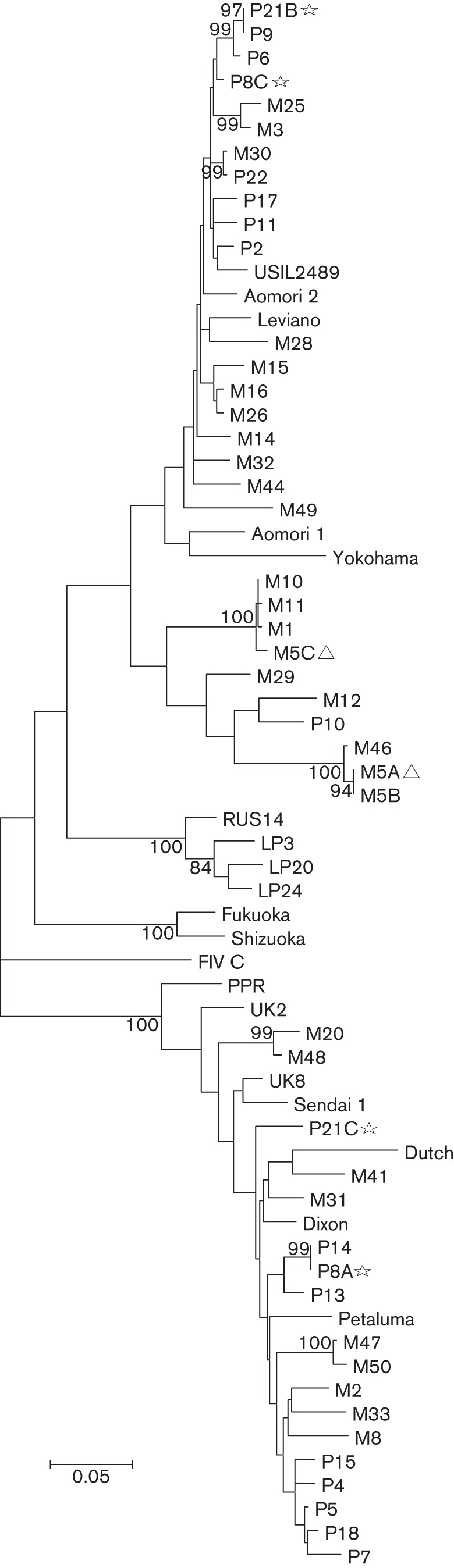
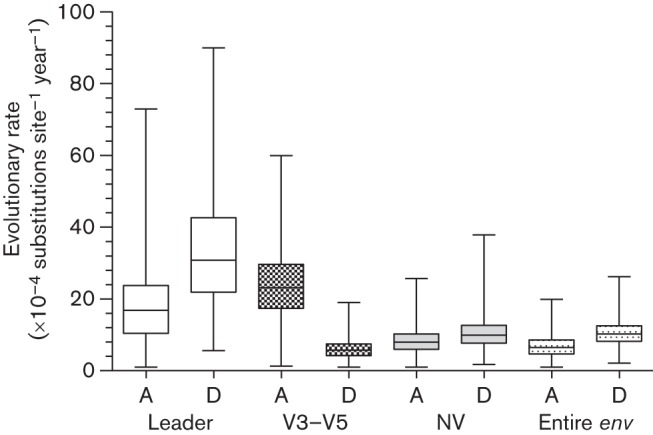
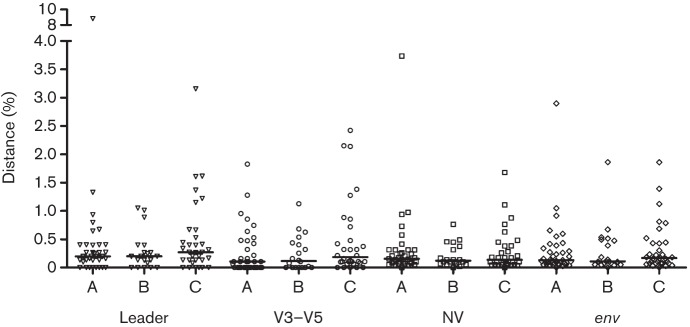
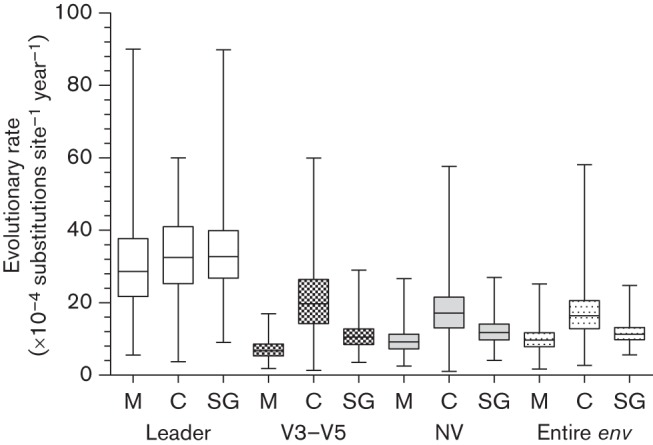
Analysing the evolution of feline immunodeficiency virus (FIV) at the intra-host level is important in order to address whether the diversity and composition of viral quasispecies affect disease progression. We examined the intra-host diversity and the evolutionary rates of the entire env and structural fragments of the env sequences obtained from sequential blood samples in 43 naturally infected domestic cats that displayed different clinical outcomes. We observed in the majority of cats that FIV env showed very low levels of intra-host diversity. We estimated that env evolved at a rate of 1.16×10(-3) substitutions per site per year and demonstrated that recombinant sequences evolved faster than non-recombinant sequences. It was evident that the V3-V5 fragment of FIV env displayed higher evolutionary rates in healthy cats than in those with terminal illness. Our study provided the first evidence that the leader sequence of env, rather than the V3-V5 sequence, had the highest intra-host diversity and the highest evolutionary rate of all env fragments, consistent with this region being under a strong selective pressure for genetic variation. Overall, FIV env displayed relatively low intra-host diversity and evolved slowly in naturally infected cats. The maximum evolutionary rate was observed in the leader sequence of env. Although genetic stability is not necessarily a prerequisite for clinical stability, the higher genetic stability of FIV compared with human immunodeficiency virus might explain why many naturally infected cats do not progress rapidly to AIDS.
分析猫免疫缺陷病毒(FIV)在宿主内水平的进化对于探讨病毒准种的多样性和组成是否影响疾病进展至关重要。我们检测了43只自然感染的家猫连续血样中获得的env序列的整个env和结构片段的宿主内多样性及进化速率,这些家猫呈现出不同的临床结局。我们在大多数猫中观察到,FIV env的宿主内多样性水平非常低。我们估计env的进化速率为每年每个位点1.16×10⁻³个替换,并证明重组序列的进化速度比非重组序列快。很明显,FIV env的V3 - V5片段在健康猫中的进化速率高于患有末期疾病的猫。我们的研究首次证明,env的前导序列而非V3 - V5序列在所有env片段中具有最高的宿主内多样性和最高的进化速率,这与该区域受到强烈的遗传变异选择压力一致。总体而言,FIV env在自然感染的猫中表现出相对较低的宿主内多样性且进化缓慢。在env的前导序列中观察到最大进化速率。虽然遗传稳定性不一定是临床稳定性的先决条件,但与人类免疫缺陷病毒相比,FIV具有更高的遗传稳定性可能解释了为什么许多自然感染的猫不会迅速发展为艾滋病。