Rodrigues Amanda, Struchiner Claudio J, Coelho Lara E, Veloso Valdilea G, Grinsztejn Beatriz, Luz Paula M
Escola Nacional de Saúde Pública, Fundação Oswaldo Cruz, Rio de Janeiro, Brazil.
Escola de Matemática Aplicada, Fundação Getúlio Vargas, Praia de Botafogo, 190, Rio de Janeiro, Brazil.
BMC Public Health. 2021 Feb 19;21(1):389. doi: 10.1186/s12889-021-10421-8.
Late antiretroviral treatment initiation for HIV disease worsens health outcomes and contributes to ongoing transmission. We investigated whether socioeconomic inequalities exist in access to treatment in a setting with universal access to care and treatment.
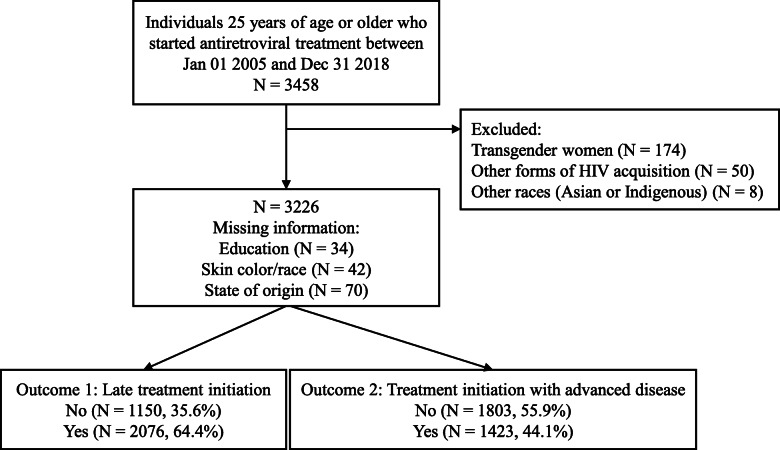
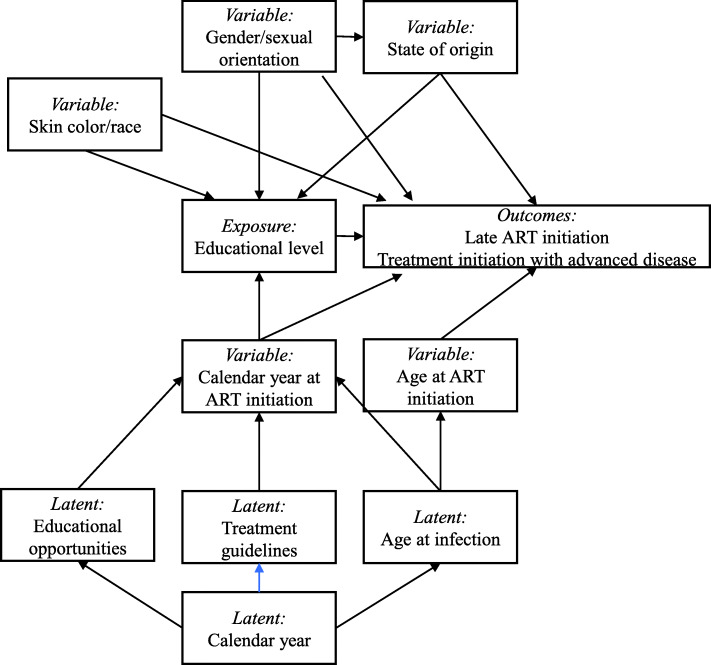
This study investigated the association of educational level, used as a proxy for socioeconomic status, with late treatment initiation and treatment initiation with advanced disease. Study participants included adults (≥25 years) who started treatment from 2005 to 2018 at Instituto Nacional de Infectologia Evandro Chagas of Fundação Oswaldo Cruz (INI/FIOCRUZ), Rio de Janeiro, Brazil. Educational level was categorized following UNESCO's International Standard Classification of Education: incomplete basic education, basic education, secondary level, and tertiary level. We defined late treatment initiation as those initiating treatment with a CD4 < 350 cells/mL or an AIDS-defining event, and treatment initiation with advanced disease as those initiating treatment with a CD4 < 200 cells/mL or an AIDS-defining event. A directed acyclic graph (DAG) was constructed to represent the theoretical-operational model and to understand the involvement of covariates. Logistic regression models were used to estimate the adjusted odds ratios (aOR) and 95% confidence intervals (95%CI). Multiple imputation using a chained equations approach was used to treat missing values and non-linear terms for continuous variables were tested.
In total, 3226 individuals composed the study population: 876 (27.4%) had incomplete basic education, 540 (16.9%) basic, 1251 (39.2%) secondary level, and 525 (16.4%) tertiary level. Late treatment initiation was observed for 2076 (64.4%) while treatment initiation with advanced disease was observed for 1423 (44.1%). Compared to tertiary level of education, incomplete basic, basic and secondary level increased the odds of late treatment initiation by 89% (aOR:1.89 95%CI:1.47-2.43), 61% (aOR:1.61 95%CI:1.23-2.10), and 35% (aOR:1.35 95%CI:1.09-1.67). Likewise, the odds of treatment initiation with advanced disease was 2.5-fold (aOR:2.53 95%CI:1.97-3.26), 2-fold (aOR:2.07 95%CI:1.59-2.71), 1.5-fold (aOR:1.51 95%CI:1.21-1.88) higher for those with incomplete basic, basic and secondary level education compared to tertiary level.
Despite universal access to HIV care and antiretroviral treatment, late treatment initiation and social inequalities persist. Lower educational level significantly increased the odds of both outcomes, reinforcing the existence of barriers to "universal" antiretroviral treatment.
艾滋病晚期才开始抗逆转录病毒治疗会使健康状况恶化,并导致病毒持续传播。我们调查了在一个可普遍获得护理和治疗的环境中,获得治疗方面是否存在社会经济不平等现象。
本研究调查了作为社会经济地位指标的教育水平与晚期开始治疗以及在疾病晚期开始治疗之间的关联。研究参与者包括2005年至2018年期间在巴西里约热内卢奥斯瓦尔多·克鲁兹基金会国家传染病研究所伊瓦尔多·查加斯研究所(INI/FIOCRUZ)开始治疗的成年人(≥25岁)。教育水平按照联合国教科文组织的国际教育标准分类进行划分:基础教育未完成、基础教育、中等教育和高等教育。我们将晚期开始治疗定义为那些CD4细胞计数<350个/毫升或出现艾滋病定义事件时开始治疗的人,而将在疾病晚期开始治疗定义为那些CD4细胞计数<200个/毫升或出现艾滋病定义事件时开始治疗的人。构建了一个有向无环图(DAG)来表示理论 - 操作模型并理解协变量的作用。使用逻辑回归模型来估计调整后的优势比(aOR)和95%置信区间(95%CI)。采用链式方程法进行多重插补来处理缺失值,并对连续变量的非线性项进行了检验。
共有3226人组成研究人群:876人(27.4%)基础教育未完成,540人(16.9%)接受过基础教育,1251人(39.2%)接受过中等教育,525人(16.4%)接受过高等教育。观察到2076人(64.4%)晚期开始治疗,1423人(44.1%)在疾病晚期开始治疗。与高等教育水平相比,基础教育未完成、接受过基础教育和中等教育水平的人晚期开始治疗的几率分别增加了89%(aOR:1.89,95%CI:1.47 - 2.43)、61%(aOR:1.61,95%CI:1.23 - 2.10)和35%(aOR:1.35,95%CI:1.09 - 1.67)。同样,与高等教育水平相比,基础教育未完成、接受过基础教育和中等教育水平的人在疾病晚期开始治疗的几率分别高出2.5倍(aOR:2.53,95%CI:1.97 - 3.26)、2倍(aOR:2.07,95%CI:1.59 - 2.71)、1.5倍(aOR:1.