Wei Chongyi, Yan Hongjing, Yang Chuankun, Raymond H Fisher, Li Jianjun, Yang Haitao, Zhao Jinkou, Huan Xiping, Stall Ron
a Behavioral and Community Health Sciences, Graduate School of Public Health , University of Pittsburgh , Pittsburgh , PA , USA.
AIDS Care. 2014;26(3):372-8. doi: 10.1080/09540121.2013.824538. Epub 2013 Aug 2.
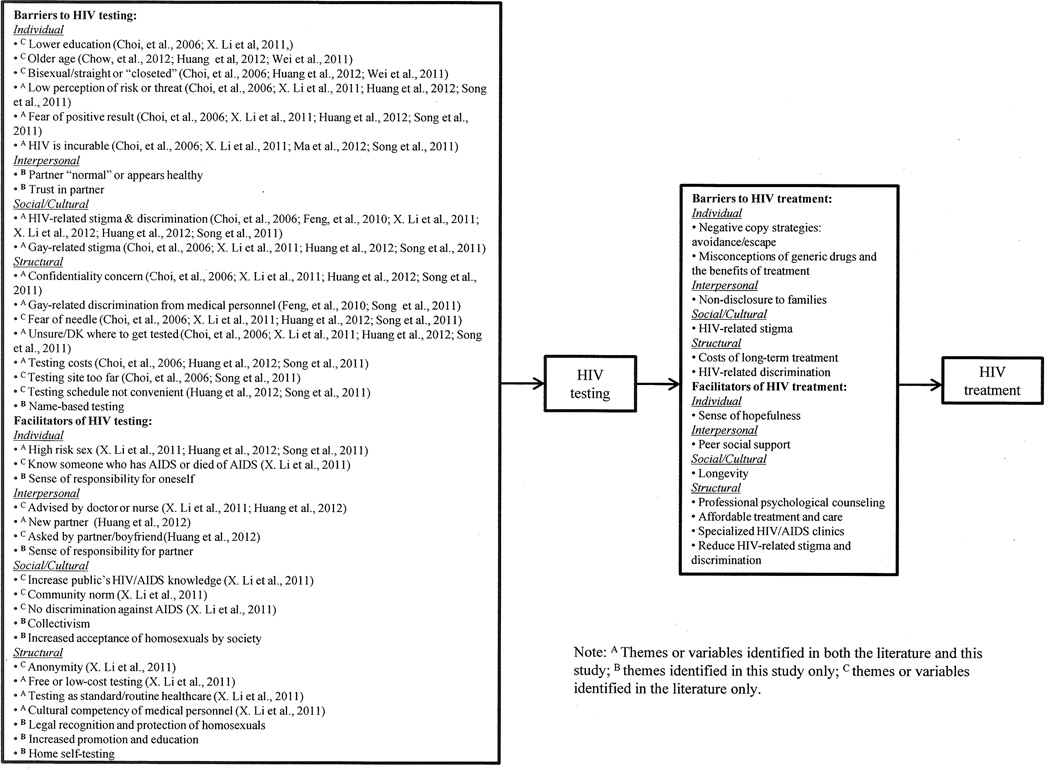
Barriers to HIV testing and HIV care and treatment pose significant challenges to HIV prevention among men who have sex with men (MSM) in China. We carried out a qualitative study to identify barriers and facilitators to HIV testing and treatment among Chinese MSM. In 2012, seven focus group (FG) discussions were conducted with 49 MSM participants in Nanjing, China. Purposive sampling was used to recruit a diverse group of MSM participants. Semi-structured interviews were conducted to collect FG data. Major barriers to testing included gay- and HIV-related stigma and discrimination, relationship type and partner characteristics, low perception of risk or threat, HIV is incurable or equals death, concerns of confidentiality, unaware that testing is offered for free, and name-based testing. Key facilitators of testing included engaging in high-risk sex, sense of responsibility for partner, collectivism, testing as a part of standard/routine medical care, MSM-friendly medical personnel, increased acceptance of gay/bisexual men by the general public, legal recognition and protection of homosexuals, and home self-testing. Barriers to treatment included negative coping, nondisclosure to families, misconceptions of domestically produced antiretroviral drugs (ARVs) and the benefits of treatment, and costs associated with long-term treatment. Facilitators of treatment included sense of hopefulness that a cure would be found, the cultural value of longevity, peer social support and professional psychological counseling, affordable and specialized treatment and care, and reduced HIV-related stigma and discrimination. Finally, for both testing and treatment, more educational and promotional activities within MSM communities and among the general public are needed.
在中国,艾滋病毒检测以及艾滋病毒护理与治疗的障碍对男男性行为者(MSM)的艾滋病毒预防构成了重大挑战。我们开展了一项定性研究,以确定中国男男性行为者在艾滋病毒检测和治疗方面的障碍及促进因素。2012年,在中国南京与49名男男性行为者参与者进行了7次焦点小组(FG)讨论。采用目的抽样法招募了不同类型的男男性行为者参与者。通过半结构化访谈收集焦点小组数据。检测的主要障碍包括与同性恋和艾滋病毒相关的耻辱感和歧视、关系类型及伴侣特征、对风险或威胁的低认知度、认为艾滋病毒无法治愈或等同于死亡、对保密性的担忧、不知道检测是免费的以及实名制检测。检测的关键促进因素包括从事高风险性行为、对伴侣的责任感、集体主义、将检测作为标准/常规医疗护理的一部分、对男男性行为者友好的医务人员、公众对男同性恋/双性恋男性接受度的提高、对同性恋者的法律认可和保护以及家庭自测。治疗的障碍包括消极应对、不向家人透露、对国产抗逆转录病毒药物(ARV)及治疗益处的误解以及长期治疗的费用。治疗的促进因素包括有望找到治愈方法的希望感、长寿的文化价值观、同伴社会支持和专业心理咨询、负担得起的专门治疗和护理,以及与艾滋病毒相关的耻辱感和歧视的减少。最后,对于检测和治疗而言,在男男性行为者社区和普通公众中都需要开展更多的教育和宣传活动。