Laboratory of Cell Differentiation Research, College of Korean Medicine, Gachon University, Seongnam, Korea.
College of Korean Medicine, Gachon University, Seongnam, Korea.
J Ginseng Res. 2015 Jan;39(1):46-53. doi: 10.1016/j.jgr.2014.06.001. Epub 2014 Jul 9.
Glucocorticoids (GCs) are commonly used in many chemotherapeutic protocols and play an important role in the normal regulation of bone remodeling. However, the prolonged use of GCs results in osteoporosis, which is partially due to apoptosis of osteoblasts and osteocytes. In this study, effects of Korean Red Ginseng (KRG) on GC-treated murine osteoblastic MC3T3-E1 cells and a GC-induced osteoporosis mouse model were investigated.
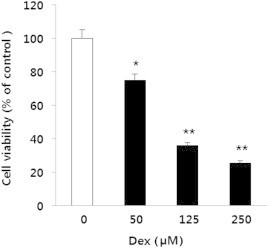
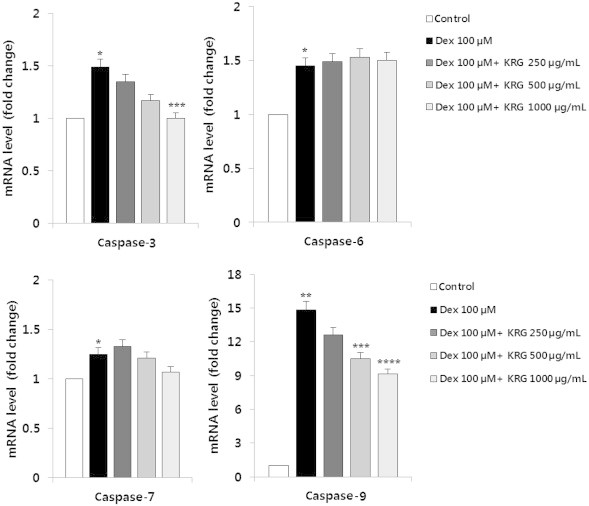
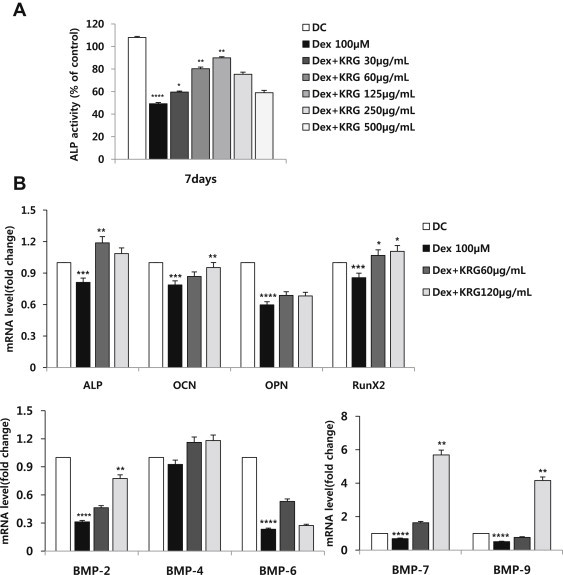
MC3T3-E1 cells were exposed to dexamethasone (Dex) with or without KRG and cell viability was measured by the 3-(4, 5-dimethylthiazol-2-yl)-2, 5-diphenyltetrazolium bromide (MTT) assay. Real-time polymerase chain reaction was performed to evaluate the apoptotic gene expression; osteogenic gene expression and alkaline phosphatase (ALP) activity were also measured. Western blotting was performed to evaluate the mitogen-activated protein kinase (MAPK) proteins. A GC-induced osteoporosis animal model was used for in vivo study.
The MTT assay revealed that Korean Red Ginseng (KRG) prevents loss of cell viability caused by Dex-induced apoptosis in MC3T3E1 cells. Real-time polymerase chain reaction data showed that groups treated with both Dex and KRG exhibited lower mRNA levels of caspase-3 and -9, whereas the mRNA levels of Bcl2, IAPs, and XIAP increased. Moreover, groups treated with both Dex and KRG demonstrated increased mRNA levels of ALP, RUNX2, and bone morphogenic proteins as well as increased ALP activity in MC3T3-E1 cells, compared to cells treated with Dex only. In addition, KRG increased protein kinase B (AKT) phosphorylation and decreased c-Jun N-terminal kinase (JNK) phosphorylation. Moreover, microcomputed tomography analysis of the femurs showed that GC implantation caused trabecular bone loss. However, a significant reduction of bone loss was observed in the KRG-treated group. These results suggest that the molecular mechanism of KRG in the GC-induced apoptosis may lead to the development of therapeutic strategies to prevent and/or delay osteoporosis.
糖皮质激素(GCs)在许多化疗方案中被广泛应用,在骨重塑的正常调节中发挥着重要作用。然而,GC 的长期使用会导致骨质疏松症,这部分是由于成骨细胞和破骨细胞的凋亡。在这项研究中,研究了高丽参(KRG)对 GC 处理的鼠成骨细胞 MC3T3-E1 细胞和 GC 诱导的骨质疏松症小鼠模型的影响。
将 MC3T3-E1 细胞暴露于地塞米松(Dex)中,有或没有 KRG,并通过 3-(4,5-二甲基噻唑-2-基)-2,5-二苯基四唑溴盐(MTT)测定法测量细胞活力。实时聚合酶链反应用于评估凋亡基因表达;还测量了成骨基因表达和碱性磷酸酶(ALP)活性。进行了 Western blot 以评估丝裂原活化蛋白激酶(MAPK)蛋白。使用 GC 诱导的骨质疏松症动物模型进行体内研究。
MTT 测定表明,高丽参(KRG)可防止 Dex 诱导的 MC3T3E1 细胞凋亡引起的细胞活力丧失。实时聚合酶链反应数据显示,同时用 Dex 和 KRG 处理的组中,caspase-3 和 -9 的 mRNA 水平较低,而 Bcl2、IAPs 和 XIAP 的 mRNA 水平升高。此外,与仅用 Dex 处理的细胞相比,同时用 Dex 和 KRG 处理的组的 MC3T3-E1 细胞中 ALP、RUNX2 和骨形态发生蛋白的 mRNA 水平升高,并且 ALP 活性也升高。此外,KRG 增加了蛋白激酶 B(AKT)的磷酸化,降低了 c-Jun N-末端激酶(JNK)的磷酸化。此外,股骨的微计算机断层扫描分析表明,GC 植入会导致小梁骨丢失。然而,在 KRG 治疗组中,骨丢失明显减少。这些结果表明,KRG 在 GC 诱导的细胞凋亡中的分子机制可能导致开发预防和/或延迟骨质疏松症的治疗策略。