Werthel Jean-David, Pelissier Alexandre, Massin Philippe, Boyer Patrick, Valenti Philippe
Hôpital Bichat, Orthopedic Department, 46 Rue Henri Huchard, 75018, Paris, France.
Hand institute, 6 Square Jouvenet, 75016, Paris, France.
Int J Shoulder Surg. 2014 Oct;8(4):101-6. doi: 10.4103/0973-6042.145232.
The double row cuff repair with suture bridging is commonly used for arthroscopic rotator cuff repair (RCR). Despite its biomechanical qualities, the rate of iterative tears with this technique is important. The aim of our study was to evaluate the effect of autologous conditioned plasma (ACP) on functional results and on the rate of iterative tears after RCR by suture bridging.
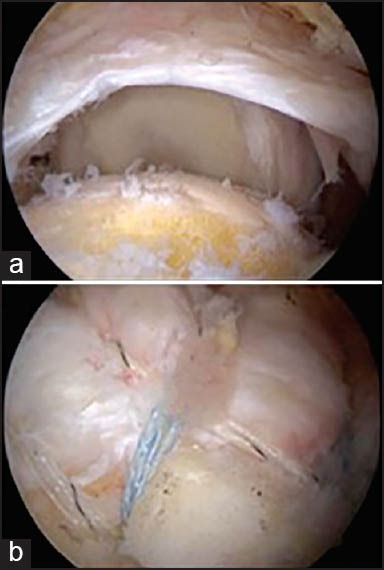
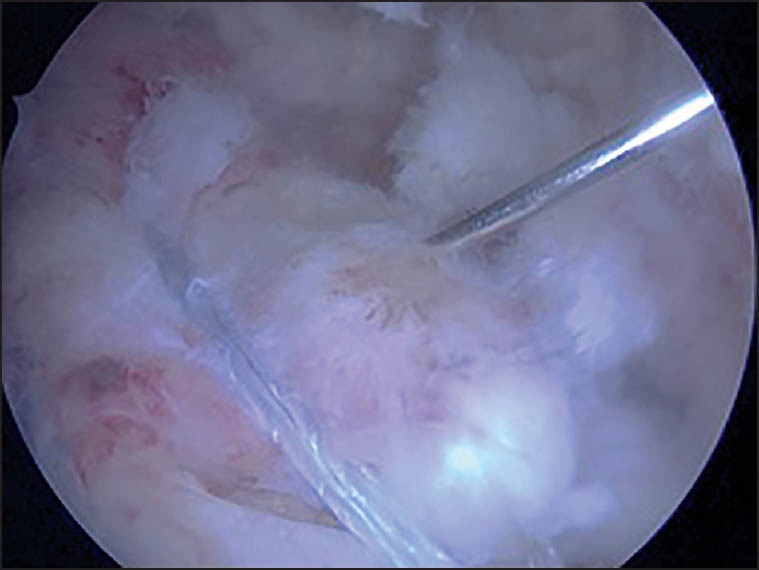
A consecutive series of 65 patients who underwent arthroscopic double-row suture bridge (Speed-Bridge, Arthrex) primary cuff repair of symptomatic full-thickness supraspinatus tear (retraction <3 in the Patte classification) were evaluated. Mean patient age was 60 (+/-8). The supraspinatus was repaired by knot-less bridging (SwiveLock, Arthrex) with suture tape material. 2 homogenous groups were created (A: 33 patients, B: 32 patients). In group A, all patients received, besides the cuff repair, an intra-tendinous ACP injection. Constant scores and Simple Shoulder Tests (SST) were measured pre-operatively and after a minimum follow-up period of 12 months post-operatively. Structural integrity of the repairs was evaluated by MRI according to the Sugaya classification. Sugaya >4 were considered as iterative tears.
Mean follow-up was 19 months (+/-42) in the 2 groups. The mean quantity of ACP injected was 6ml. (+/-1.5) and no specific complication of the injection was found. Mean preoperative Constant-Murley scores were 41,2 (±7,7) and 38 (±11)in group B. Mean normalized Constant-Murley score increased from 41 points (±7) pre-operatively to 70 points (±8) post-operatively in group A and from 38 points (±11) to 73 points (±11) in group B. There were no significative differences between the two groups (P > 0.05). In group A, 31 repairs were Sugaya 1-3 (94%), vs. 30 in group B (93%), and 1 was type 4 in group A (5%) vs. 2 in group B (8%).
In both groups, RCR with suture bridging gave successful functional outcomes, with a low rate of iterative tear. In this preliminary study, the adjuvant effect of ACP injections could not be showed on both functional and structural results. Longer follow-up is needed to evaluate potential differences.
带缝线桥接的双排袖套修复术常用于关节镜下肩袖修复术(RCR)。尽管该技术具有生物力学特性,但该技术导致的再次撕裂率仍很重要。我们研究的目的是评估自体浓缩血浆(ACP)对RCR缝线桥接术后功能结果和再次撕裂率的影响。
对连续65例接受关节镜下双排缝线桥接(Speed-Bridge,Arthrex)治疗有症状的全层冈上肌撕裂(Patte分类中回缩<3)的患者进行评估。患者平均年龄为60岁(±8岁)。采用缝线带材料通过无结桥接(SwiveLock,Arthrex)修复冈上肌。分为2个同质组(A组:33例患者,B组:32例患者)。在A组中,除袖套修复外,所有患者均接受了肌腱内ACP注射。术前及术后至少随访12个月后测量Constant评分和简单肩关节测试(SST)。根据Sugaya分类通过MRI评估修复的结构完整性。Sugaya>4被视为再次撕裂。
两组平均随访时间为(19±4.2)个月。注射的ACP平均量为(6±1.5)ml,未发现注射的特异性并发症。B组术前Constant-Murley平均评分为41.2(±7.7)分和38(±11)分。A组术前标准化Constant-Murley评分平均从41分(±7分)提高到术后70分(±8分),B组从38分(±11分)提高到73分(±11分)。两组之间无显著差异(P>0.05)。A组3组修复为Sugaya 1-3级(94%),B组为30例(93%),A组1例为4级(5%),B组为2例(8%)。
两组采用缝线桥接的RCR均取得了成功的功能结果,再次撕裂率较低。在这项初步研究中,未显示ACP注射对功能和结构结果的辅助作用。需要更长时间的随访来评估潜在差异。