Cell Biology, Department of Biology, Faculty of Science, Utrecht University Utrecht, Netherlands.
Department of Applied Physics, Eindhoven University of Technology Eindhoven, Netherlands.
Front Neuroanat. 2014 Dec 4;8:142. doi: 10.3389/fnana.2014.00142. eCollection 2014.
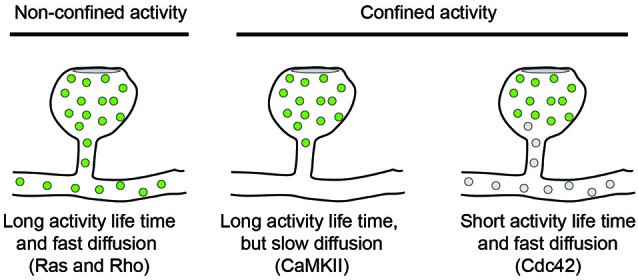
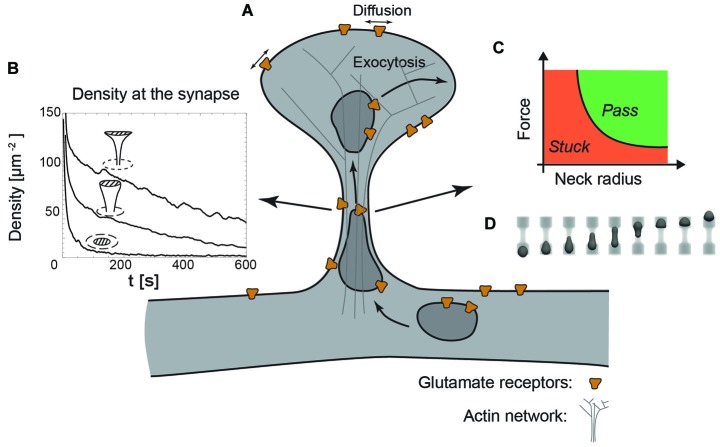
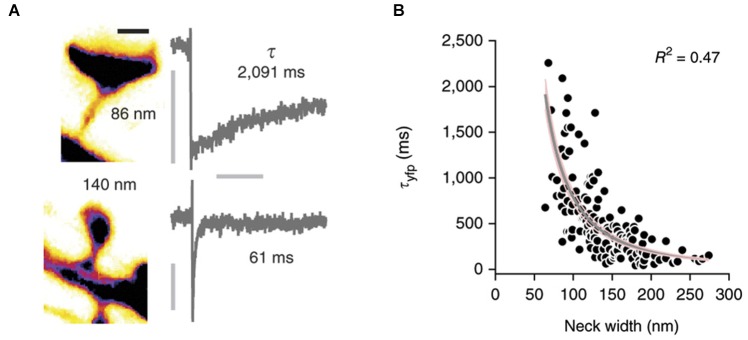
Dendritic spines are micron-sized protrusions that harbor the majority of excitatory synapses in the central nervous system. The head of the spine is connected to the dendritic shaft by a 50-400 nm thin membrane tube, called the spine neck, which has been hypothesized to confine biochemical and electric signals within the spine compartment. Such compartmentalization could minimize interspinal crosstalk and thereby support spine-specific synapse plasticity. However, to what extent compartmentalization is governed by spine morphology, and in particular the diameter of the spine neck, has remained unresolved. Here, we review recent advances in tool development - both experimental and theoretical - that facilitate studying the role of the spine neck in compartmentalization. Special emphasis is given to recent advances in microscopy methods and quantitative modeling applications as we discuss compartmentalization of biochemical signals, membrane receptors and electrical signals in spines. Multidisciplinary approaches should help to answer how dendritic spine architecture affects the cellular and molecular processes required for synapse maintenance and modulation.
树突棘是微米级的突起,在中枢神经系统中承载着大多数兴奋性突触。棘突的头部通过一个 50-400nm 厚的膜管与树突干相连,这个膜管被称为棘突颈部,它被假设可以将生化和电信号限制在棘突腔内。这种分隔可以最大限度地减少棘突之间的串扰,从而支持棘突特异性突触可塑性。然而,分隔在多大程度上受到棘突形态的控制,特别是棘突颈部的直径,仍然没有得到解决。在这里,我们回顾了工具开发方面的最新进展——包括实验和理论方面的进展——这些进展有助于研究棘突颈部在分隔中的作用。特别强调了显微镜方法和定量建模应用方面的最新进展,因为我们讨论了生化信号、膜受体和电信号在棘突中的分隔。多学科的方法应该有助于回答树突棘结构如何影响维持和调节突触所需的细胞和分子过程。