Laboratory of Neurophysiology, Department of Physiology, Federal University of Sergipe , São Cristóvão , Brazil.
Department of Applied Psychology, Institute of Psychology, Federal University of Rio de Janeiro , Rio de Janeiro , Brazil.
Front Psychiatry. 2014 Dec 8;5:177. doi: 10.3389/fpsyt.2014.00177. eCollection 2014.
Yoga is a holistic system of different mind-body practices that can be used to improve mental and physical health. It has been shown to reduce perceived stress and anxiety as well as improve mood and quality of life. Research documenting the therapeutic benefits of yoga has grown progressively for the past decades and now includes controlled trials on a variety of mental health conditions such as depression, anxiety, and panic disorder.
The primary goal of this study was to investigate the effects of yoga in patients suffering from panic disorder. We aimed at observing the efficacy of yoga techniques on reducing the symptomatology of panic disorder (anxiety and agoraphobia), compared to a combined intervention of yoga and psychotherapy.
Twenty subjects previously diagnosed with panic disorder were selected. Subjects were randomly assigned to both experimental groups: Group 1 (G1-Yoga: 10 subjects) attended yoga classes and Group 2 (G2-CBT + Yoga: 10 subjects) participated in a combined intervention of yoga practice followed by a cognitive-behavioral therapy (CBT) session. Both interventions occurred weekly for 100 min and lasted 2 months. Subjects were evaluated two times during the study: pre-test and post-test. Psychometric tools included the Beck Anxiety Inventory (BAI), Hamilton Anxiety Rating Scale (HAM-A), The Panic Beliefs Inventory (PBI), and Body Sensations Questionnaire (BSQ).
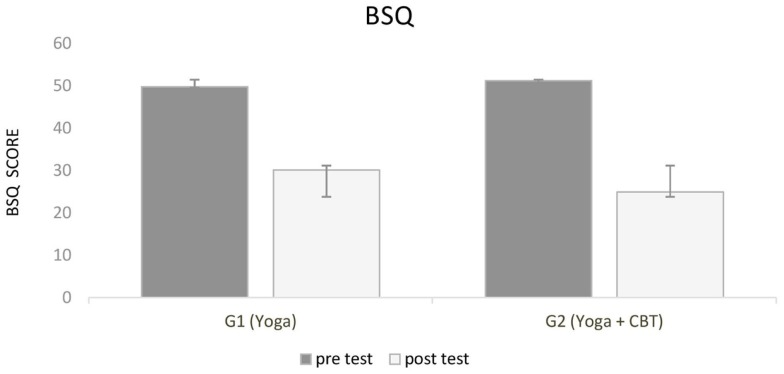
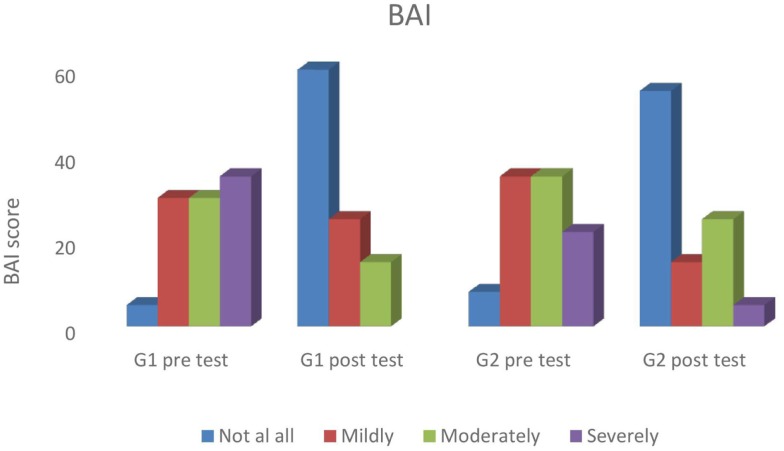
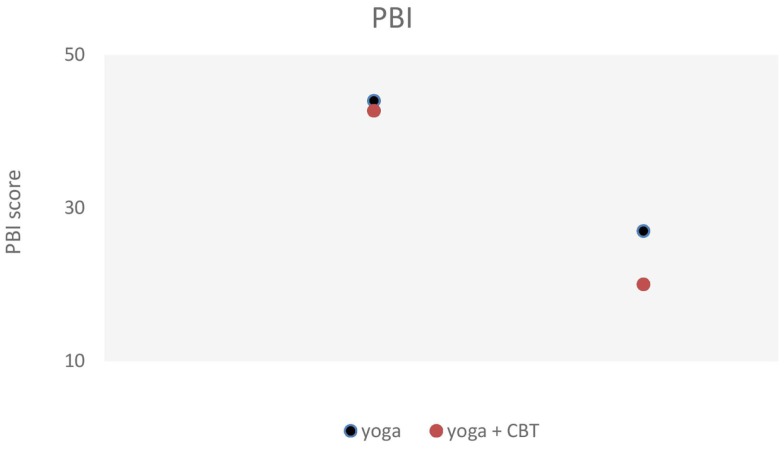
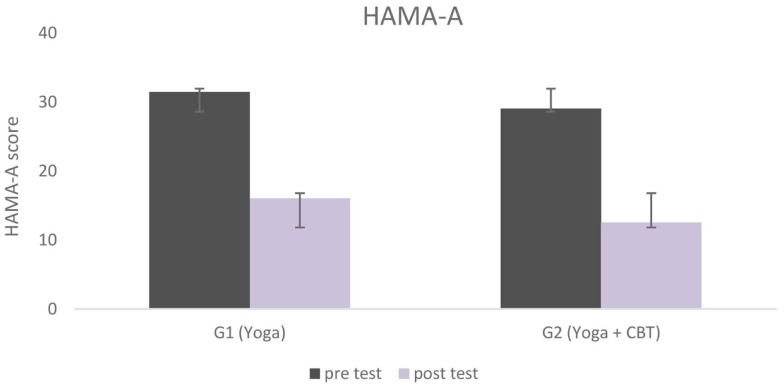
Statistical analysis showed significant reductions in anxiety levels associated with panic disorder (G1: BAI - p = 0.035, HAM-A - p = 0.000; G2: BAI - p = 0.002, HAM-A - p = 0.000), panic-related beliefs (G1: PBI - p = 0.000; G2: PBI - p = 0.000) and panic-related body sensations (G1: BSQ - p = 0.000; G2: BSQ - p = 0.000) both in G1 and G2. However, the combination of yoga and CBT (G2) showed even further reductions in all observed parameters (mean values).
This study observed significant improvement in panic symptomatology following both the practice of yoga and the combination of yoga and psychotherapy. While contemplative techniques such as yoga promote a general change in dealing with private events, CBT teaches how to modify irrational beliefs and specific cognitive distortions. The results observed in G2 might indicate that the techniques complemented each other, increasing the intervention efficacy. These findings are in agreement with many investigations found in the literature which observed improvements in different mental health parameters after the practice of contemplative techniques alone or combined to psychotherapy. Future research joining psychological and physiological variables could help better elucidate the mechanisms through which mind-body practices work to improve mental health.
瑜伽是一种身心结合的整体系统,可用于改善心理健康和身体健康。它已被证明可以减轻感知到的压力和焦虑,同时改善情绪和生活质量。过去几十年来,记录瑜伽治疗益处的研究不断增加,现在包括针对各种心理健康状况(如抑郁症、焦虑症和恐慌症)的对照试验。
本研究的主要目的是调查瑜伽对患有恐慌症的患者的影响。我们的目的是观察瑜伽技术对减轻恐慌症(焦虑和广场恐惧症)症状的疗效,与瑜伽和心理治疗相结合的干预措施相比。
选择了 20 名先前被诊断患有恐慌症的患者。患者被随机分配到两个实验组:第 1 组(G1-瑜伽:10 名患者)参加瑜伽课程,第 2 组(G2-CBT+瑜伽:10 名患者)参加瑜伽练习与认知行为疗法(CBT)相结合的干预措施。两种干预措施每周进行 100 分钟,持续 2 个月。在研究期间,患者进行了两次评估:前测和后测。心理计量工具包括贝克焦虑量表(BAI)、汉密尔顿焦虑量表(HAM-A)、恐慌症信念量表(PBI)和身体感觉问卷(BSQ)。
统计分析显示,与恐慌症相关的焦虑水平显著降低(G1:BAI-p=0.035,HAM-A-p=0.000;G2:BAI-p=0.002,HAM-A-p=0.000),恐慌相关信念(G1:PBI-p=0.000;G2:PBI-p=0.000)和恐慌相关身体感觉(G1:BSQ-p=0.000;G2:BSQ-p=0.000),G1 和 G2 均有改善。然而,瑜伽和 CBT 的结合(G2)显示出所有观察到的参数(平均值)进一步降低。
本研究观察到瑜伽练习和瑜伽与心理治疗相结合均可显著改善恐慌症状。虽然冥想技术,如瑜伽,促进了对私人事件的一般性处理方式的改变,但认知行为疗法教授如何改变非理性信念和特定的认知扭曲。G2 中观察到的结果可能表明,这些技术相互补充,增加了干预的效果。这些发现与文献中许多观察到的研究结果一致,即单独练习冥想技术或与心理治疗相结合可改善不同的心理健康参数。未来的研究将心理和生理变量结合起来,可以帮助更好地阐明身心实践改善心理健康的机制。