Department of Psychology, Center for Mind and Brain, University of California Davis, Davis, CA, USA.
Department of Psychology, Stony Brook University Stony Brook, NY, USA.
Front Psychol. 2014 Dec 4;5:1368. doi: 10.3389/fpsyg.2014.01368. eCollection 2014.
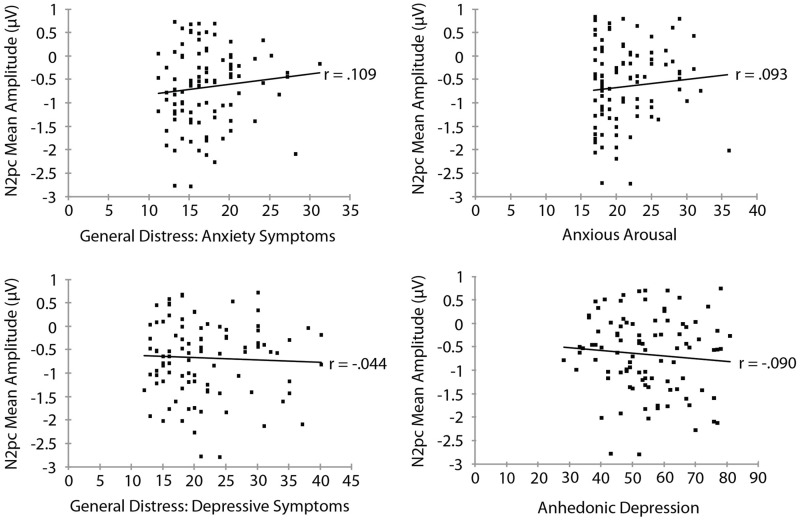
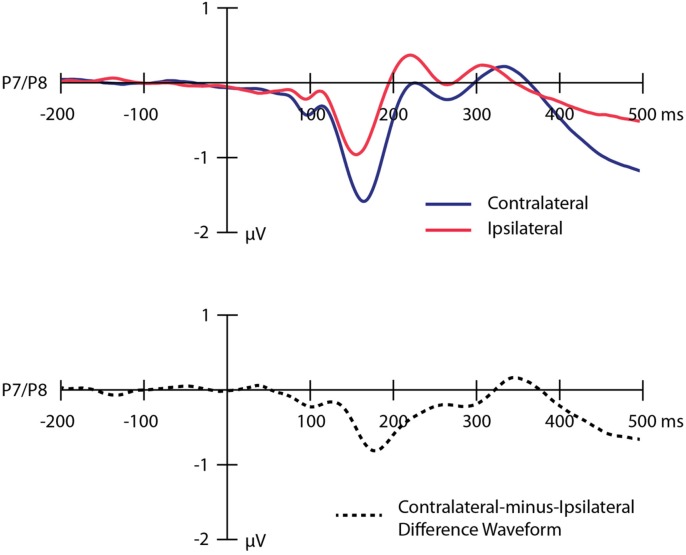
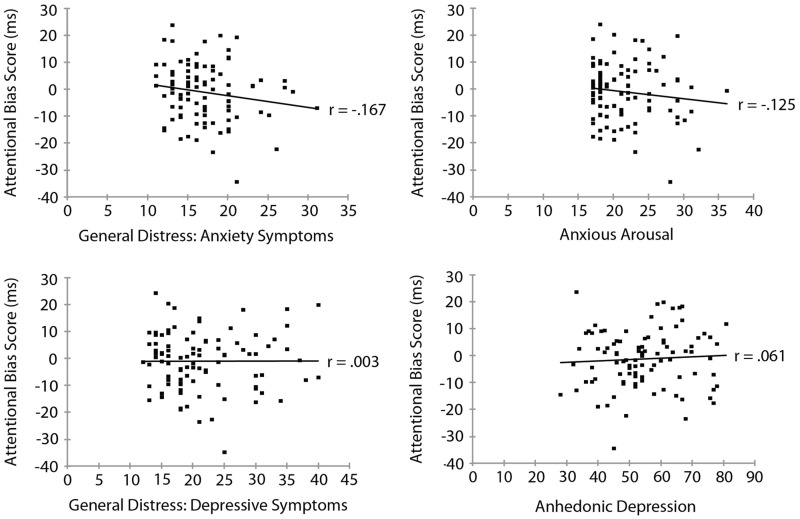
The dot-probe task is often considered a gold standard in the field for investigating attentional bias to threat. However, serious issues with the task have been raised. Specifically, a number of studies have demonstrated that the traditional reaction time (RT) measure of attentional bias to threat in the dot-probe task has poor internal reliability and poor test-retest reliability. In addition, although threatening stimuli capture attention in other paradigms, attentional bias to threat has not usually been found in typical research participants in the dot-probe task. However, when attention is measured in the dot-probe task with the N2pc component of the event-related potential waveform, substantial attentional orienting to threat is observed, and the internal reliability is moderate. To provide a rigorous comparison of the reliability of this N2pc measure and the conventional behavioral measure, as well as to examine the relationship of these measures to anxiety, the present study examined the N2pc in conjunction with RT in the dot-probe task in a large sample of participants (N = 96). As in previous studies, RT showed no bias to threatening images across the sample and exhibited poor internal reliability. Moreover, this measure did not relate to trait anxiety. By contrast, the N2pc revealed a significant initial shift of attention to threat, and this measure was internally reliable. However, the N2pc was not correlated with trait anxiety, indicating that it does not provide a meaningful index of individual differences in anxiety in the dot-probe task. Together, these results indicate a serious need to develop new tasks and methods to more reliably investigate attentional bias to threat and its relationship to anxiety in both clinical and non-clinical populations.
点探测任务通常被认为是研究威胁性注意偏向的领域中的黄金标准。然而,该任务已经出现了一些严重的问题。具体来说,许多研究表明,点探测任务中传统的威胁性注意偏向的反应时(RT)测量方法内部可靠性和重测信度都较差。此外,尽管在其他范式中威胁性刺激会引起注意,但在点探测任务中,典型的研究参与者通常不会表现出对威胁的注意偏向。然而,当使用事件相关电位波形的 N2pc 成分来测量点探测任务中的注意力时,会观察到对威胁的大量注意定向,并且内部可靠性适中。为了对点探测任务中 N2pc 测量和传统行为测量的可靠性进行严格比较,并研究这些测量方法与焦虑的关系,本研究在一个大样本的参与者中(N=96)结合 RT 对点探测任务中的 N2pc 进行了研究。与之前的研究一样,RT 没有表现出对整个样本中威胁性图像的偏向,并且内部可靠性较差。此外,该测量方法与特质焦虑无关。相比之下,N2pc 显示出对威胁的初始注意转移,并且该测量方法内部可靠。然而,N2pc 与特质焦虑无关,表明它不能为点探测任务中的焦虑个体差异提供有意义的指标。综上所述,这些结果表明,迫切需要开发新的任务和方法,以更可靠地研究威胁性注意偏向及其与焦虑之间的关系,无论是在临床还是非临床人群中。