Newton Michelle S, McLachlan Helen L, Willis Karen F, Forster Della A
School of Nursing and Midwifery, La Trobe University, Bundoora, VIC, 3086, Australia.
Judith Lumley Centre, La Trobe University, 215 Franklin St, Melbourne, VIC, 3000, Australia.
BMC Pregnancy Childbirth. 2014 Dec 24;14:426. doi: 10.1186/s12884-014-0426-7.
Caseload midwifery reduces childbirth interventions and increases women's satisfaction with care. It is therefore important to understand the impact of caseload midwifery on midwives working in and alongside the model. While some studies have reported higher satisfaction for caseload compared with standard care midwives, others have suggested a need to explore midwives' work-life balance as well as potential for stress and burnout. This study explored midwives' attitudes to their professional role, and also measured burnout in caseload midwives compared to standard care midwives at two sites in Victoria, Australia with newly introduced caseload midwifery models.
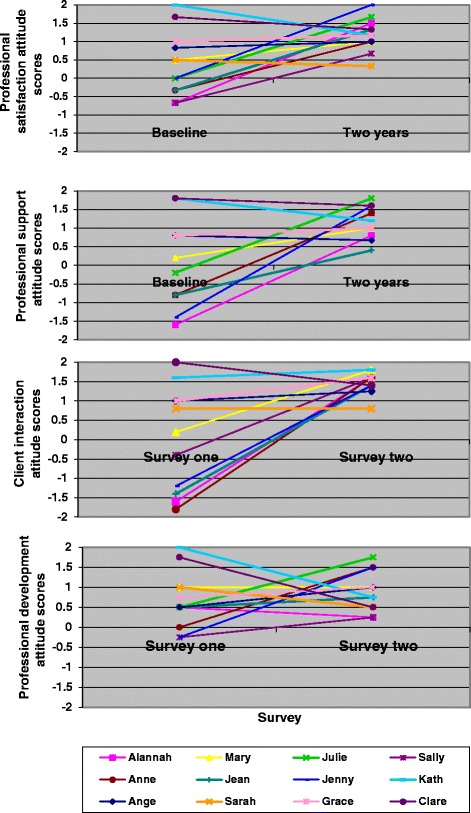
All midwives providing maternity care at the study sites were sent questionnaires at the commencement of the caseload midwifery model and two years later. Data items included the Midwifery Process Questionnaire (MPQ) to examine midwives' attitude to their professional role, the Copenhagen Burnout Inventory (CBI) to measure burnout, and questions about midwives' views of caseload work. Data were pooled for the two sites and comparisons made between caseload and standard care midwives. The MPQ and CBI data were summarised as individual and group means.
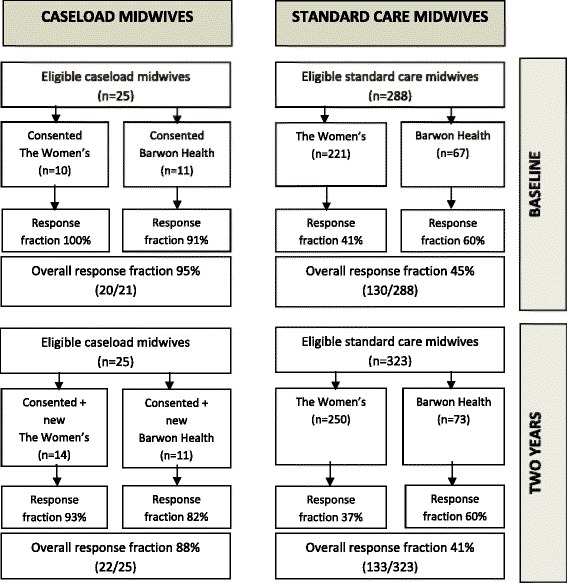
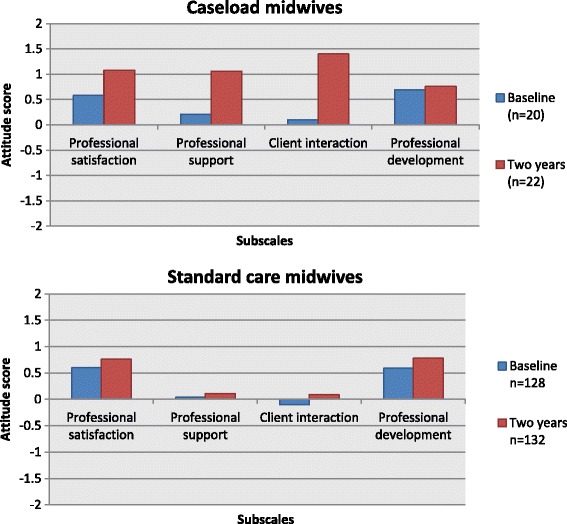
Twenty caseload midwives (88%) and 130 standard care midwives (41%) responded at baseline and 22 caseload midwives (95%) and 133 standard care midwives (45%) at two years. Caseload and standard care midwives were initially similar across all measures except client-related burnout, which was lower for caseload midwives (12.3 vs 22.4, p = 0.02). After two years, compared to midwives in standard care, caseload midwives had higher mean scores in professional satisfaction (1.08 vs 0.76, p = 0.01), professional support (1.06 vs 0.11, p <0.01) and client interaction (1.4 vs 0.09, p <0.01) and lower scores for personal burnout (35.7 vs 47.7, p < 0.01), work-related burnout (27.3 vs 42.7, p <0.01), and client-related burnout (11.3 vs 21.4, p < 0.01).
Caseload midwifery was associated with lower burnout scores and higher professional satisfaction. Further research should focus on understanding the key features of the caseload model that are related to these outcomes to help build a picture of what is required to ensure the long-term sustainability of the model.
个案管理助产模式可减少分娩干预措施,并提高女性对护理的满意度。因此,了解个案管理助产模式对在该模式下工作及与之协同工作的助产士的影响很重要。虽然一些研究报告称,与标准护理助产士相比,个案管理助产士的满意度更高,但也有其他研究表明,需要探讨助产士的工作与生活平衡以及压力和倦怠的可能性。本研究探讨了助产士对其职业角色的态度,并在澳大利亚维多利亚州的两个采用新引入的个案管理助产模式的地点,对个案管理助产士与标准护理助产士的倦怠情况进行了测量。
在个案管理助产模式开始时及两年后,向研究地点所有提供产科护理的助产士发送问卷。数据项包括用于检查助产士对其职业角色态度的助产过程问卷(MPQ)、用于测量倦怠的哥本哈根倦怠量表(CBI),以及关于助产士对个案管理工作看法的问题。将两个地点的数据汇总,并对个案管理助产士和标准护理助产士进行比较。MPQ和CBI数据以个体和组均值进行汇总。
基线时,20名个案管理助产士(88%)和130名标准护理助产士(41%)做出了回应,两年后,22名个案管理助产士(95%)和133名标准护理助产士(45%)做出了回应。除与客户相关的倦怠外,个案管理助产士和标准护理助产士在所有指标上最初相似,个案管理助产士的与客户相关的倦怠较低(12.3对22.4,p = 0.02)。两年后,与标准护理助产士相比,个案管理助产士在职业满意度(1.08对0.76,p = 0.01)、职业支持(1.06对0.11,p <0.01)和与客户互动(1.4对0.09,p <0.01)方面的平均得分更高,而在个人倦怠(35.7对47.7,p <0.01)、工作相关倦怠(27.3对42.7,p <0.01)和与客户相关的倦怠(11.3对21.4,p <0.01)方面的得分更低。
个案管理助产模式与较低的倦怠得分和较高的职业满意度相关。进一步的研究应侧重于了解与这些结果相关的个案管理模式的关键特征,以帮助勾勒出确保该模式长期可持续性所需的条件。