Wu Yong-Xiang, Zhu Guo-Xia, Liu Xin-Qin, Sun Fei, Zhou Ke, Wang Shuang, Wang Chun-Mei, Jia Jin-Wen, Song Jian-Tao, Lu Lian-Jun
Department of Otolaryngology, Head and Neck Surgery, Xijing Hospital, Fourth Military Medical University, Xi'an, Shaanxi, China.
Department of Otorhinolaryngology, Head and Neck Surgery, NO.474 Hospital of Chinese PLA, Urumchi, Xinjiang, China.
BMC Neurosci. 2014 Dec 24;15:136. doi: 10.1186/s12868-014-0136-0.
Noise exposure (NE) is a severe modern health hazard that induces hearing impairment. However, the noise-induced ultrastructural changes of blood-labyrinth barrier (BLB) and the potential involvements of tight junction proteins (TJP) remain inconclusive. We investigated the effects of NE on not only the ultrastructure of cochlea and permeability of BLB but also the expression of TJP within the guinea pig cochlea.
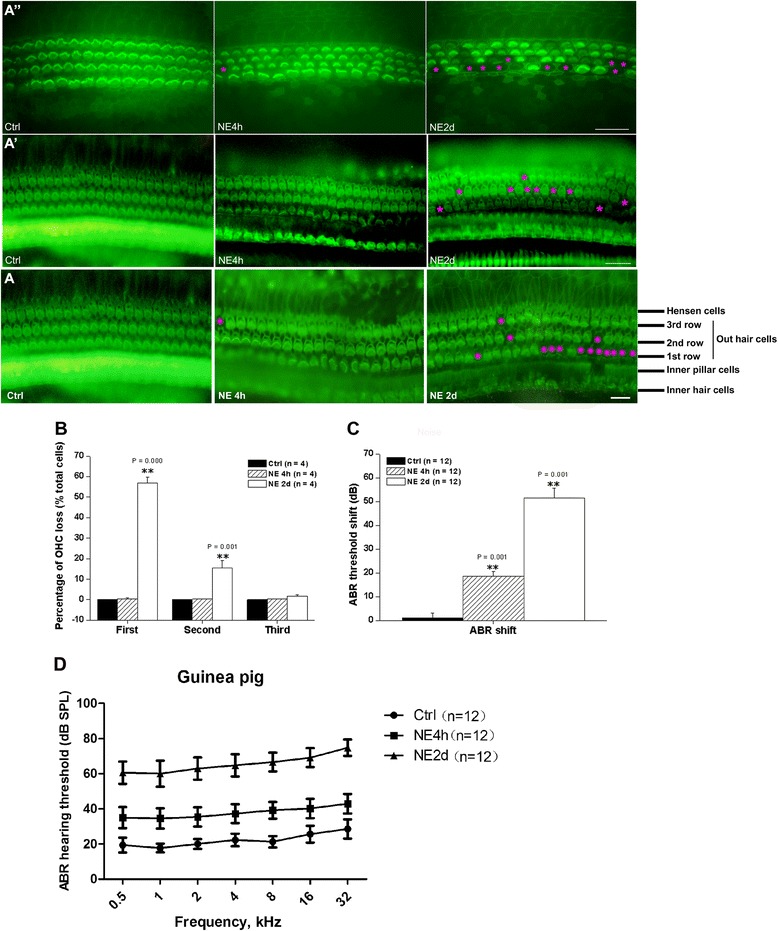
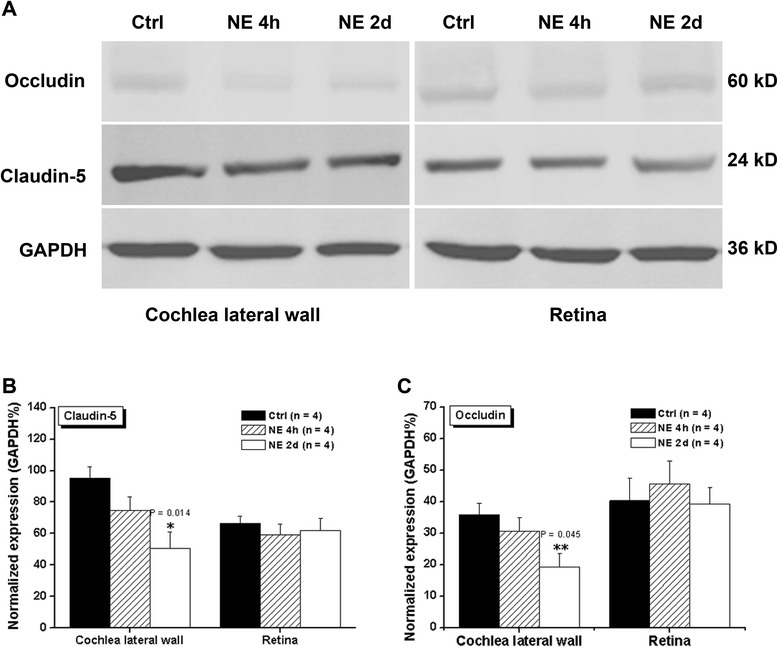
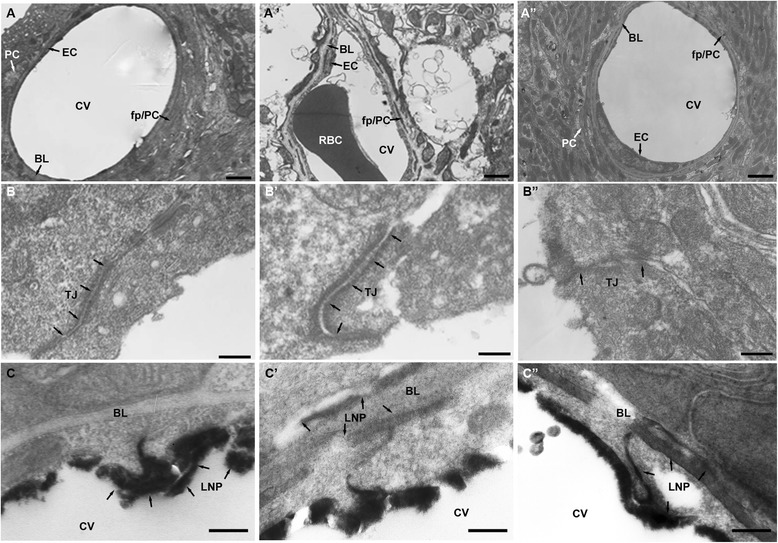
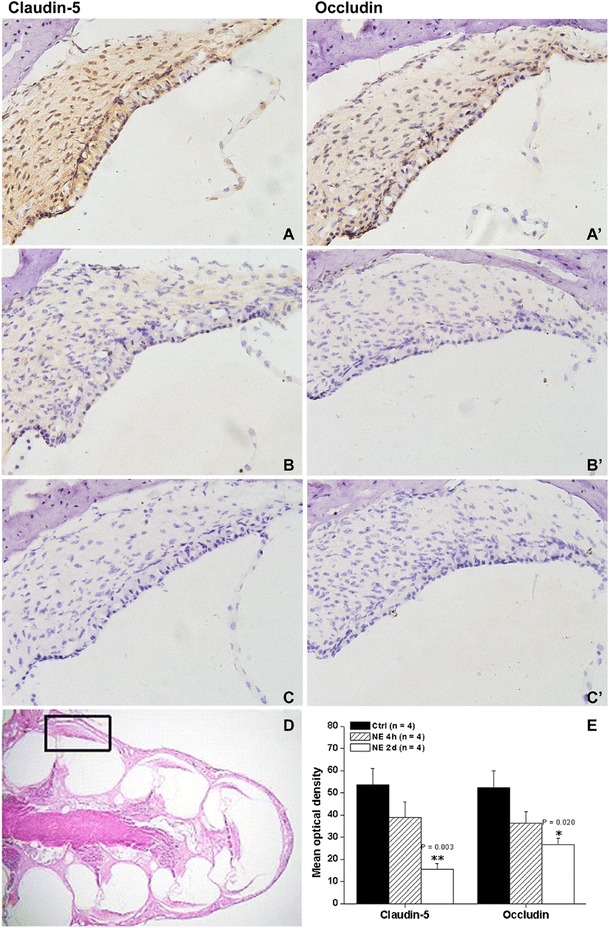
Male albino guinea pigs were exposed to white noise for 4 h or 2 consecutive days (115 dB sound pressure level, 6 hours per day) and the hearing impairments and light microscopic change of BLB were evaluated with auditory brainstem responses (ABR) and the cochlear sensory epithelia surface preparation, respectively. The cochlear ultrastructure and BLB permeability after NE 2d were revealed with transmission electron microscope (TEM) and lanthanum nitrate-tracing techniques, respectively. The potential alterations of TJPs Claudin-5 and Occludin were quantified with immunohistochemistry and western blot. NE induced significant hearing impairment and NE 2d contributed to significant outer hair cell (OHC) loss that is most severe in the first row of outer hair cells. Furthermore, the loosen TJ and an obvious leakage of lanthanum nitrate particles beneath the basal lamina were revealed with TEM. Moreover, a dose-dependent decrease of Claudin-5 and Occludin was observed in the cochlea after NE.
All these findings suggest that both decrease of Claudin-5 and Occludin and increased BLB permeability are involved in the pathologic process of noise-induced hearing impairment; however, the causal relationship and underlying mechanisms should be further investigated.
噪声暴露(NE)是一种严重的现代健康危害因素,可导致听力损伤。然而,噪声引起的血迷路屏障(BLB)超微结构变化以及紧密连接蛋白(TJP)的潜在作用仍不明确。我们研究了NE对豚鼠耳蜗超微结构、BLB通透性以及TJP表达的影响。
雄性白化豚鼠暴露于白噪声4小时或连续2天(声压级115分贝,每天6小时),分别通过听性脑干反应(ABR)和耳蜗感觉上皮表面制备评估听力损伤和BLB的光镜变化。分别用透射电子显微镜(TEM)和硝酸镧示踪技术揭示NE 2天后的耳蜗超微结构和BLB通透性。用免疫组织化学和蛋白质印迹法定量检测紧密连接蛋白Claudin-5和闭合蛋白的潜在变化。NE导致明显的听力损伤,NE 2天导致显著的外毛细胞(OHC)丢失,在外毛细胞第一排最为严重。此外,TEM显示紧密连接松散,基膜下硝酸镧颗粒明显渗漏。而且,NE后耳蜗中Claudin-5和闭合蛋白呈剂量依赖性降低。
所有这些发现表明,Claudin-5和闭合蛋白的减少以及BLB通透性增加均参与了噪声性听力损伤的病理过程;然而,因果关系和潜在机制仍需进一步研究。