Djaja Ngadiman, Youl Pip, Aitken Joanne, Janda Monika
School of Public Health, Queensland University of Technology, Brisbane, QLD, Australia.
National Health and Medical Research Council Centre for Research Excellence in Sun and Health, Institute of Health and Biomedical Innovation, Queensland University of Technology, Brisbane, Australia.
Health Qual Life Outcomes. 2014 Dec 24;12:189. doi: 10.1186/s12955-014-0189-x.
The Skin Self-Examination Attitude Scale (SSEAS) is a brief measure that allows for the assessment of attitudes in relation to skin self-examination. This study evaluated the psychometric properties of the SSEAS using Item Response Theory (IRT) methods in a large sample of men ≥ 50 years in Queensland, Australia.
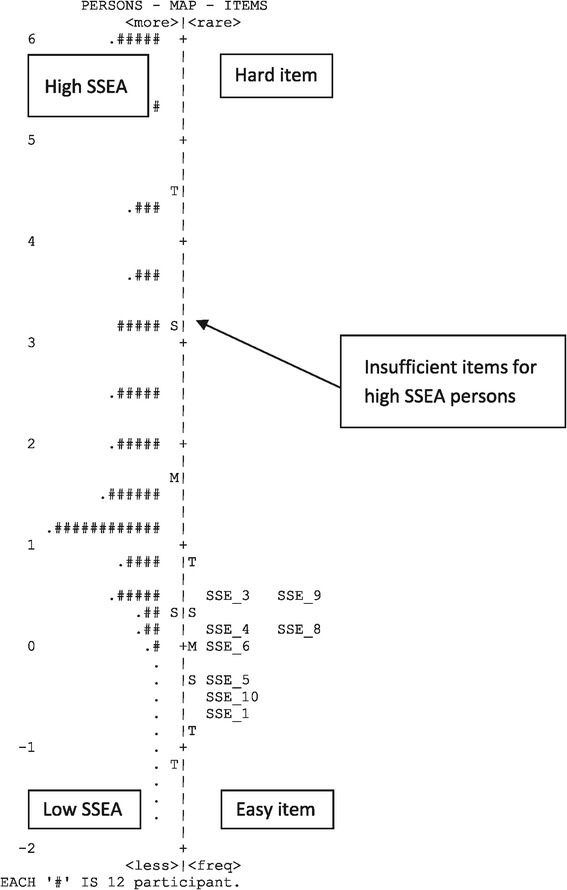
A sample of 831 men (420 intervention and 411 control) completed a telephone assessment at the 13-month follow-up of a randomized-controlled trial of a video-based intervention to improve skin self-examination (SSE) behaviour. Descriptive statistics (mean, standard deviation, item-total correlations, and Cronbach's alpha) were compiled and difficulty parameters were computed with Winsteps using the polytomous Rasch Rating Scale Model (RRSM). An item person (Wright) map of the SSEAS was examined for content coverage and item targeting.
The SSEAS have good psychometric properties including good internal consistency (Cronbach's alpha = 0.80), fit with the model and no evidence for differential item functioning (DIF) due to experimental trial grouping was detected.
The present study confirms the SSEA scale as a brief, useful and reliable tool for assessing attitudes towards skin self-examination in a population of men 50 years or older in Queensland, Australia. The 8-item scale shows unidimensionality, allowing levels of SSE attitude, and the item difficulties, to be ranked on a single continuous scale. In terms of clinical practice, it is very important to assess skin cancer self-examination attitude to identify people who may need a more extensive intervention to allow early detection of skin cancer.
皮肤自我检查态度量表(SSEAS)是一种简短的测量工具,可用于评估与皮肤自我检查相关的态度。本研究采用项目反应理论(IRT)方法,在澳大利亚昆士兰州的一个由年龄≥50岁男性组成的大样本中,评估了SSEAS的心理测量特性。
831名男性(420名干预组和411名对照组)参与了一项基于视频的干预措施以改善皮肤自我检查(SSE)行为的随机对照试验,并在13个月的随访时完成了电话评估。编制了描述性统计数据(均值、标准差、项目与总分的相关性以及克朗巴哈系数),并使用Winsteps软件通过多分类Rasch评分量表模型(RRSM)计算难度参数。检查了SSEAS的项目-人员(赖特)图,以了解内容覆盖范围和项目针对性。
SSEAS具有良好的心理测量特性,包括良好的内部一致性(克朗巴哈系数=0.80),与模型拟合良好,且未检测到因试验分组导致的项目功能差异(DIF)。
本研究证实SSEA量表是一种简短、有用且可靠的工具,可用于评估澳大利亚昆士兰州50岁及以上男性群体对皮肤自我检查的态度。这个包含8个条目的量表显示出单维性,能够在单一连续量表上对SSE态度水平和项目难度进行排序。在临床实践中,评估皮肤癌自我检查态度对于识别可能需要更广泛干预以实现皮肤癌早期检测的人群非常重要。