Thomas Rae, Glasziou Paul, Rychetnik Lucie, Mackenzie Geraldine, Gardiner Robert, Doust Jenny
Faculty of Health Sciences and Medicine, Centre for Research in Evidence-Based Practice (CREBP), Bond University, Gold Coast, Queensland, Australia.
School of Medicine, University of Notre Dame, Sydney, New South Wales, Australia School of Public Health, University of Sydney, Sydney, New South Wales, Australia.
BMJ Open. 2014 Dec 24;4(12):e005691. doi: 10.1136/bmjopen-2014-005691.
Prostate-specific antigen (PSA) screening is controversial. A community jury allows presentation of complex information and may clarify how participants view screening after being well-informed. We examined whether participating in a community jury had an effect on men's knowledge about and their intention to participate in PSA screening.
Random allocation to either a 2-day community jury or a control group, with preassessment, postassessment and 3-month follow-up assessment.
Participants from the Gold Coast (Australia) recruited via radio, newspaper and community meetings.
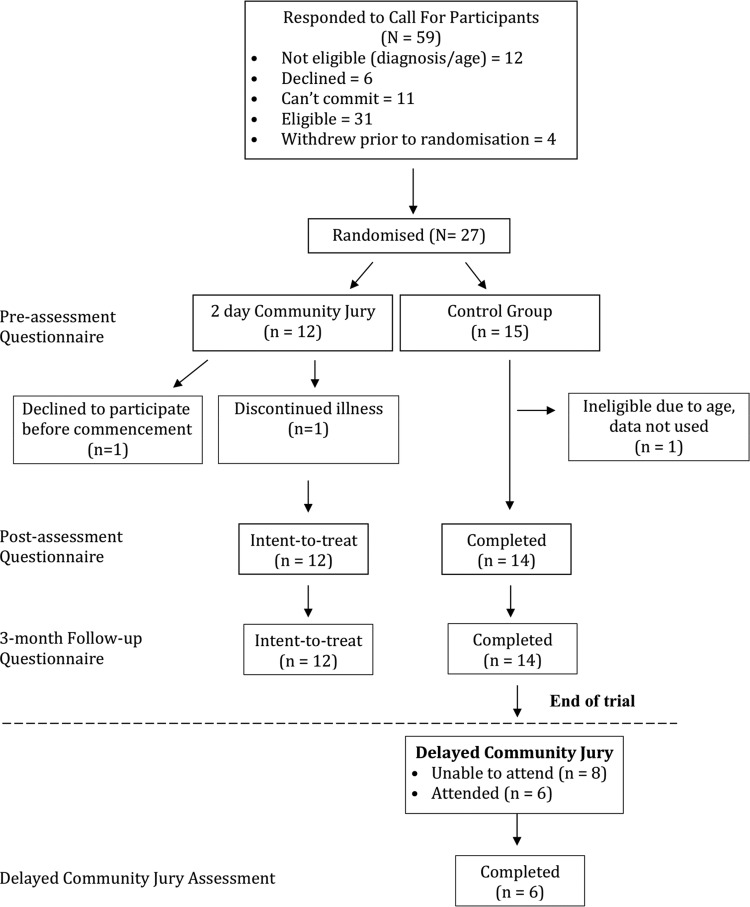
Twenty-six men aged 50-70 years with no previous diagnosis of prostate cancer.
The control group (n=14) received factsheets on PSA screening. Community jury participants (n=12) received the same factsheets and further information about screening for prostate cancer. In addition, three experts presented information on PSA screening: a neutral scientific advisor provided background information, one expert emphasised the potential benefits of screening and another expert emphasised the potential harms. Participants discussed information, asked questions to the experts and deliberated on personal and policy decisions.
Our primary outcome was change in individual intention to have a PSA screening test. We also assessed knowledge about screening for prostate cancer.
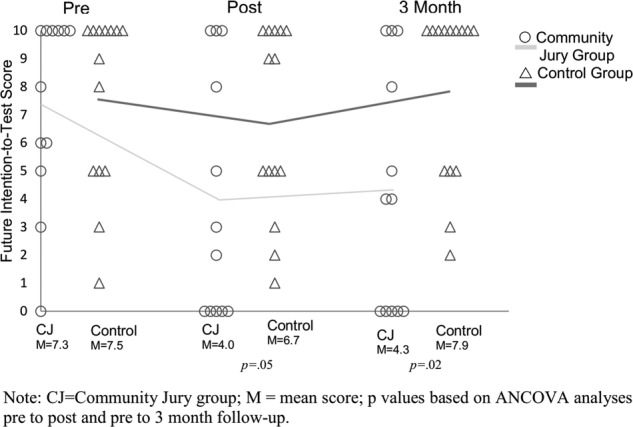
Analyses were conducted using intention-to-treat. Immediately after the jury, the community jury group had less intention-to-screen for prostate cancer than men in the control group (effect size=-0.6 SD, p=0.05). This was sustained at 3-month follow-up. Community jury men also correctly identified PSA test accuracy and considered themselves more informed (effect size=1.2 SD, p<0.001).
Evidence-informed deliberation of the harms and benefits of PSA screening effects men's individual choice to be screened for prostate cancer. Community juries may be a valid method for eliciting target group input to policy decisions.
Australian and New Zealand Clinical Trials Registry (ACTRN12612001079831).
前列腺特异性抗原(PSA)筛查存在争议。社区陪审团能够呈现复杂信息,或许可以阐明参与者在充分了解情况后对筛查的看法。我们研究了参与社区陪审团是否会对男性关于PSA筛查的知识以及他们参与筛查的意愿产生影响。
随机分配至为期2天的社区陪审团或对照组,进行预评估、后评估以及3个月的随访评估。
通过广播、报纸和社区会议从澳大利亚黄金海岸招募参与者。
26名年龄在50 - 70岁且既往未诊断出前列腺癌的男性。
对照组(n = 14)收到关于PSA筛查的情况说明书。社区陪审团参与者(n = 12)收到相同的情况说明书以及关于前列腺癌筛查的更多信息。此外,三位专家介绍了PSA筛查的信息:一位中立的科学顾问提供背景信息,一位专家强调筛查的潜在益处,另一位专家强调潜在危害。参与者讨论信息、向专家提问并就个人和政策决策进行审议。
我们的主要结局是个体进行PSA筛查测试意愿的变化。我们还评估了关于前列腺癌筛查的知识。
采用意向性分析。在陪审团结束后即刻,社区陪审团组进行前列腺癌筛查的意愿低于对照组男性(效应量 = -0.6标准差,p = 0.05)。这在3个月随访时持续存在。社区陪审团组的男性也能正确识别PSA检测的准确性,并认为自己了解得更多(效应量 = 1.2标准差,p < 0.001)。
基于证据对PSA筛查的利弊进行审议会影响男性个体进行前列腺癌筛查的选择。社区陪审团可能是一种有效的方法,可用于获取目标群体对政策决策的意见。
澳大利亚和新西兰临床试验注册中心(ACTRN12612001079831)