State Key Laboratory of Earth Surface Processes and Resource Ecology & College of Life Sciences, Beijing Normal University Beijing, 100875, China.
Ecol Evol. 2014 Nov;4(22):4332-45. doi: 10.1002/ece3.1278. Epub 2014 Oct 27.
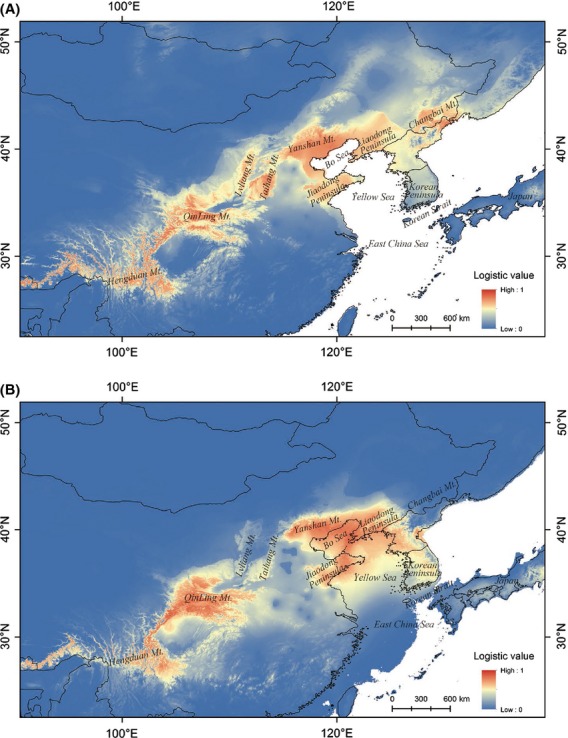
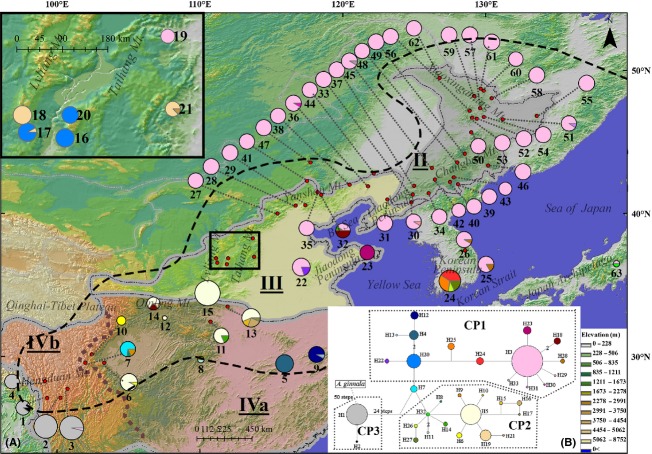
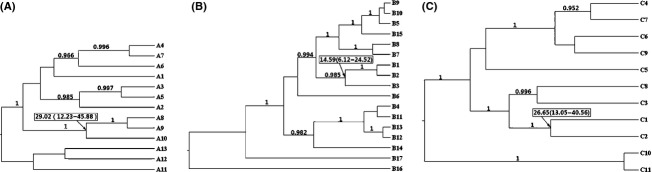
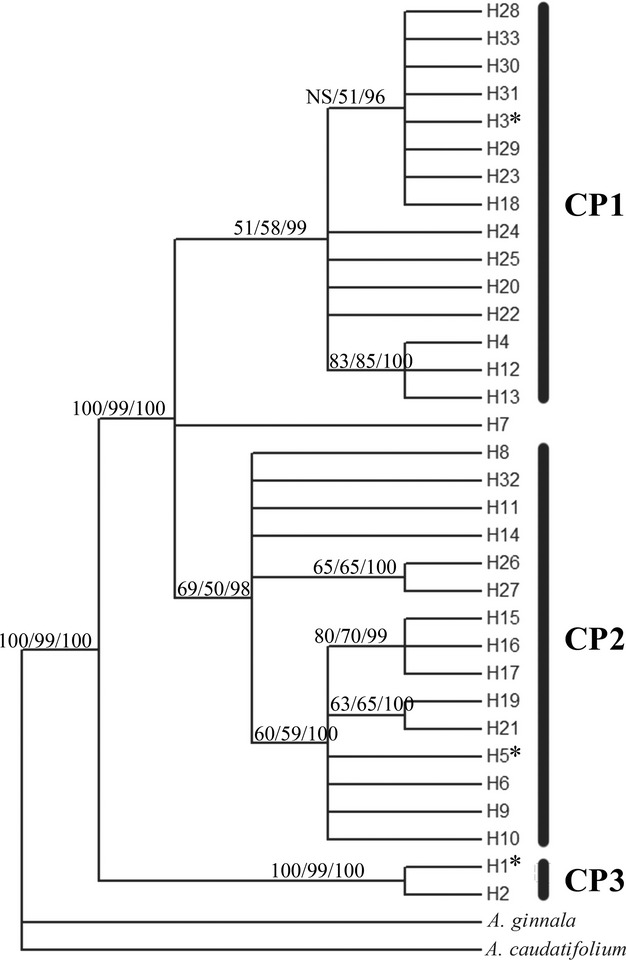
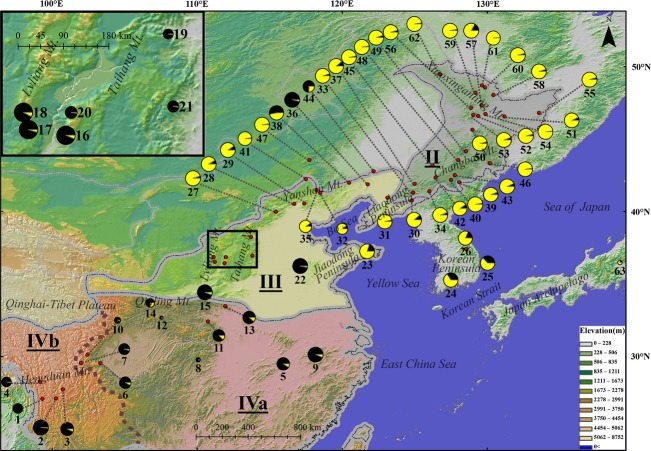
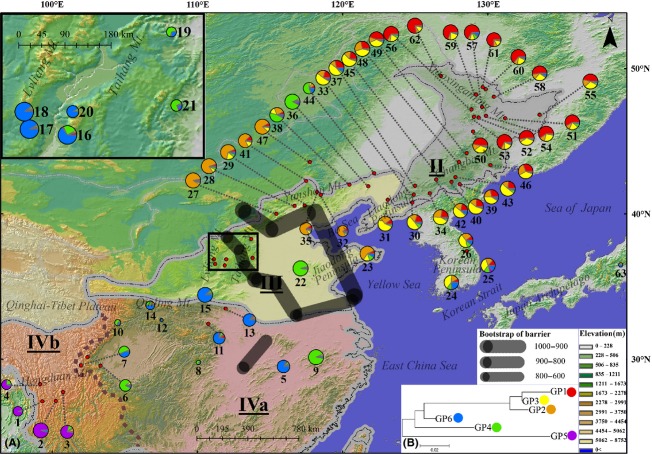
East Asia has the most diverse temperate flora in the world primarily due to the lack of Pleistocene glaciation and the geographic heterogeneity. Although increasing phylogeography studies in this region provided more proofs in this issue, discrepancies and uncertainty still exist, especially in northern temperate deciduous broad-leaved and coniferous mixed forest region (II). And a widespread plant species could reduce the complexity to infer the relationship between diversity and physiographical pattern. Hence, we studied the evolution history of a widespread temperate tree, Acer mono, populations in region II and the influence of physiographic patterns on intraspecific genetic diversity. Analyses of chloroplast sequences and nuclear microsatellites indicated high levels of genetic diversity. The diversity distribution was spatially heterogeneous and a latitudinal cline existed in both markers. The spatial distribution pattern between genetic diversity within A. mono and the diversity at species level was generally consistent. Western subtropical evergreen broad-leaved forest subregion (IVb) had a unique ancient chloroplast clade (CP3) and a nuclear gene pool (GP5) with dominance indicating the critical role of this area in species diversification. Genetic data and ecological niche model results both suggested that populations in region II disappeared during the last glacial maximum (LGM) and recovered from south of Changbai Mt. and the Korean Peninsula. Two distribution centers were likely during the LGM, one in the north edge of warm temperate deciduous broad-leaved forest region (III) and another in the south edge of region III. This was reflected by the genetic pattern with two spatially independent genetic groups. This study highlights the key role of region III in sustaining genetic diversity in the northern range and connecting diversity between southern and northern range. We elucidated the diversity relationship between vegetation regions which could facilitate the understanding of biodiversity origin and maintenance in East Asia.
东亚拥有世界上最多样化的温带植物区系,主要是由于缺乏更新世冰川作用和地理异质性。尽管该地区越来越多的系统地理学研究为此问题提供了更多证据,但仍存在差异和不确定性,尤其是在北温带落叶阔叶林和针叶林混交林区域(II)。而广泛分布的植物物种可以降低推断多样性与地理形态模式之间关系的复杂性。因此,我们研究了分布广泛的温带树种 Acer mono 种群在区域 II 的进化历史以及地理形态模式对种内遗传多样性的影响。叶绿体序列和核微卫星分析表明其具有高水平的遗传多样性。多样性的分布存在空间异质性,两种标记均存在纬度梯度。A. mono 内遗传多样性与物种水平多样性之间的空间分布模式基本一致。亚热带常绿阔叶林亚区域(IVb)具有独特的古老叶绿体分支(CP3)和核基因库(GP5),优势明显,表明该地区在物种多样化过程中发挥了关键作用。遗传数据和生态位模型结果均表明,区域 II 中的种群在末次冰盛期(LGM)期间消失,并从长白山和朝鲜半岛南部恢复。LGM 期间可能存在两个分布中心,一个在暖温带落叶阔叶林区域(III)北缘,另一个在区域 III 南缘。这反映在遗传模式中,存在两个空间独立的遗传群体。本研究强调了区域 III 在维持北部地区遗传多样性以及连接南部和北部地区多样性方面的关键作用。我们阐明了植被区域之间的多样性关系,这有助于理解东亚生物多样性的起源和维持。