Mu Xian-Yun, Wu Yuan-Mi, Shen Xue-Li, Tong Ling, Lei Feng-Wei, Xia Xiao-Fei, Ning Yu
Laboratory of Systematic Evolution and Biogeography of Woody Plants, School of Ecology and Nature Conservation, Beijing Forestry University, Beijing, China.
Beijing Museum of Natural History, Beijing, China.
Front Plant Sci. 2022 May 9;13:832559. doi: 10.3389/fpls.2022.832559. eCollection 2022.
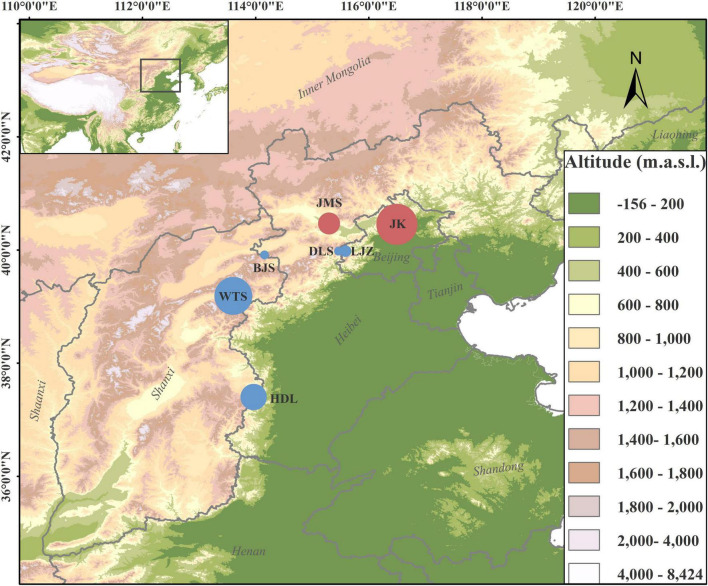
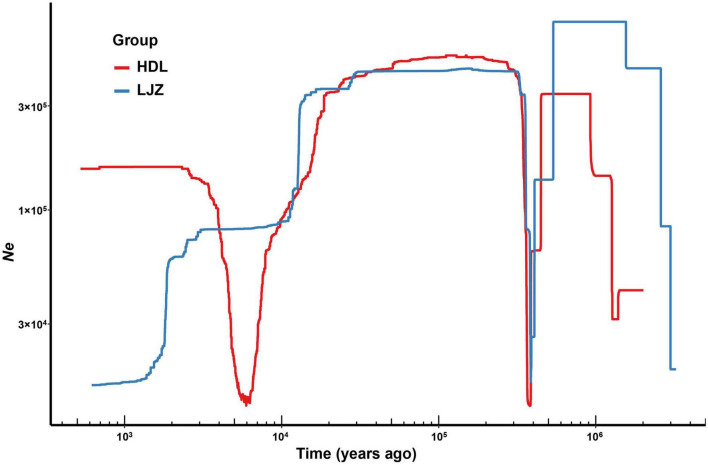
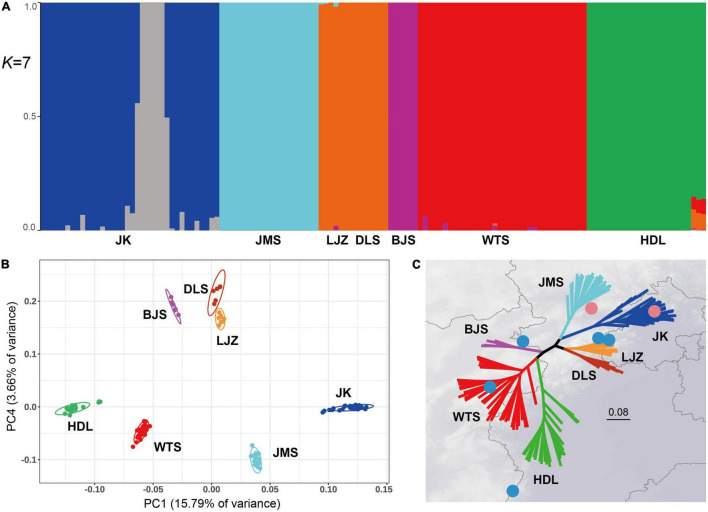
Characterizing genetic diversity and structure and identifying conservation units are both crucial for the conservation and management of threatened species. The development of high-throughput sequencing technology provides exciting opportunities for conservation genetics. Here, we employed the powerful SuperGBS method to identify 33, 758 high-quality single-nucleotide polymorphisms (SNP) from 134 individuals of a critically endangered montane shrub endemic to North China, . A low level of genetic diversity and a high degree of genetic differentiation among populations were observed based on the SNP data. Both principal component and phylogenetic analyses detected seven clusters, which correspond exactly to the seven geographic populations. Under the optimal = 7, Admixture suggested the combination of the two small and geographically neighboring populations in the Taihang Mountains, Dongling Mountains, and Lijiazhuang, while the division of the big population of Jiankou Great Wall in the Yan Mountains into two clusters. High population genetic diversity and a large number of private alleles were detected in the four large populations, while low diversity and non-private alleles were observed for the remaining three small populations, implying the importance of these large populations as conservation units in priority. Demographic history inference suggested two drastic contractions of population size events that occurred after the Middle Pleistocene Transition and the Last Glacial Maximum, respectively. Combining our previous ecological niche modeling results with the present genomic data, there was a possible presence of glacial refugia in the Taihang and Yan Mountains, North China. This study provides valuable data for the conservation and management of and broadens the understanding of the high biodiversity in the Taihang and Yan Mountains.
表征遗传多样性和结构以及识别保护单元对于濒危物种的保护和管理都至关重要。高通量测序技术的发展为保护遗传学提供了令人兴奋的机遇。在此,我们采用强大的简化基因组测序方法,从中国北方特有的一种极度濒危山地灌木的134个个体中鉴定出33758个高质量单核苷酸多态性(SNP)。基于SNP数据,观察到种群间遗传多样性水平较低且遗传分化程度较高。主成分分析和系统发育分析均检测到七个聚类,这与七个地理种群完全对应。在最优K = 7时,混合分析表明太行山、东灵山和李家庄两个地理上相邻的小种群合并,而燕山的箭扣长城大种群被分为两个聚类。在四个大种群中检测到高种群遗传多样性和大量私有等位基因,而其余三个小种群则观察到低多样性和非私有等位基因,这意味着这些大种群作为优先保护单元的重要性。种群历史推断表明,分别在中更新世过渡和末次盛冰期之后发生了两次种群大小的急剧收缩事件。将我们之前的生态位建模结果与当前的基因组数据相结合,中国北方的太行山和燕山可能存在冰川避难所。本研究为该物种的保护和管理提供了有价值的数据,并拓宽了对太行山和燕山高生物多样性的理解。