Speziale Pietro, Pietrocola Giampiero, Foster Timothy J, Geoghegan Joan A
Department of Molecular Medicine, Unit of Biochemistry, University of Pavia Pavia, Italy.
Department of Microbiology, Moyne Institute of Preventive Medicine, Trinity College Dublin Dublin, Ireland.
Front Cell Infect Microbiol. 2014 Dec 10;4:171. doi: 10.3389/fcimb.2014.00171. eCollection 2014.
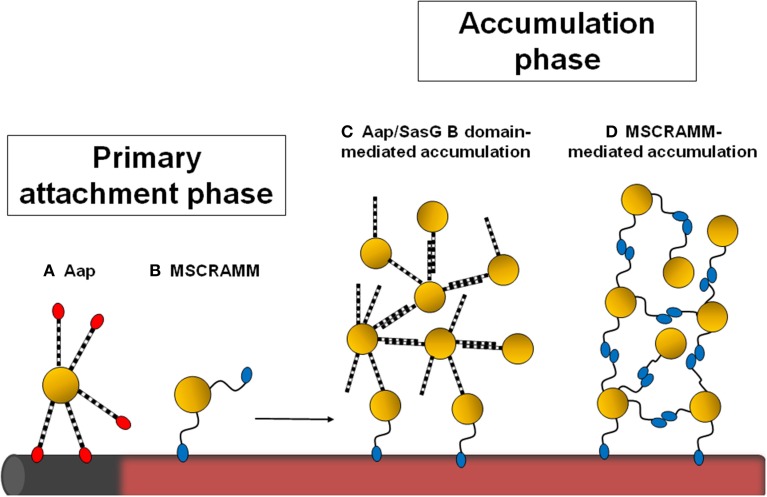
Staphylococcus aureus and Staphylococcus epidermidis are the most important etiological agents of biofilm associated-infections on indwelling medical devices. Biofilm infections may also develop independently of indwelling devices, e.g., in native valve endocarditis, bone tissue, and open wounds. After attachment to tissue or indwelling medical devices that have been conditioned with host plasma proteins, staphylococcal biofilms grow, and produce a specific environment which provides the conditions for cell-cell interaction and formation of multicellular communities. Bacteria living in biofilms express a variety of macromolecules, including exopolysaccharides, proteins, extracellular eDNA, and other polymers. The S. aureus surface protein C and G (SasC and SasG), clumping factor B (ClfB), serine aspartate repeat protein (SdrC), the biofilm-associated protein (Bap), and the fibronectin/fibrinogen-binding proteins (FnBPA and FnBPB) are individually implicated in biofilm matrix formation. In S. epidermidis, a protein named accumulation-associated protein (Aap) contributes to both the primary attachment phase and the establishment of intercellular connections by forming fibrils on the cell surface. In S. epidermidis, proteinaceous biofilm formation can also be mediated by the extracellular matrix binding protein (Embp) and S. epidermidis surface protein C (SesC). Additionally, multifunctional proteins such as extracellular adherence protein (Eap) and extracellular matrix protein binding protein (Emp) of S. aureus and the iron-regulated surface determinant protein C (IsdC) of S. lugdunensis can promote biofilm formation in iron-depleted conditions. This multitude of proteins intervene at different stages of biofilm formation with certain proteins contributing to biofilm accumulation and others mediating primary attachment to surfaces. This review examines the contribution of proteins to biofilm formation in Staphylococci. The potential to develop vaccines to prevent protein-dependent biofilm formation during staphylococcal infection is discussed.
金黄色葡萄球菌和表皮葡萄球菌是留置医疗器械上生物膜相关感染的最重要病原体。生物膜感染也可能在没有留置器械的情况下发生,例如在自体瓣膜心内膜炎、骨组织和开放性伤口中。在附着于已被宿主血浆蛋白调理过的组织或留置医疗器械后,葡萄球菌生物膜开始生长,并产生一个特定环境,为细胞间相互作用和多细胞群落的形成提供条件。生活在生物膜中的细菌会表达多种大分子,包括胞外多糖、蛋白质、细胞外eDNA和其他聚合物。金黄色葡萄球菌表面蛋白C和G(SasC和SasG)、凝聚因子B(ClfB)、丝氨酸天冬氨酸重复蛋白(SdrC)、生物膜相关蛋白(Bap)以及纤连蛋白/纤维蛋白原结合蛋白(FnBPA和FnBPB)各自参与生物膜基质的形成。在表皮葡萄球菌中,一种名为聚集相关蛋白(Aap)的蛋白质通过在细胞表面形成纤维,对初始附着阶段和细胞间连接的建立都有作用。在表皮葡萄球菌中,蛋白质性生物膜的形成也可由细胞外基质结合蛋白(Embp)和表皮葡萄球菌表面蛋白C(SesC)介导。此外,多功能蛋白,如金黄色葡萄球菌的细胞外黏附蛋白(Eap)和细胞外基质蛋白结合蛋白(Emp)以及路邓葡萄球菌的铁调节表面决定簇蛋白C(IsdC),可在缺铁条件下促进生物膜形成。众多此类蛋白质在生物膜形成的不同阶段发挥作用,某些蛋白质有助于生物膜的积累,而其他蛋白质则介导对表面的初始附着。本综述探讨了蛋白质对葡萄球菌生物膜形成的作用。还讨论了开发疫苗以预防葡萄球菌感染期间依赖蛋白质的生物膜形成的潜力。