Zhou Qiangyong, Chen Haiyan, Yang Simeng, Li Yuehua, Wang Binqiao, Chen Yuanyuan, Wu Xueqing
Department of Obstetrics and Gynecology, The First Affiliated Hospital of Wenzhou Medical University, Wenzhou, Zhejiang, China.
Reprod Biol Endocrinol. 2014 Dec 26;12:127. doi: 10.1186/1477-7827-12-127.
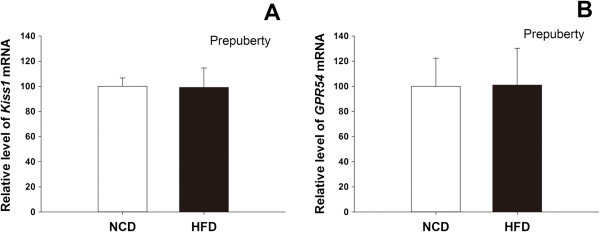
Female reproductive health is noticeably compromised by obesity. The underlying mechanisms remain to be elucidated. Accumulating evidence indicates that the expression level of ovarian Kiss1 peaks in the afternoon during prooestrus, suggesting local regulatory roles for Kiss1 in the ovulatory process. We used a diet-induced model of obesity to evaluate whether the ovarian Kiss1 system is affected by obesity, and, to investigate the association of the Kiss1 system with ovulatory disorders in female rats.
Post-weaning, female, Sprague-Dawley rats were randomly fed either a high-fat diet (HFD) or a normal chow diet (NCD) until they reached postnatal day 30 (PND 30), PND 42, or PND 70. The timing of vaginal opening was recorded, and oestrous cyclicity was monitored for 2 consecutive weeks immediately post puberty and again at 8-9 weeks of age. Tissues from the left ovary were collected for determination of the levels of Kiss1 and G protein-coupled receptor 54 (GPR54) mRNA, and tissues from the right ovary were collected for assessment of the immunoreactivity (IR) of the corresponding protein products, kisspeptin and GPR54.
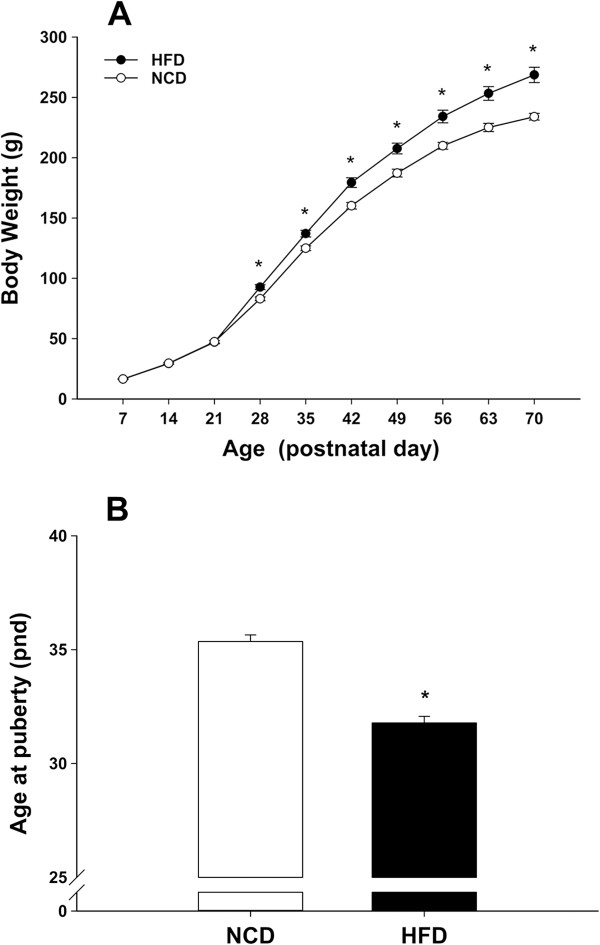
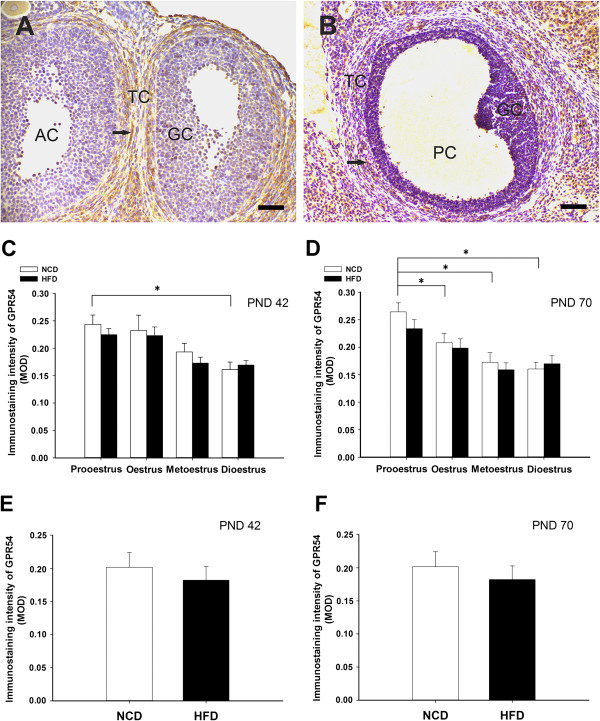
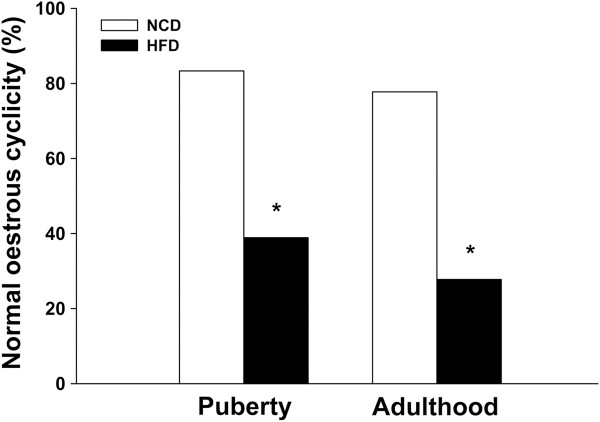
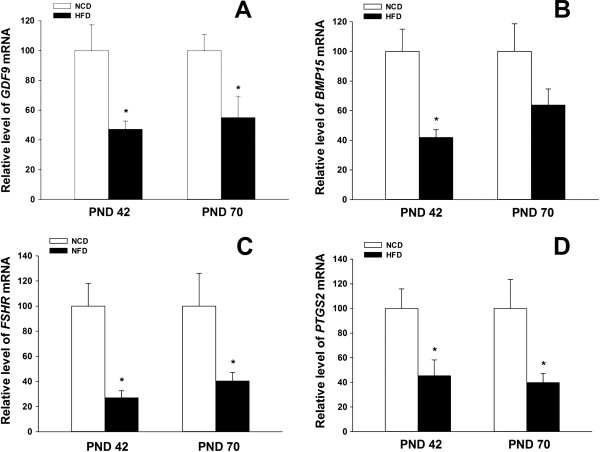
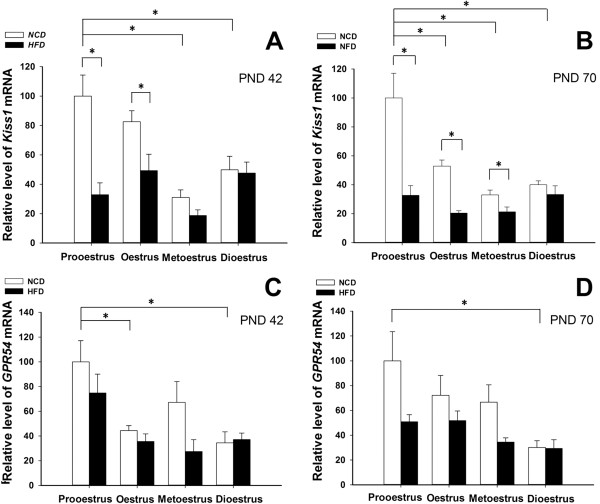
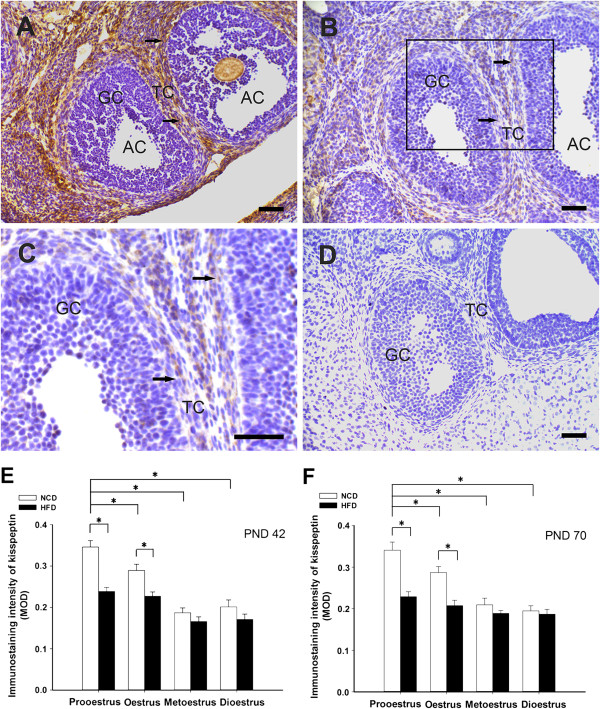
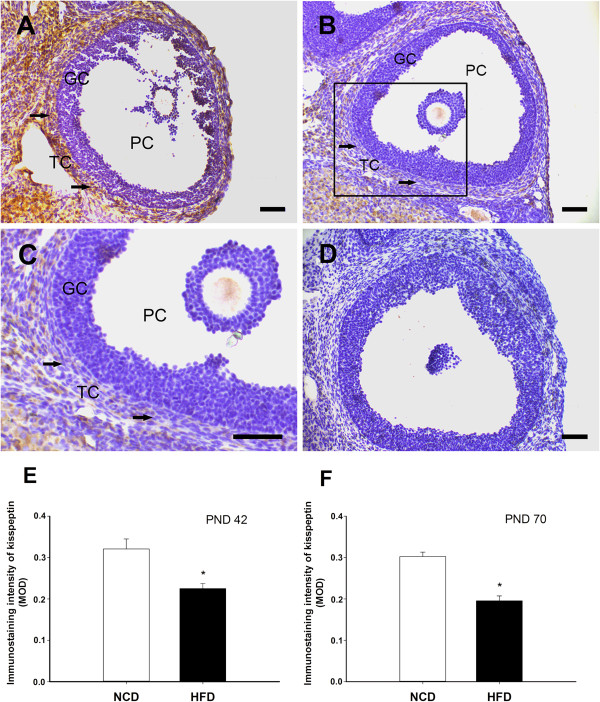
The high-fat diet resulted in a significantly higher body weight and an earlier puberty onset. Oestrous cyclicity was disrupted by the HFD with significant reductions in the expression of ovulation-related genes. A marked suppression of ovarian Kiss1 mRNA levels was observed during prooestrus and oestrus at PND 42, and, during prooestrus, oestrus, and metoestrus at PND 70 in the HFD rats compared with the NCD controls. In the HFD group, the immunoreactivity of kisspeptin was significantly lower in theca cells from antral follicles during prooestrus and oestrus at PND 42, and, during prooestrus, oestrus at PND 70. At the prooestrus stage, in the HFD group the immunoreactivity of kisspeptin was also lower in the theca cells of preovulatory follicles at both PND 42 and PND 70.
Exposure of female rats to an post-weaning, high-fat diet has long-term deleterious effects on ovulation, that may involve down-regulation of ovarian Kiss1 mRNA and kisspeptin.
肥胖显著损害女性生殖健康。其潜在机制仍有待阐明。越来越多的证据表明,卵巢Kiss1的表达水平在发情前期的下午达到峰值,提示Kiss1在排卵过程中具有局部调节作用。我们使用饮食诱导的肥胖模型来评估卵巢Kiss1系统是否受肥胖影响,并研究Kiss1系统与雌性大鼠排卵障碍之间的关联。
断奶后,将雌性Sprague-Dawley大鼠随机分为高脂饮食组(HFD)和正常饮食组(NCD),喂养至出生后第30天(PND 30)、PND 42或PND 70。记录阴道开口时间,并在青春期后立即连续监测2周发情周期,8-9周龄时再次监测。收集左侧卵巢组织用于测定Kiss1和G蛋白偶联受体54(GPR54)mRNA水平,收集右侧卵巢组织用于评估相应蛋白产物kisspeptin和GPR54的免疫反应性(IR)。
高脂饮食导致体重显著增加和青春期提前开始。高脂饮食扰乱了发情周期,排卵相关基因的表达显著降低。与正常饮食对照组相比,在PND 42的发情前期和发情期以及PND 70的发情前期、发情期和间情期,高脂饮食组大鼠的卵巢Kiss1 mRNA水平受到明显抑制。在高脂饮食组中,PND 42的发情前期和发情期以及PND 70的发情前期和发情期,窦状卵泡膜细胞中kisspeptin的免疫反应性显著降低。在发情前期阶段,在PND 42和PND 70时,高脂饮食组排卵前卵泡膜细胞中kisspeptin的免疫反应性也较低。
雌性大鼠断奶后暴露于高脂饮食对排卵有长期有害影响,可能涉及卵巢Kiss1 mRNA和kisspeptin的下调。