Department of Obstetrics and Gynecology, Shenzhen University General Hospital, Shenzhen, 518055, Guangdong, China.
Shenzhen University Clinical Medical Academy, Shenzhen, 518055, Guangdong, China.
Reprod Biol Endocrinol. 2019 Jan 22;17(1):13. doi: 10.1186/s12958-019-0457-z.
Excessive gestational weight gain (GWG), which is associated with adverse long-term effects on the health of the offspring, has become a major clinical problem. Accumulating evidence indicates that the ovary kisspeptin/GPR54 system directly participates in a series of physiological activities. We used a model of high-fat diet (HFD) during gestational to investigate offspring's ovarian function and whether kisspeptin/GPR54 system is involved.
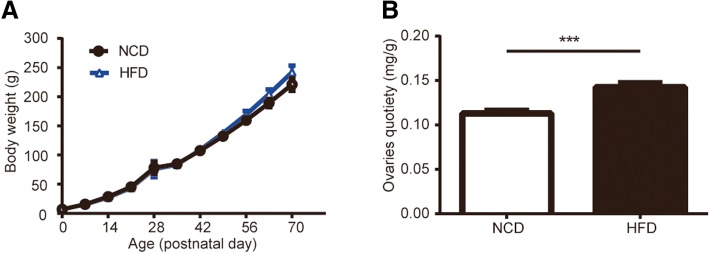
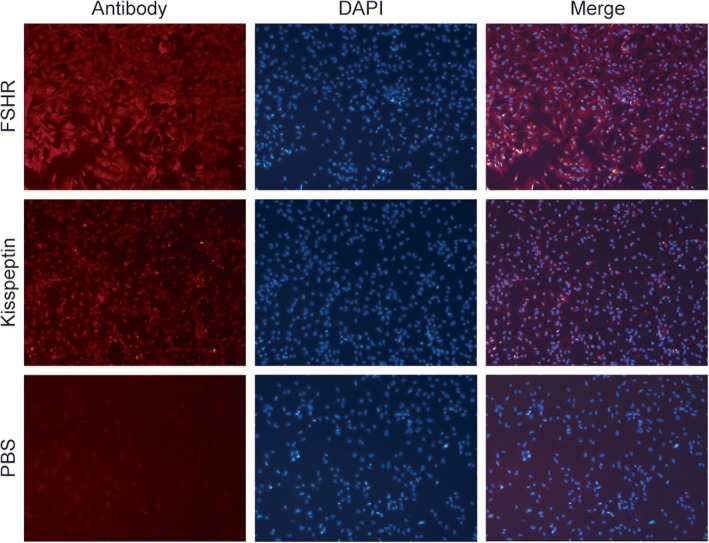
After introducing the male and confirmation of mating by checking a vaginal sperm plug, female rats were randomized into two groups: control diet called NCD group and high-fat diet called HFD group. After birth, all rats were changed into a control diet and litter size was adjusted to 12 pups per litter. Ovaries were collected for assessment at postnatal day (PND) 4 and PND 30. The timing of vaginal opening was recorded, and the estrous cyclicity was monitored for 2 consecutive weeks immediately. Primary granulosa cells and ovaries which were taken from PND 4 were collected for determination of the direct effect of kisspeptin-10 (kp-10) in vitro.
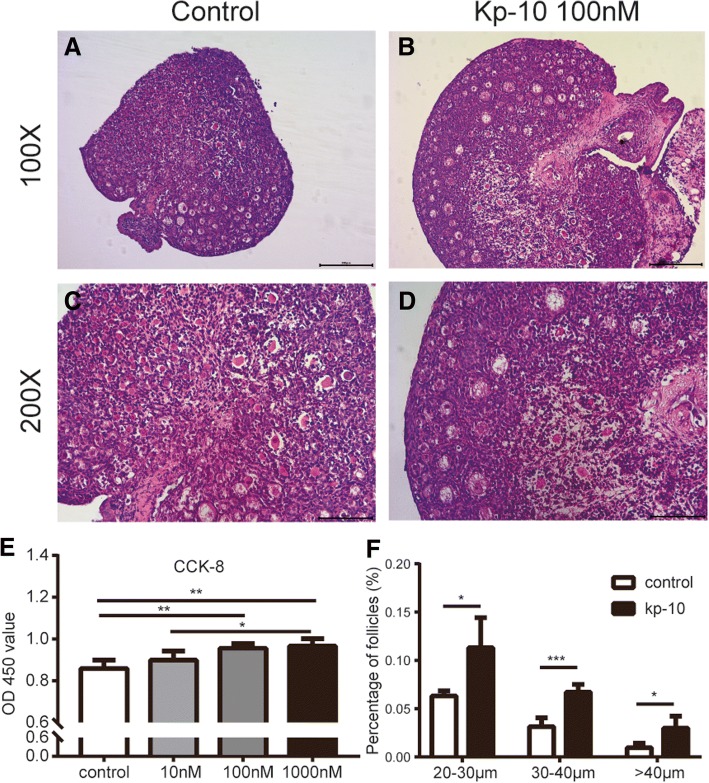
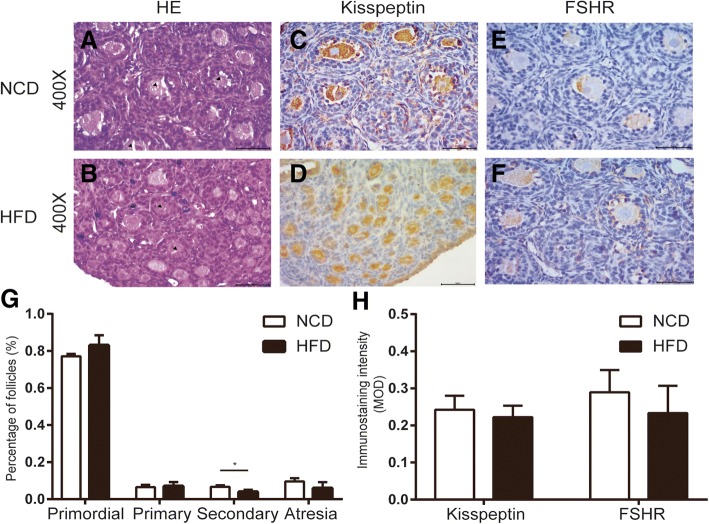
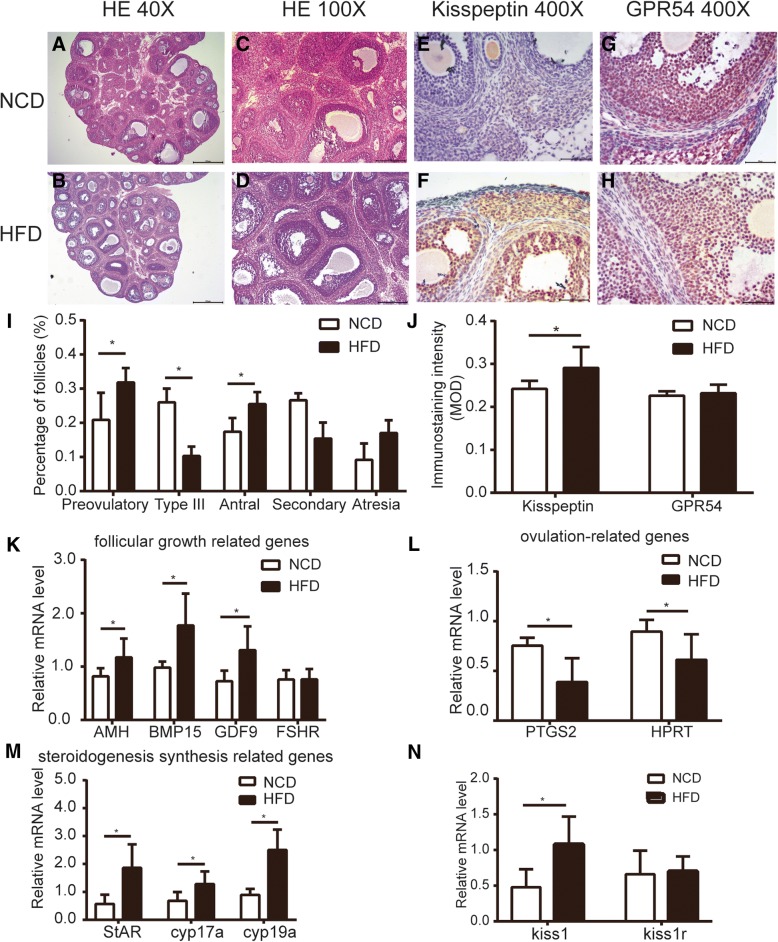
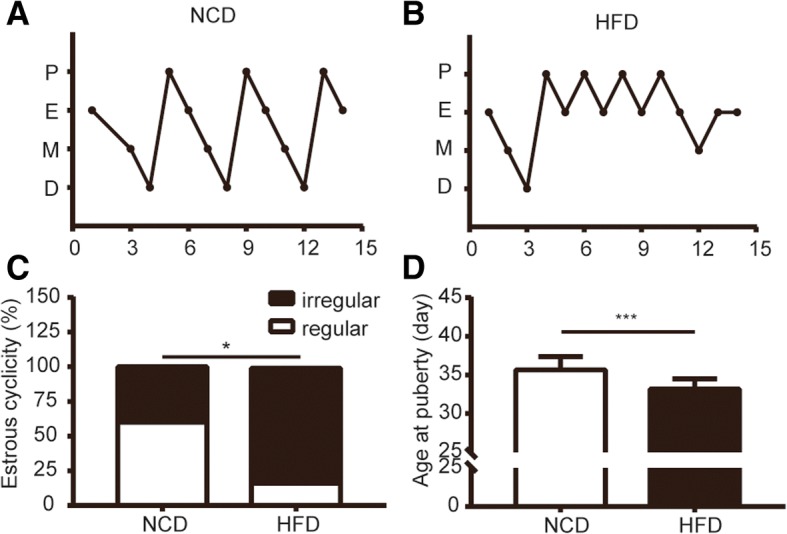
Neonatal rats exposed to HFD during gestation had a lower number of secondary follicles in the ovary. The expression of follicle-stimulating hormone receptor (FSHR) and kisspeptin was not altered. At prepuberty, the number of antral follicles and preovulatory follicles was elevated with decreased type III follicles in the HFD group. While the expression of ovulation-related genes was decreased, the expression levels of follicular growth-related genes and steroidogenesis synthesis related genes were elevated. A significant increase in kiss1 mRNA and kisspeptin protein was detected without changes in kiss1r mRNA and GPR54. Maternal high-fat diet during gestation resulted in a significant advanced puberty onset and an irregular estrous cycle in offspring rats. In addition, the administration of kp-10 produced an increase in viability of primary granulosa cells and enlarged the size of oocytes.
HFD exposure during maternal gestation had a long-term effect on reproductive function in the offspring and the increased ovarian kisspeptin/GPR54 system might be involved.
过度的孕期体重增加(GWG)与后代健康的不良长期影响有关,已成为一个主要的临床问题。越来越多的证据表明,卵巢 kisspeptin/GPR54 系统直接参与一系列生理活动。我们使用高脂肪饮食(HFD)在妊娠期建立模型,以研究后代的卵巢功能以及 kisspeptin/GPR54 系统是否参与其中。
在引入雄性并通过检查阴道精子栓确认交配后,将雌性大鼠随机分为两组:对照组称为 NCD 组,高脂肪饮食组称为 HFD 组。出生后,所有大鼠均改为对照饮食,并将每个窝的幼仔数调整为 12 只。在产后第 4 天(PND4)和第 30 天(PND30)收集卵巢进行评估。记录阴道开口时间,并立即连续监测 2 周的动情周期。从 PND4 收集的原始颗粒细胞和卵巢用于测定 kisspeptin-10(kp-10)的体外直接作用。
妊娠期暴露于 HFD 的新生大鼠卵巢中的次级卵泡数量减少。促卵泡激素受体(FSHR)和 kisspeptin 的表达没有改变。在青春期前,HFD 组的窦卵泡和排卵前卵泡数量增加,III 型卵泡减少。虽然排卵相关基因的表达减少,但卵泡生长相关基因和类固醇合成相关基因的表达水平升高。检测到 kiss1mRNA 和 kisspeptin 蛋白显著增加,而 kiss1r mRNA 和 GPR54 没有变化。妊娠期间母体高脂肪饮食导致后代大鼠青春期提前和动情周期不规则。此外,kp-10 的给药可增加初级颗粒细胞的活力并增大卵母细胞的大小。
妊娠期母体 HFD 暴露对后代的生殖功能有长期影响,增加的卵巢 kisspeptin/GPR54 系统可能参与其中。