Balbag M Alison, Pedersen Nancy L, Gatz Margaret
Davis School of Gerontology, University of Southern California, 3715 McClintock Avenue, Los Angeles, CA 90089-0191, USA.
Department of Psychology, University of Southern California, Los Angeles, CA 90089-1061, USA ; Department of Medical Epidemiology and Biostatistics, Karolinska Institutet, 171 77 Stockholm, Sweden.
Int J Alzheimers Dis. 2014;2014:836748. doi: 10.1155/2014/836748. Epub 2014 Dec 2.
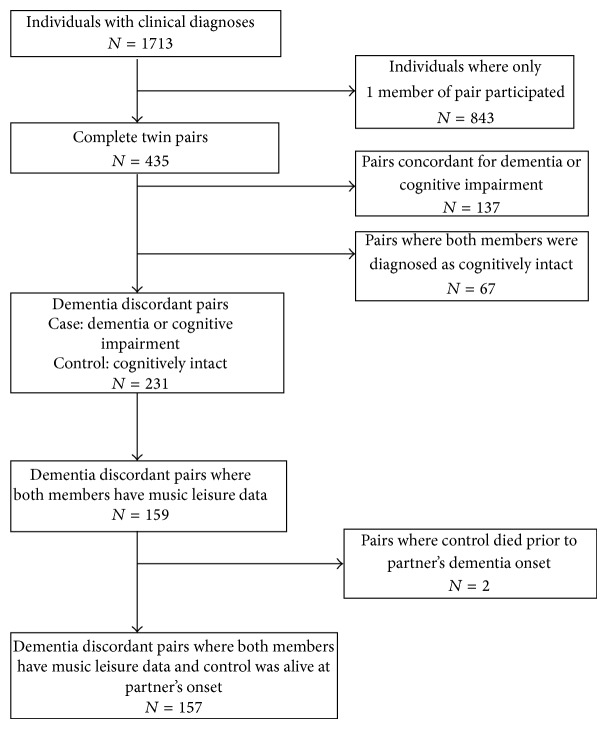
Increasing evidence supports that playing a musical instrument may benefit cognitive development and health at young ages. Whether playing an instrument provides protection against dementia has not been established. In a population-based cotwin control study, we examined the association between playing a musical instrument and whether or not the twins developed dementia or cognitive impairment. Participation in playing an instrument was taken from informant-based reports of twins' leisure activities. Dementia diagnoses were based on a complete clinical workup using standard diagnostic criteria. Among 157 twin pairs discordant for dementia and cognitive impairment, 27 pairs were discordant for playing an instrument. Controlling for sex, education, and physical activity, playing a musical instrument was significantly associated with less likelihood of dementia and cognitive impairment (odds ratio [OR] = 0.36 [95% confidence interval 0.13-0.99]). These findings support further consideration of music as a modifiable protective factor against dementia and cognitive impairment.
越来越多的证据表明,在年轻时演奏乐器可能有益于认知发展和健康。演奏乐器是否能预防痴呆症尚未得到证实。在一项基于人群的同卵双胞胎对照研究中,我们研究了演奏乐器与双胞胎是否患痴呆症或认知障碍之间的关联。参与演奏乐器的信息来自双胞胎休闲活动的知情者报告。痴呆症诊断基于使用标准诊断标准的完整临床检查。在157对患痴呆症和认知障碍情况不一致的双胞胎中,有27对在演奏乐器方面情况不一致。在控制了性别、教育程度和体育活动后,演奏乐器与患痴呆症和认知障碍的可能性显著降低相关(优势比[OR]=0.36[95%置信区间0.13 - 0.99])。这些发现支持进一步将音乐视为预防痴呆症和认知障碍的可改变保护因素加以考虑。