Yong Tai-Soon, Chai Jong-Yil, Sohn Woon-Mok, Eom Keeseon S, Jeoung Hoo-Gn, Hoang Eui-Hyug, Yoon Cheong-Ha, Jung Bong-Kwang, Lee Soon-Hyung, Sinuon Muth, Socheat Duong
Department of Environmental Medical Biology and Arthropods of Medical Importance Bank, Institute of Tropical Medicine, Yonsei University College of Medicine, Seoul 120-752, Korea.
Department of Parasitology and Tropical Medicine, Seoul National University College of Medicine, Seoul 110-799, Korea.
Korean J Parasitol. 2014 Dec;52(6):661-6. doi: 10.3347/kjp.2014.52.6.661. Epub 2014 Dec 23.
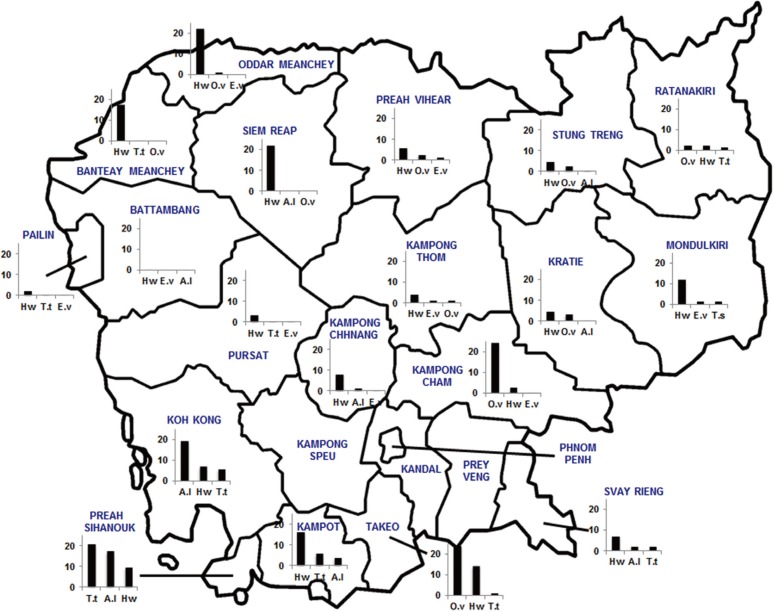
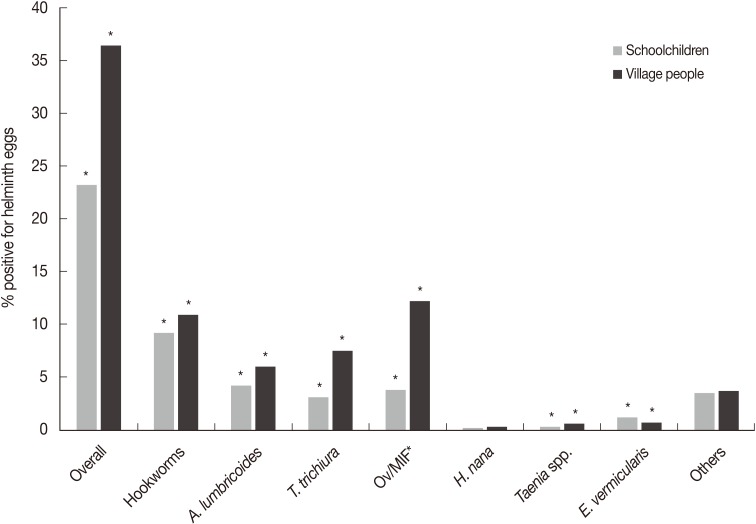
In order to investigate the status of intestinal helminthic infections in Cambodia, epidemiological surveys were carried out on a national scale, including 19 provinces. A total of 32,201 fecal samples were collected from schoolchildren and adults between 2006 and 2011 and examined once by the Kato-Katz thick smear technique. The overall egg positive rate of intestinal helminths was 26.2%. The prevalence of hookworms was the highest (9.6%), followed by that of Opisthorchis viverrini/minute intestinal flukes (Ov/MIF) (5.7%), Ascaris lumbricoides (4.6%), and Trichuris trichiura (4.1%). Other types of parasites detected were Enterobius vermicularis (1.1%), Taenia spp. (0.4%), and Hymenolepis spp. (0.2%). The northwestern regions such as the Siem Reap, Oddar Meanchey, and Banteay Meanchey Provinces showed higher prevalences (17.4-22.3%) of hookworms than the other localities. The southwestern areas, including Koh Kong and Preah Sihanouk Provinces showed higher prevalences of A. lumbricoides (17.5-19.2%) and T. trichiura (6.1-21.0%). Meanwhile, the central and southern areas, in particular, Takeo and Kampong Cham Provinces, showed high prevalences of Ov/MIF (23.8-24.0%). The results indicate that a considerably high prevalence of intestinal helminths has been revealed in Cambodia, and thus sustained national parasite control projects are necessary to reduce morbidity due to parasitic infections in Cambodia.
为调查柬埔寨肠道蠕虫感染状况,在全国范围内开展了流行病学调查,涵盖19个省份。2006年至2011年间,共收集了32201份学童和成人的粪便样本,并采用加藤厚涂片技术进行了一次检测。肠道蠕虫的总体虫卵阳性率为26.2%。钩虫的感染率最高(9.6%),其次是肝吸虫/微小肠吸虫(Ov/MIF)(5.7%)、蛔虫(4.6%)和鞭虫(4.1%)。检测到的其他寄生虫类型有蛲虫(1.1%)、带绦虫属(0.4%)和膜壳绦虫属(0.2%)。暹粒、奥多棉吉和班迭棉吉等西北地区的钩虫感染率(17.4 - 22.3%)高于其他地区。包括国公和西哈努克省在内的西南地区蛔虫(17.5 - 19.2%)和鞭虫(6.1 - 21.0%)的感染率较高。同时,中部和南部地区,特别是茶胶省和干丹省,Ov/MIF的感染率较高(23.8 - 24.0%)。结果表明,柬埔寨肠道蠕虫的感染率相当高,因此有必要持续开展全国性的寄生虫防治项目,以降低柬埔寨寄生虫感染导致的发病率。