Ren Tao, Shan Jinlu, Qing Yi, Qian Chengyuan, Li Qing, Lu Guoshou, Li Mengxia, Li Chongyi, Peng Yu, Luo Hao, Zhang Shiheng, Zhang Weiwei, Wang Dong, Zhou Shu-Feng
Cancer Center, Daping Hospital and Research Institute of Surgery, Third Military Medical University, Chongqing, People's Republic of China ; Oncology Department, The Affiliated Hospital, North Sichuan Medical College, Nanchong, People's Republic of China.
Cancer Center, Daping Hospital and Research Institute of Surgery, Third Military Medical University, Chongqing, People's Republic of China.
Drug Des Devel Ther. 2014 Dec 12;8:2517-29. doi: 10.2147/DDDT.S71432. eCollection 2014.
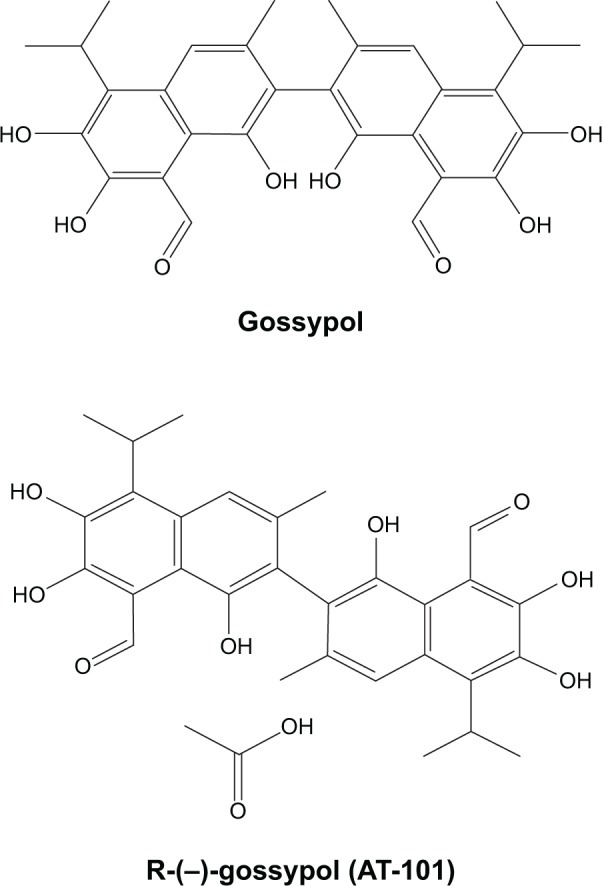
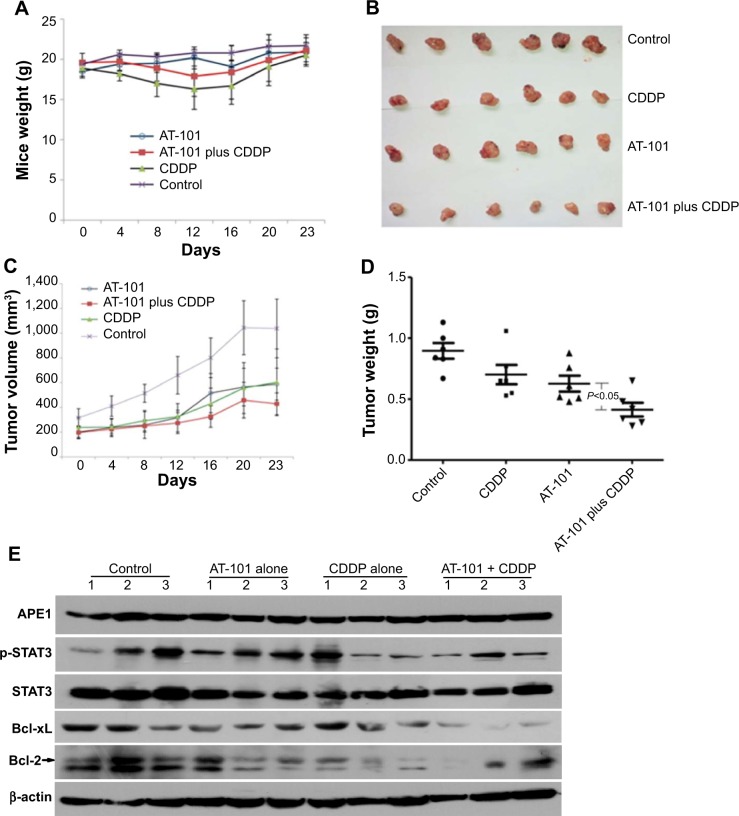
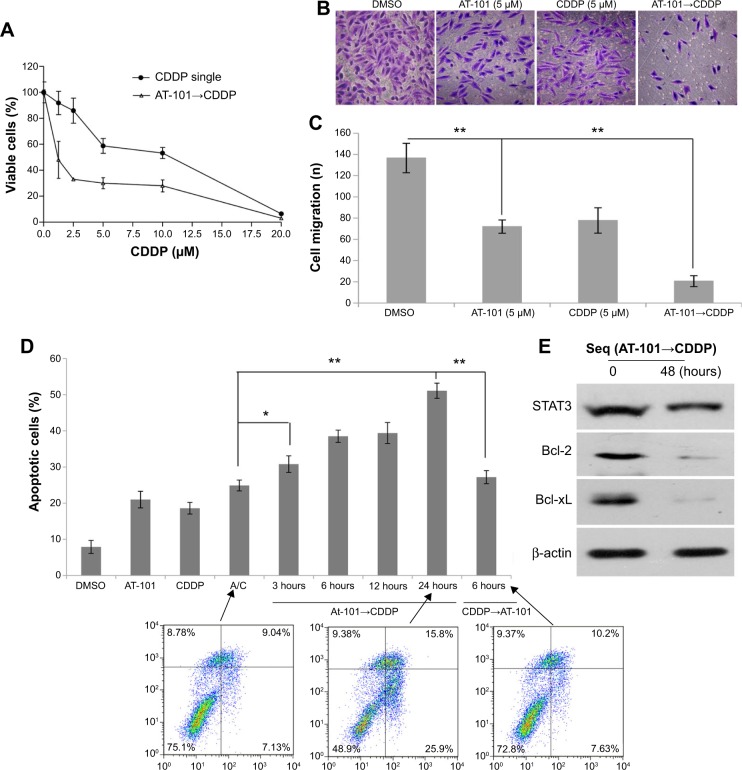
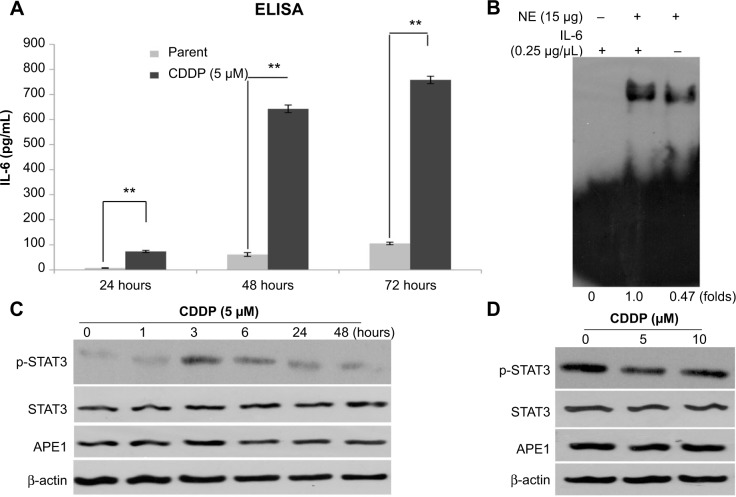
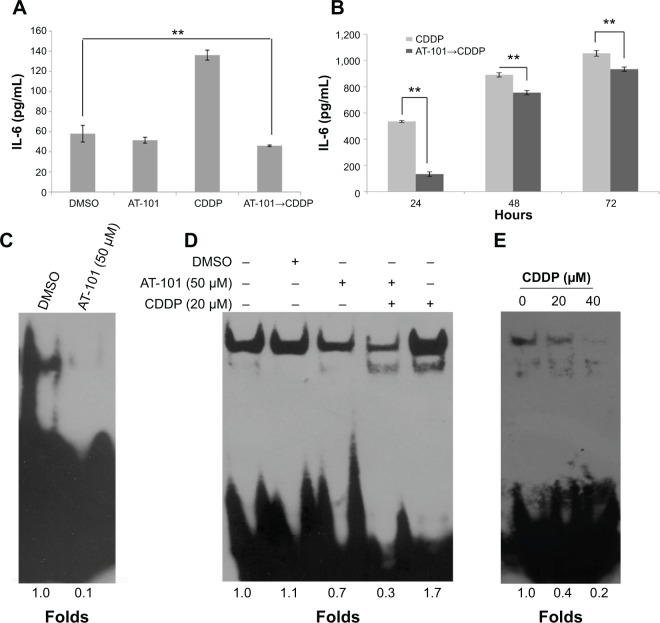
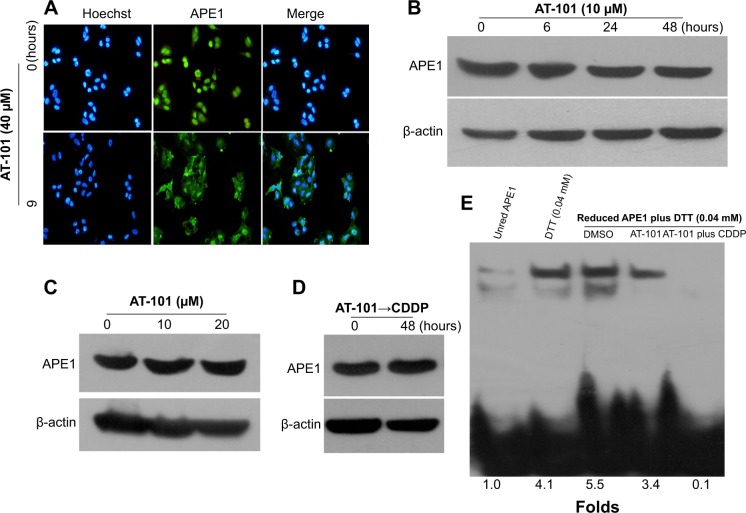
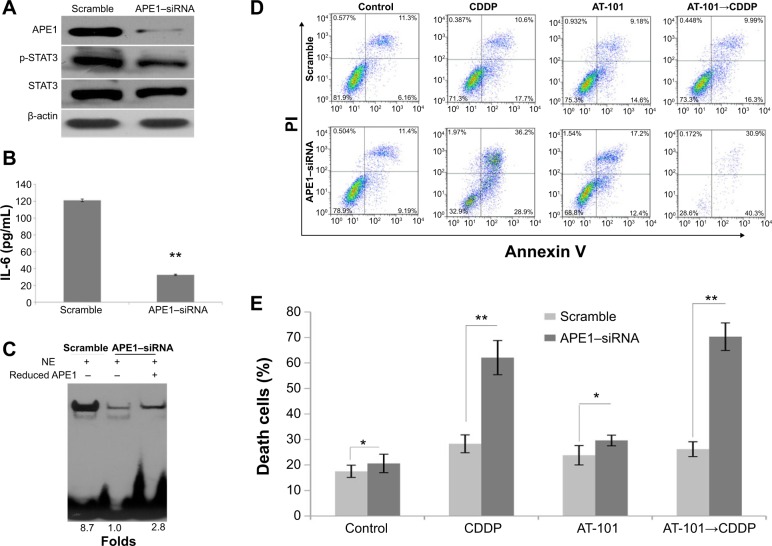
AT-101, known as R-(-)-gossypol, is a potent anticancer agent, but its chemosensitizing effects remain elusive. The present study aimed to examine whether AT-101 could increase the sensitivity of non-small cell lung cancer A549 cells to cisplatin (CDDP) and the underlying mechanisms. We evaluated the efficacy of the sequential treatment with AT-101 and CDDP using both in vitro and in vivo models. Our results showed that as compared to AT-101 or CDDP monotherapy, or AT-101 plus CDDP concurrent treatment, the sequential treatment significantly inhibited cell proliferation and migration and induced tumor cell death. Moreover, the efficacy of the sequential treatment was also confirmed in a mouse A549 xenograft model. Our study revealed that AT-101 inhibited the reduced status of apurinic/apyrimidinic endonuclease 1 (APE1) and attenuated APE1-mediated IL-6/STAT3 signaling activation by decreasing IL-6 protein expression; suppressing the STAT3-DNA binding; and reducing the expression of the downstream antiapoptotic proteins Bcl-2 and Bcl-xL. In conclusion, AT-101 enhances the sensitivity of A549 cells to CDDP in vitro and in vivo through the inhibition of APE1-mediated IL-6/STAT3 signaling activation, providing a rationale for the combined use of AT-101 and CDDP in non-small cell lung cancer chemotherapy.
AT-101,即R-(-)-棉酚,是一种强效抗癌剂,但其化学增敏作用仍不明确。本研究旨在探讨AT-101是否能增加非小细胞肺癌A549细胞对顺铂(CDDP)的敏感性及其潜在机制。我们使用体外和体内模型评估了AT-101与CDDP序贯治疗的疗效。我们的结果表明,与AT-101或CDDP单药治疗,或AT-101加CDDP联合治疗相比,序贯治疗显著抑制细胞增殖和迁移,并诱导肿瘤细胞死亡。此外,序贯治疗的疗效在小鼠A549异种移植模型中也得到了证实。我们的研究表明,AT-101通过降低白细胞介素-6(IL-6)蛋白表达抑制脱嘌呤/脱嘧啶内切酶1(APE1)的低水平状态,并减弱APE1介导的IL-6/信号转导和转录激活因子3(STAT3)信号激活;抑制STAT3与DNA的结合;并降低下游抗凋亡蛋白Bcl-2和Bcl-xL的表达。总之,AT-101通过抑制APE1介导的IL-6/STAT3信号激活,在体外和体内增强了A549细胞对CDDP的敏感性,为AT-101与CDDP联合用于非小细胞肺癌化疗提供了理论依据。