Clinical Medical College, Chengdu Medical College, Chengdu, P. R. China.
Department of Gastroenterology, Clinical Medical College, The First Affiliated Hospital of Chengdu Medical College, Chengdu, P. R. China.
Clin Transl Med. 2022 May;12(5):e876. doi: 10.1002/ctm2.876.
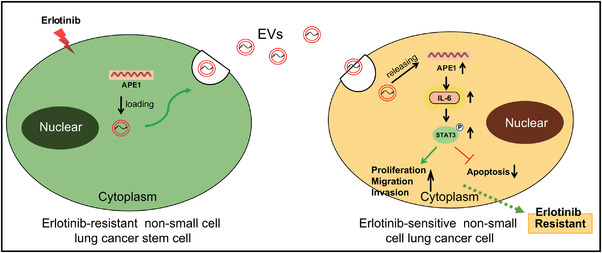
Apurinic endonuclease 1 (APE1) has been suggested as an oncogene of lung tumours and our bioinformatics analysis identified the association between Erlotinib resistance and interleukin-6 (IL-6). Thus, we performed this work to delineate the mechanistic actions of APE1/IL-6 signalling in Erlotinib resistance of non-small cell lung cancer (NSCLC).
We selected human NSCLC cell lines HCC827 and PC9 to establish Erlotinib-resistant HCC827R and PC9R cells. Cancer stem cells (CSCs) were isolated from Erlotinib-sensitive HCC827P and PC9P cells (PCSCs) and from HCC827R and PC9R cells (RCSCs). Further, extracellular vesicles (EVs) were separated from PCSCs (PCSC-EVs) and RCSCs (RCSC-EVs) and co-cultured with RCSCs with or without short hairpin RNA (shRNA)-targeting APE1 (APE1 shRNA) transduction. In addition, functional assays were conducted to determine the effect of APE1 shRNA on malignant phenotypes of cancer cells in vitro and in vivo and the activation of IL-6/STAT3 signalling.
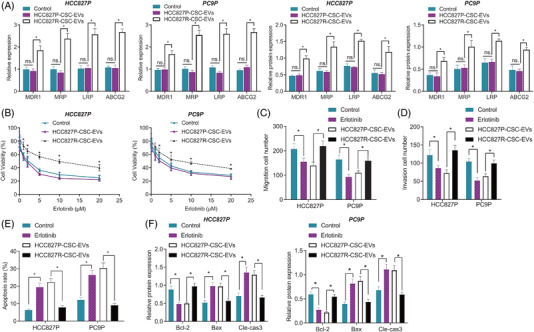
It was found that NSCLC cells could internalize both RCSC-EVs and PCSC-EVs. RCSC-EVs augmented the resistance of NSCLC cells to Erlotinib. The overexpression of APE1 occurred in NSCLC tissues, and IL-6 was enriched in serum samples of patients with NSCLC. APE1 shRNA was demonstrated to restrict the Erlotinib resistance of NSCLC cells by inactivating the IL-6/STAT3 signalling. Additionally, shAPE1-loaded RCSC-EVs suppressed the Erlotinib resistance of NSCLC via the IL-6/STAT3 axis both in vitro and in vivo, as reflected by impeded malignant phenotypes and xenograft tumour formation.
Collectively, these data indicate that APE1 confers Erlotinib resistance by activating the IL-6/STAT3 signalling, suggesting targeting APE1 as a possible therapeutic target in Erlotinib-resistant NSCLC.
脱嘌呤/脱嘧啶核酸内切酶 1(APE1)被认为是肺癌肿瘤的癌基因,我们的生物信息学分析确定了厄洛替尼耐药性与白细胞介素 6(IL-6)之间的关联。因此,我们进行了这项工作,以描绘 APE1/IL-6 信号在非小细胞肺癌(NSCLC)厄洛替尼耐药中的作用机制。
我们选择人 NSCLC 细胞系 HCC827 和 PC9 建立厄洛替尼耐药的 HCC827R 和 PC9R 细胞。从厄洛替尼敏感的 HCC827P 和 PC9P 细胞(PCSCs)和 HCC827R 和 PC9R 细胞(RCSCs)中分离癌症干细胞(CSCs)。此外,从 PCSCs(PCSC-EVs)和 RCSCs(RCSC-EVs)中分离出细胞外囊泡(EVs),并与未经短发夹 RNA(shRNA)靶向 APE1(APE1 shRNA)转导的 RCSCs 共培养。此外,进行功能测定以确定 APE1 shRNA 对体外和体内癌细胞恶性表型和 IL-6/STAT3 信号激活的影响。
发现 NSCLC 细胞可以内化 RCSC-EVs 和 PCSC-EVs。RCSC-EVs 增强了 NSCLC 细胞对厄洛替尼的耐药性。APE1 在 NSCLC 组织中过度表达,IL-6 在 NSCLC 患者的血清样本中富集。APE1 shRNA 通过使 IL-6/STAT3 信号失活来限制 NSCLC 细胞对厄洛替尼的耐药性。此外,shAPE1 负载的 RCSC-EVs 通过 IL-6/STAT3 轴在体外和体内均抑制 NSCLC 的厄洛替尼耐药性,表现在恶性表型和异种移植肿瘤形成受阻。
综上所述,这些数据表明 APE1 通过激活 IL-6/STAT3 信号赋予厄洛替尼耐药性,表明靶向 APE1 可能是厄洛替尼耐药性 NSCLC 的一种潜在治疗靶点。