Kong Pengfei, Cai Qingqing, Geng Qirong, Wang Jing, Lan Yadong, Zhan Youqing, Xu Dazhi
State Key Laboratory of Oncology in South China, Collaborative Innovation Center for Cancer Medicine, Guangzhou, China; Department of Gastric and Pancreatic Surgery, Sun Yat-sen University Cancer Center, Guangzhou, China.
State Key Laboratory of Oncology in South China, Collaborative Innovation Center for Cancer Medicine, Guangzhou, China; Department of Medical Oncology, Sun Yat-sen University Cancer Center, Guangzhou, China.
PLoS One. 2014 Dec 30;9(12):e116060. doi: 10.1371/journal.pone.0116060. eCollection 2014.
The association between vitamin intake and gastric cancer (GC) has been widely debated due to the relatively weak evidence. In this study, a meta-analysis of prospective and well designed observational studies were performed to explore this association.
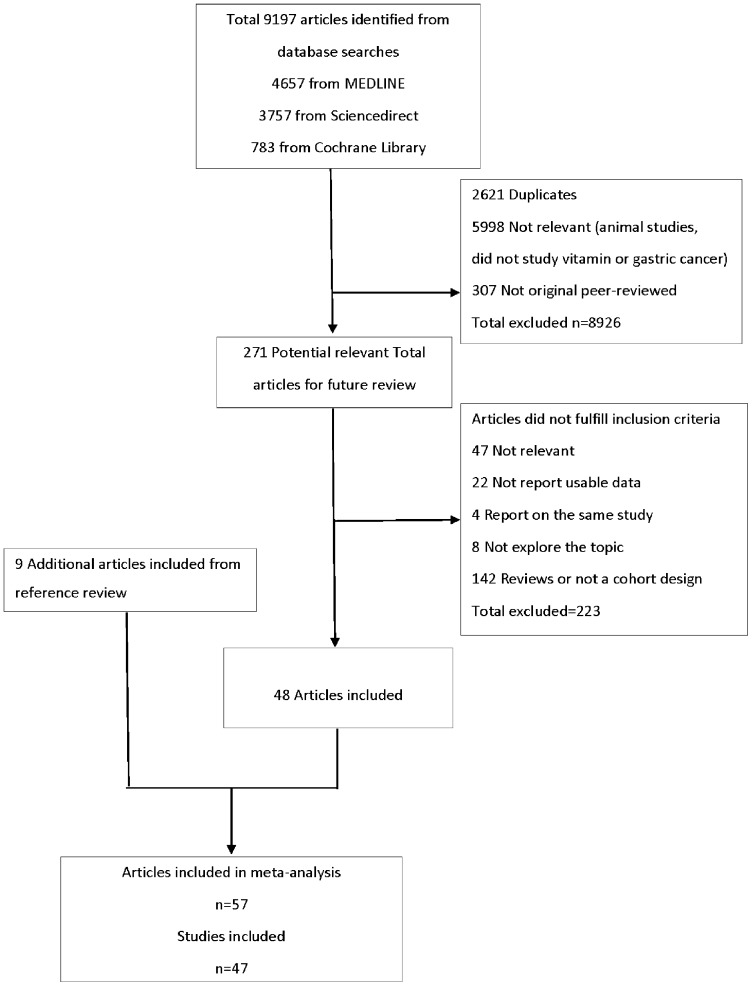
MEDLINE, Cochrane Library, and Sciencedirect were searched for studies of vitamin consumption and gastric cancer. This produced 47 relevant studies covering 1,221,392 human subjects. Random effects models were used to estimate summary relative risk (RR). Dose-response, subgroup, sensitivity, meta-regression, and publication bias analyses were conducted.
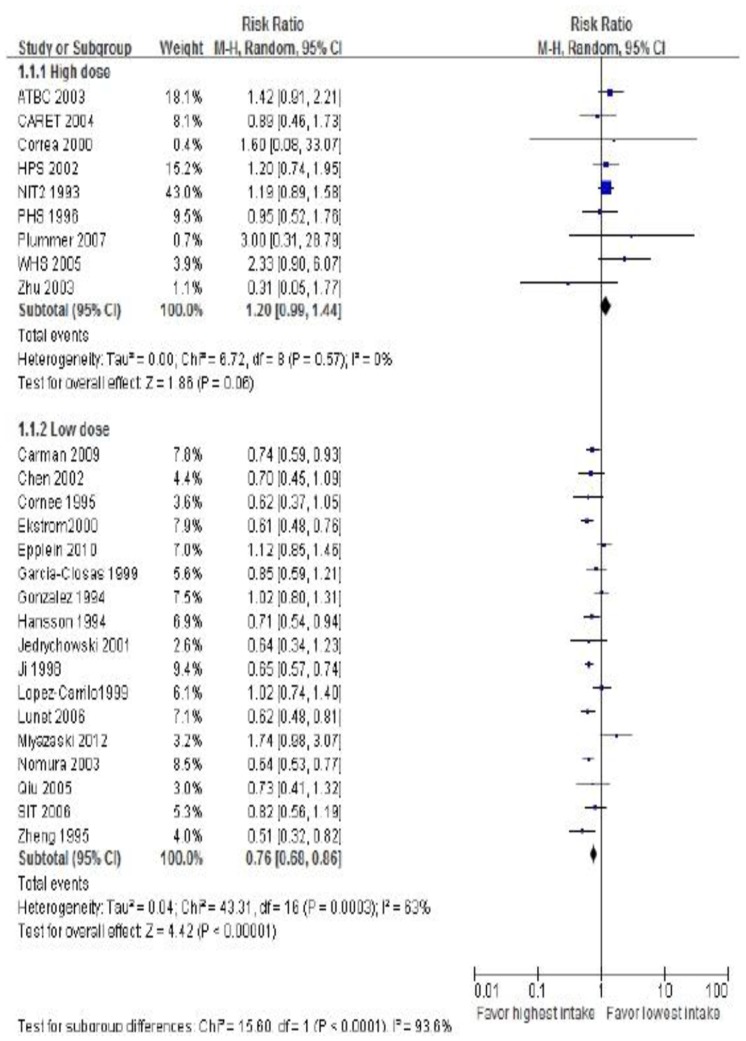
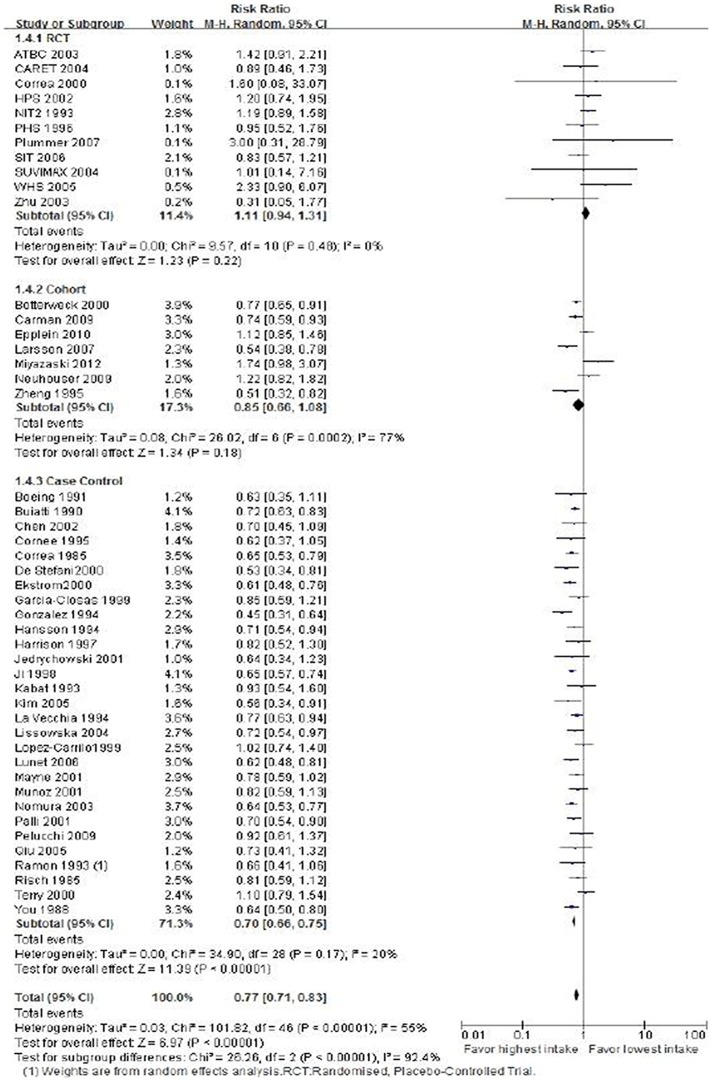
The RR of gastric cancer in the group with the highest vitamin intake was compared to that of the lowest intake group. Total vitamin intake was 0.78 (95% CI, 0.71-0.83). In 9 studies that individuals were given doses at least 4 times above the tolerable upper intake (UL) vitamins, the RR was 1.20 (95% CI, 0.99-1.44). However, in 17 studies that individuals received doses below the UL, the RR was 0.76 (95% CI, 0.68-0.86). Dose-response analysis was conducted on different increments in different types of vitamins (vitamin A: 1.5 mg/day, vitamin C: 100 mg/day, vitamin E: 10 mg/day) intake with a significant reduction in the risk of gastric cancer, respectively, 29% in vitamin A, 26% in vitamin C, and 24% in vitamin E.
This meta-analysis clearly demonstrated that low doses of vitamins can significantly reduce the risk of GC, especially vitamin A, vitamin C, vitamin E.
由于证据相对薄弱,维生素摄入与胃癌(GC)之间的关联一直存在广泛争议。在本研究中,我们对前瞻性和设计良好的观察性研究进行了荟萃分析,以探讨这种关联。
检索MEDLINE、Cochrane图书馆和Sciencedirect数据库中关于维生素摄入与胃癌的研究。共获得47项相关研究,涵盖1,221,392名受试者。采用随机效应模型估计汇总相对风险(RR)。进行了剂量反应、亚组、敏感性、meta回归和发表偏倚分析。
将维生素摄入量最高组的胃癌RR与最低摄入量组进行比较。总维生素摄入量的RR为0.78(95%CI,0.71-0.83)。在9项研究中,个体摄入的维生素剂量至少是可耐受最高摄入量(UL)的4倍,RR为1.20(95%CI,0.99-1.44)。然而,在17项研究中,个体摄入的剂量低于UL,RR为0.76(95%CI,0.68-0.86)。对不同类型维生素(维生素A:1.5毫克/天,维生素C:100毫克/天,维生素E:10毫克/天)摄入量的不同增量进行剂量反应分析,胃癌风险分别显著降低,维生素A降低29%,维生素C降低26%,维生素E降低24%。
这项荟萃分析清楚地表明,低剂量维生素可显著降低胃癌风险,尤其是维生素A、维生素C、维生素E。