Curtis Emily M, Xiao Xingqing, Sofou Stavroula, Hall Carol K
Department of Chemical and Biomolecular Engineering, North Carolina State University , Engineering Building I, 911 Partners Way, Raleigh, North Carolina 27695-7905, United States.
Langmuir. 2015 Jan 27;31(3):1086-94. doi: 10.1021/la504082x. Epub 2015 Jan 15.
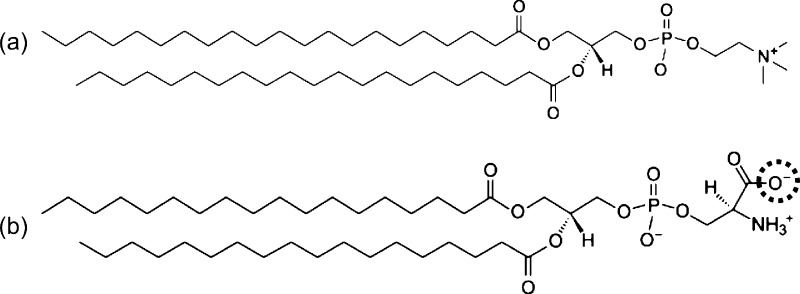
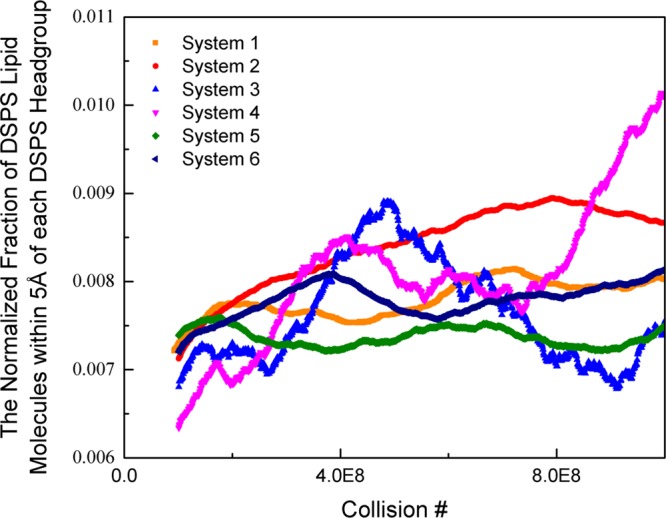
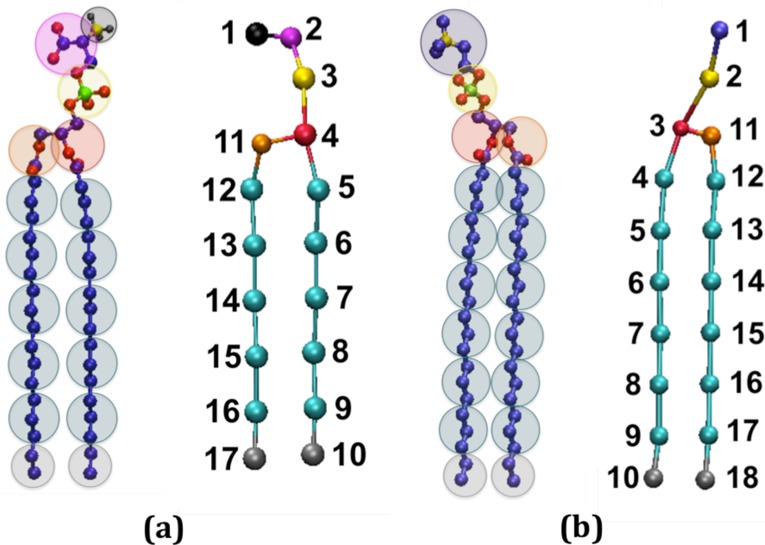
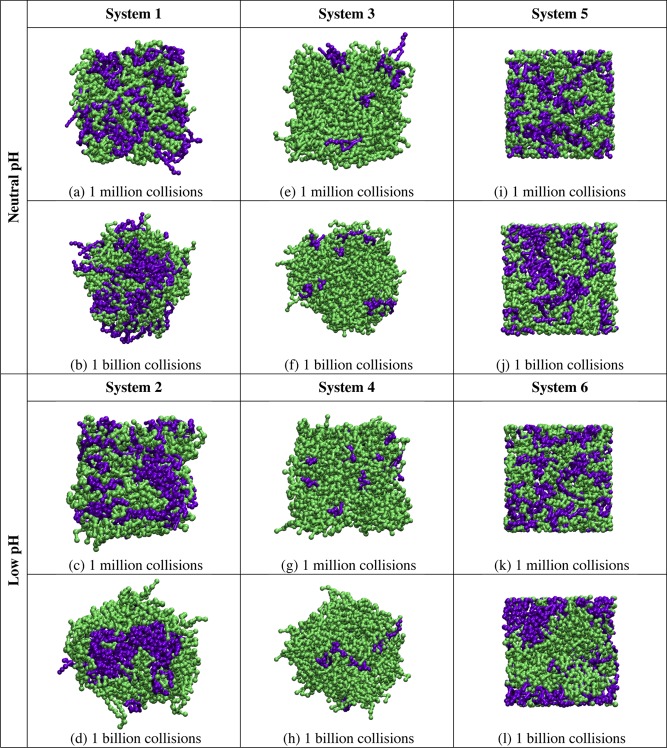
We extend LIME, an intermediate resolution, implicit solvent model for phospholipids previously used in discontinuous molecular dynamics simulations of 1,2-dipalmitoyl-sn-glycero-3-phosphocholine (DPPC) bilayer formation at 325 K, to the description of the geometry and energetics of 1,2-distearoyl-sn-glycero-3-phospho-L-serine (DSPS) and 1,2-dihenarachidoyl-sn-glycero-3-phosphocholine (21PC) and mixtures thereof at both neutral and low pH at 310 K. A multiscale modeling approach is used to calculate the LIME parameters from atomistic simulation data on a mixed DPPC/DSPS system at different pH values. In the model, 17 coarse-grained sites represent DSPS and 18 coarse-grained sites represent 21PC. Each of these coarse-grained sites is classified as 1 of 9 types. LIME/DMD simulations of equimolar bilayers show the following: (1) 21PC/DSPS bilayers with and without surface area restrictions separate faster at low pH than at neutral pH, (2) 21PC/DSPS systems separate at approximately the same rate regardless of whether they are subjected to surface area restrictions, and (3) bilayers with a molar ratio of 9:1 (21PC:DSPS) phase separate to form heterogeneous domains faster at low pH than at neutral pH. Our results are consistent with experimental findings of Sofou and co-workers (Bandekar et al. Mol. Pharmaceutics, 2013, 10, 152-160; Karve et al. Biomaterials, 2010, 31, 4409-4416) that more doxorubicin is released from 21PC/DSPS liposomes at low pH than at neutral pH, presumably because greater phase separation is achieved at low pH than at neutral pH. These are the first molecular-level simulations of the phase separation in mixed lipid bilayers induced by a change in pH.
我们将LIME(一种中等分辨率的隐式溶剂模型,之前用于325K下1,2 - 二棕榈酰 - sn - 甘油 - 3 - 磷酸胆碱(DPPC)双层形成的不连续分子动力学模拟)扩展到对1,2 - 二硬脂酰 - sn - 甘油 - 3 - 磷酸 - L - 丝氨酸(DSPS)、1,2 - 二花生四烯酰 - sn - 甘油 - 3 - 磷酸胆碱(21PC)及其混合物在310K中性和低pH条件下的几何结构和能量学的描述。采用多尺度建模方法,根据不同pH值下混合DPPC/DSPS系统的原子模拟数据计算LIME参数。在该模型中,17个粗粒度位点代表DSPS,18个粗粒度位点代表21PC。这些粗粒度位点中的每一个都被归类为9种类型中的1种。等摩尔双层的LIME/DMD模拟结果表明:(1)有和没有表面积限制的21PC/DSPS双层在低pH下比在中性pH下分离得更快;(2)21PC/DSPS系统无论是否受到表面积限制,分离速率大致相同;(3)摩尔比为9:1(21PC:DSPS)的双层在低pH下比在中性pH下更快地相分离形成异质域。我们的结果与Sofou及其同事的实验结果一致(Bandekar等人,《分子药剂学》,2013年,10卷,152 - 160页;Karve等人,《生物材料》,2010年,31卷,4409 - 4416页),即在低pH下从21PC/DSPS脂质体中释放的阿霉素比在中性pH下更多,推测是因为在低pH下比在中性pH下实现了更大程度的相分离。这些是首次对pH变化引起的混合脂质双层相分离进行的分子水平模拟。