Schilp Janneke, Boot Sanne, de Blok Carolien, Spreeuwenberg Peter, Wagner Cordula
NIVEL, Netherlands Institute for Health Services Research, Utrecht, The Netherlands.
NIVEL, Netherlands Institute for Health Services Research, Utrecht, The Netherlands Department of Public and Occupation Health, EMGO+Institute for Health and Care Research, VU University Medical Center (VUmc), Amsterdam, The Netherlands.
BMJ Open. 2014 Dec 30;4(12):e005232. doi: 10.1136/bmjopen-2014-005232.
Preventable adverse drug events (ADEs) are closely related to administration processes of parenteral medication. The Dutch Patient Safety Program provided a protocol for administering parenteral medication to reduce the amount of ADEs. The execution of the protocol was evaluated and a cost estimation was performed to provide insight in the associated costs of protocol compliance.
A longitudinal evaluation study was performed in secondary care. A total of 2154 observations of the administration process of parenteral medication were carried out within 10 measurements in 19 hospitals between November 2011 and December 2012. The total time needed for the process was measured in a sample of five hospitals. Multilevel linear and logistic regression analyses were used to analyse the trend over time of the implementation and to assess the association between hospital and administration characteristics, and compliance of the protocol. A cost estimation provided insight into the costs of performing a complete administration process and the costs at department level for 1 year.
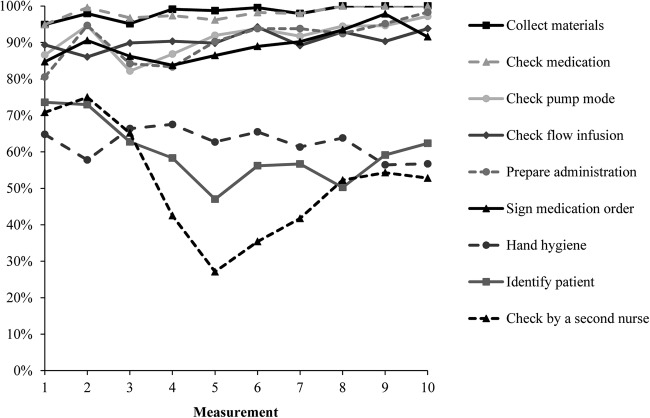
The complete protocol was performed in 19% of the observations. The proceeding 'check by a second nurse' was least performed. Large differences were found between individual hospitals in performing the administration protocol. The compliance of the protocol was negatively influenced in case of disturbance of the administrator. The overall trend over time of completion of the protocol fluctuated during the study period. On average, 3 min 26 s were needed to perform the complete protocol, which costs €2.42. Extrapolating the costs to department level, including cost for clinical lessons, the difference in costs in performing the complete protocol and an incomplete protocol was €7.891 for 1 year.
The protocol for administering parenteral medication is still not implemented completely, therefore an investment in time and Euros is needed.
可预防的药物不良事件(ADEs)与肠外用药的给药过程密切相关。荷兰患者安全计划提供了一份肠外用药给药方案,以减少ADEs的发生量。对该方案的执行情况进行了评估,并进行了成本估算,以深入了解方案合规的相关成本。
在二级护理机构中进行了一项纵向评估研究。2011年11月至2012年12月期间,在19家医院进行了10次测量,共对2154次肠外用药给药过程进行了观察。在五家医院的样本中测量了该过程所需的总时间。采用多水平线性和逻辑回归分析来分析实施的时间趋势,并评估医院与给药特征之间的关联以及方案的合规性。成本估算提供了对完成一个完整给药过程的成本以及部门层面一年成本的深入了解。
在19%的观察中执行了完整方案。“由第二名护士检查”这一步骤执行得最少。各医院在执行给药方案方面存在很大差异。在给药人员受到干扰的情况下,方案的合规性受到负面影响。在研究期间,方案完成情况随时间的总体趋势波动。平均而言,执行完整方案需要3分26秒,成本为2.42欧元。将成本推算至部门层面,包括临床培训成本,执行完整方案和不完整方案的成本差异在一年中为7891欧元。
肠外用药给药方案仍未完全实施,因此需要在时间和资金上进行投入。