Guilliam Thomas A, Jozwiakowski Stanislaw K, Ehlinger Aaron, Barnes Ryan P, Rudd Sean G, Bailey Laura J, Skehel J Mark, Eckert Kristin A, Chazin Walter J, Doherty Aidan J
Genome Damage and Stability Centre, School of Life Sciences, University of Sussex, Brighton BN1 9RQ, UK.
Departments of Biochemistry and Chemistry and Center for Structural Biology, Vanderbilt University School of Medicine, Nashville, TN 37232, USA.
Nucleic Acids Res. 2015 Jan;43(2):1056-68. doi: 10.1093/nar/gku1321. Epub 2014 Dec 29.
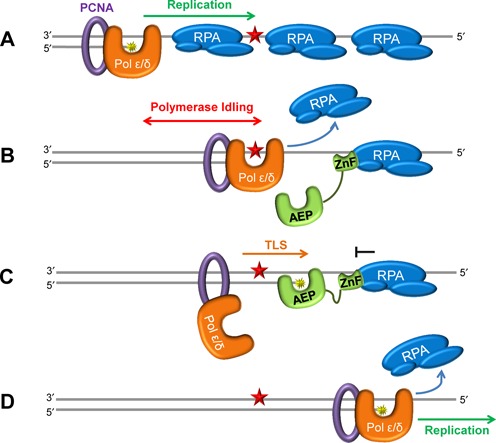
PrimPol is a recently identified polymerase involved in eukaryotic DNA damage tolerance, employed in both re-priming and translesion synthesis mechanisms to bypass nuclear and mitochondrial DNA lesions. In this report, we investigate how the enzymatic activities of human PrimPol are regulated. We show that, unlike other TLS polymerases, PrimPol is not stimulated by PCNA and does not interact with it in vivo. We identify that PrimPol interacts with both of the major single-strand binding proteins, RPA and mtSSB in vivo. Using NMR spectroscopy, we characterize the domains responsible for the PrimPol-RPA interaction, revealing that PrimPol binds directly to the N-terminal domain of RPA70. In contrast to the established role of SSBs in stimulating replicative polymerases, we find that SSBs significantly limit the primase and polymerase activities of PrimPol. To identify the requirement for this regulation, we employed two forward mutation assays to characterize PrimPol's replication fidelity. We find that PrimPol is a mutagenic polymerase, with a unique error specificity that is highly biased towards insertion-deletion errors. Given the error-prone disposition of PrimPol, we propose a mechanism whereby SSBs greatly restrict the contribution of this enzyme to DNA replication at stalled forks, thus reducing the mutagenic potential of PrimPol during genome replication.
PrimPol是一种最近发现的参与真核生物DNA损伤耐受的聚合酶,用于重新引发和跨损伤合成机制,以绕过核DNA和线粒体DNA损伤。在本报告中,我们研究了人类PrimPol的酶活性是如何被调控的。我们发现,与其他跨损伤合成聚合酶不同,PrimPol不受增殖细胞核抗原(PCNA)的刺激,且在体内不与PCNA相互作用。我们确定PrimPol在体内与两种主要的单链结合蛋白,即复制蛋白A(RPA)和线粒体单链结合蛋白(mtSSB)相互作用。利用核磁共振光谱,我们对负责PrimPol-RPA相互作用的结构域进行了表征,发现PrimPol直接结合到RPA70的N端结构域。与单链结合蛋白在刺激复制性聚合酶方面已确立的作用相反,我们发现单链结合蛋白显著限制了PrimPol的引发酶和聚合酶活性。为了确定这种调控的必要性,我们采用了两种正向突变试验来表征PrimPol的复制保真度。我们发现PrimPol是一种诱变聚合酶,具有独特的错误特异性,高度倾向于插入-缺失错误。鉴于PrimPol易于出错的特性,我们提出了一种机制,即单链结合蛋白极大地限制了这种酶对停滞复制叉处DNA复制的贡献,从而降低了PrimPol在基因组复制过程中的诱变潜力。