Lee Eun Young, Lee Hae Lyoung, Kim Hyung Tae, Lee Hyoung Doo, Park Ji Ae
Department of Pediatrics, Good Gang-An Hospital, Busan, Korea.
Heart Center, Pusan National University Children's Hospital, Yangsan, Korea.
Korean J Pediatr. 2014 Nov;57(11):489-95. doi: 10.3345/kjp.2014.57.11.489. Epub 2014 Nov 30.
The aims of this study were to document our single-center experience with pediatric acute fulminant myocarditis (AFM) and to investigate its clinical features and short-term outcomes.
We performed a retrospective chart review of all children <18 years old who were diagnosed with AFM between October 2008 and February 2013. Data about patient demographics, initial symptoms, investigation results, management, and outcomes between survivors and nonsurvivors were collected.
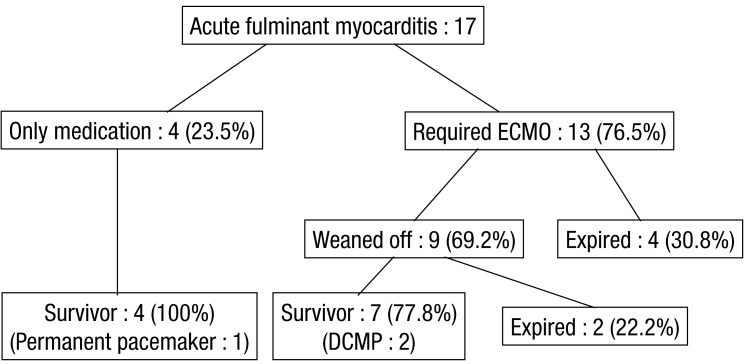
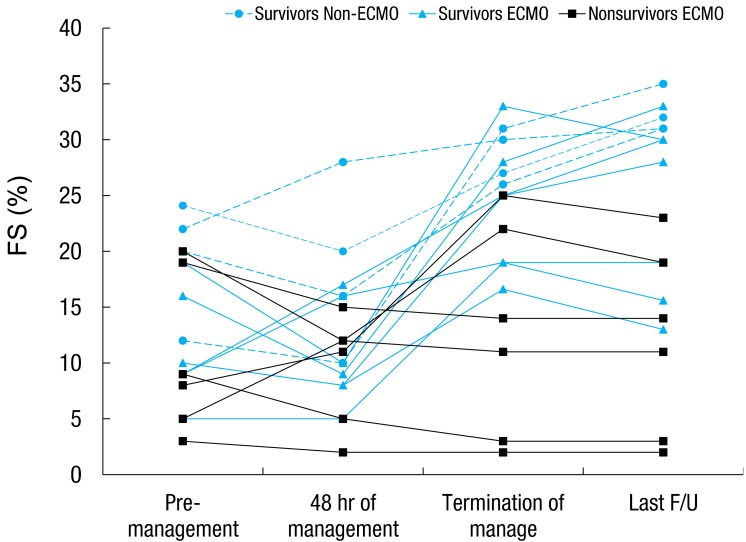
Seventeen of 21 patients (80.9%) with myocarditis were diagnosed with AFM. Eleven patients (64.7%) survived to discharge, and 6 (35.3%) died. Electrocardiography on admission revealed dysrhythmia in 10 patients (58.8%); of these, all 7 patients with a complete atrioventricular block survived. Fractional shortening upon admission was significantly different between the survivors (16%) and nonsurvivors (8.5%) (P=0.01). Of the serial biochemical markers, only the initial brain natriuretic peptide (P=0.03) and peak blood urea nitrogen levels (P=0.02) were significantly different. Of 17 patients, 4 (23.5%) required medical treatment only. Extracorporeal membrane oxygenation (ECMO) was performed in 13 patients (76.5%); the survival rate in these patients was 53.8%. ECMO support was initiated >24 hours after admission in 4 of the 13 patients (30.7%), and 3 of those 4 patients (75%) died.
AFM outcomes may be associated with complete atrioventricular block upon hospital admission, left ventricular fractional shortening at admission, time from admission to the initiation of ECMO support, initial brain natriuretic peptide level, and peak blood urea nitrogen level.
本研究旨在记录我们单中心治疗小儿急性暴发性心肌炎(AFM)的经验,并调查其临床特征和短期预后。
我们对2008年10月至2013年2月期间诊断为AFM的所有18岁以下儿童进行了回顾性病历审查。收集了患者人口统计学、初始症状、检查结果、治疗及幸存者和非幸存者结局的数据。
21例心肌炎患者中有17例(80.9%)被诊断为AFM。11例患者(64.7%)存活出院,6例(35.3%)死亡。入院时心电图显示10例患者(58.8%)存在心律失常;其中,所有7例完全性房室传导阻滞患者均存活。幸存者(16%)和非幸存者(8.5%)入院时的左室短轴缩短率有显著差异(P=0.01)。在一系列生化指标中,只有初始脑钠肽(P=0.03)和血尿素氮峰值水平(P=0.02)有显著差异。17例患者中,4例(23.5%)仅需药物治疗。13例患者(76.5%)接受了体外膜肺氧合(ECMO)治疗;这些患者的存活率为53.8%。13例患者中有4例(30.7%)在入院>24小时后开始ECMO支持,这4例患者中有3例(75%)死亡。
AFM的预后可能与入院时的完全性房室传导阻滞、入院时的左室短轴缩短率、从入院到开始ECMO支持的时间、初始脑钠肽水平和血尿素氮峰值水平有关。