
交互式3D PDF在临床常规肝脏手术规划结果展示与分享中的应用及评估
Application and evaluation of interactive 3D PDF for presenting and sharing planning results for liver surgery in clinical routine.
作者信息
Newe Axel, Becker Linda, Schenk Andrea
机构信息
Chair of Medical Informatics, Friedrich-Alexander-University Erlangen-Nuremberg, Erlangen, Germany.
Institute of Psychology, Friedrich-Alexander-University Erlangen-Nuremberg, Erlangen, Germany.
出版信息
PLoS One. 2014 Dec 31;9(12):e115697. doi: 10.1371/journal.pone.0115697. eCollection 2014.
BACKGROUND & OBJECTIVES: The Portable Document Format (PDF) is the de-facto standard for the exchange of electronic documents. It is platform-independent, suitable for the exchange of medical data, and allows for the embedding of three-dimensional (3D) surface mesh models. In this article, we present the first clinical routine application of interactive 3D surface mesh models which have been integrated into PDF files for the presentation and the exchange of Computer Assisted Surgery Planning (CASP) results in liver surgery. We aimed to prove the feasibility of applying 3D PDF in medical reporting and investigated the user experience with this new technology.
METHODS
We developed an interactive 3D PDF report document format and implemented a software tool to create these reports automatically. After more than 1000 liver CASP cases that have been reported in clinical routine using our 3D PDF report, an international user survey was carried out online to evaluate the user experience.
RESULTS
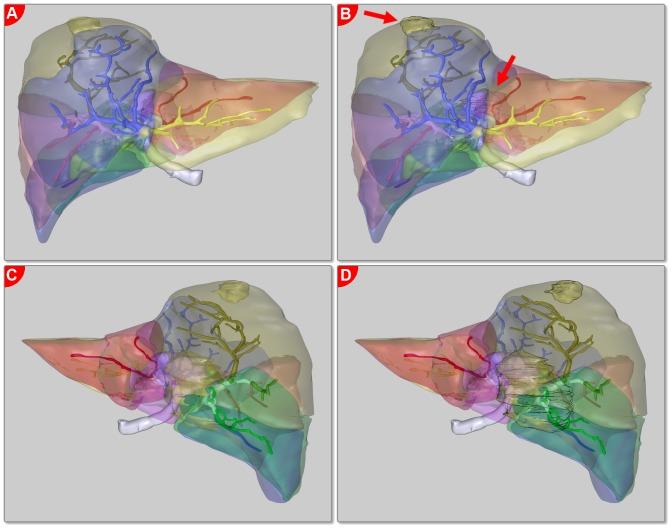
Our solution enables the user to interactively explore the anatomical configuration and to have different analyses and various resection proposals displayed within a 3D PDF document covering only a single page that acts more like a software application than like a typical PDF file ("PDF App"). The new 3D PDF report offers many advantages over the previous solutions. According to the results of the online survey, the users have assessed the pragmatic quality (functionality, usability, perspicuity, efficiency) as well as the hedonic quality (attractiveness, novelty) very positively.
CONCLUSION
The usage of 3D PDF for reporting and sharing CASP results is feasible and well accepted by the target audience. Using interactive PDF with embedded 3D models is an enabler for presenting and exchanging complex medical information in an easy and platform-independent way. Medical staff as well as patients can benefit from the possibilities provided by 3D PDF. Our results open the door for a wider use of this new technology, since the basic idea can and should be applied for many medical disciplines and use cases.
背景与目的
便携式文档格式(PDF)是电子文档交换的实际标准。它独立于平台,适用于医学数据交换,并允许嵌入三维(3D)表面网格模型。在本文中,我们展示了交互式3D表面网格模型在临床常规中的首次应用,该模型已集成到PDF文件中,用于肝脏手术中计算机辅助手术规划(CASP)结果的展示和交换。我们旨在证明3D PDF在医学报告中的应用可行性,并调查用户对这项新技术的体验。
方法
我们开发了一种交互式3D PDF报告文档格式,并实现了一个软件工具来自动创建这些报告。在使用我们的3D PDF报告在临床常规中报告了1000多例肝脏CASP病例后,进行了一项国际在线用户调查,以评估用户体验。
结果
我们的解决方案使用户能够交互式地探索解剖结构,并在仅覆盖单页的3D PDF文档中显示不同的分析和各种切除方案,该文档更像是一个软件应用程序,而不是典型的PDF文件(“PDF应用程序”)。新的3D PDF报告比以前的解决方案有许多优势。根据在线调查结果,用户对实用质量(功能、可用性、清晰度、效率)以及享乐质量(吸引力、新颖性)给予了非常积极的评价。
结论
使用3D PDF报告和共享CASP结果是可行的,并且受到目标受众的广泛接受。使用嵌入3D模型的交互式PDF能够以简单且独立于平台的方式呈现和交换复杂的医学信息。医务人员以及患者都可以从3D PDF提供的可能性中受益。我们的结果为这项新技术的更广泛应用打开了大门,因为其基本理念可以而且应该应用于许多医学学科和用例。




 Zotero 插件