Bobola Michael S, Alnoor Mohammad, Chen John Y-S, Kolstoe Douglas D, Silbergeld Daniel L, Rostomily Robert C, Blank A, Chamberlain Marc C, Silber John R
Department of Neurological Surgery, University of Washington, Seattle, WA.
Taipei Medical University Hospital, Department of Neurosurgery, 252 Wu-Xin Street, Taipei, Taiwan 110.
BBA Clin. 2015 Jun 1;3:1-10. doi: 10.1016/j.bbacli.2014.11.003.
CpG methylation in the O-methylguanine-DNA methyltransferase (MGMT) promoter is associated with better outcome following alkylating agent chemotherapy in glioblastoma (GBM) and anaplastic glioma (AG). To what extent improved response reflects low or absent MGMT activity in glioma tissue has not been unequivocally assessed. This information is central to developing anti-resistance therapies.
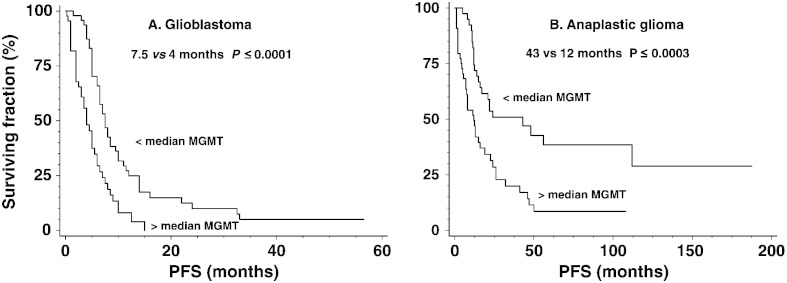
We examined the relationship of MGMT activity in 91 GBMs and 84 AGs with progression-free survival (PFS) following alkylator therapy and with promoter methylation status determined by methylation-specific PCR (MSP).
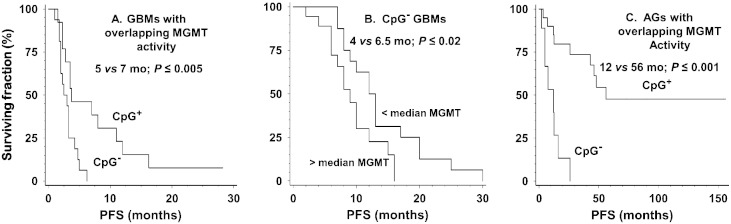
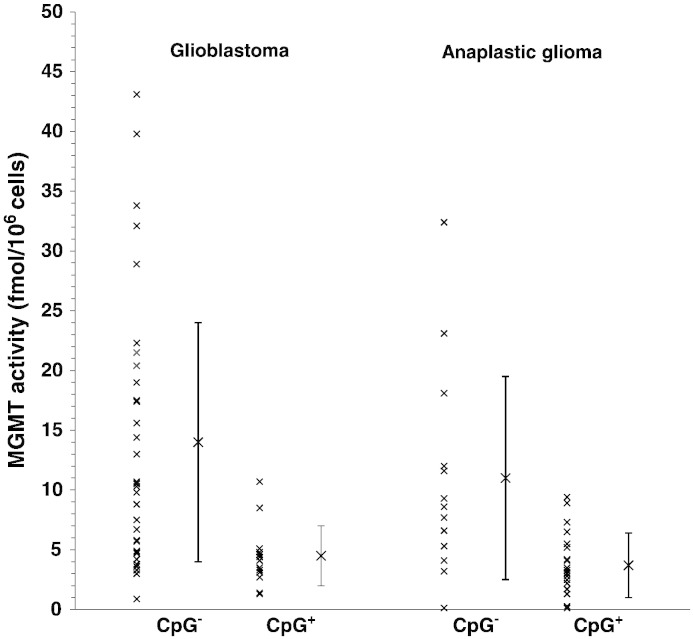
Cox regression analysis revealed that GBMs with high activity had a significantly greater risk for progression in dichotomous ( ≤ 0.001) and continuous ( ≤ 0.003) models, an association observed for different alkylator regimens, including concurrent chemo-radiation with temozolomide. Analysis of MGMT promoter methylation status in 47 of the GBMs revealed that methylated tumors had significantly lower activity ( ≤ 0.005) and longer PFS ( ≤ 0.036) compared to unmethylated tumors, despite overlapping activities. PFS was also significantly greater in methylated . unmethylated GBMs with comparable activity ( ≤ 0.005), and among unmethylated tumors with less than median activity ( ≤ 0.026), suggesting that mechanisms in addition to MGMT promote alkylator resistance. Similar associations of MGMT activity with PFS and promoter methylation status were observed for AGs.
Our results provide strong support for the hypotheses that MGMT activity promotes alkylator resistance and reflects promoter methylation status in malignant gliomas.
MGMT activity is an attractive target for anti-resistance therapy regardless of methylation status.
在胶质母细胞瘤(GBM)和间变性胶质瘤(AG)中,O-甲基鸟嘌呤-DNA甲基转移酶(MGMT)启动子中的CpG甲基化与烷化剂化疗后的较好预后相关。但改善的反应在多大程度上反映了胶质瘤组织中MGMT活性低或缺乏尚未得到明确评估。这一信息对于开发抗耐药性疗法至关重要。
我们研究了91例GBM和84例AG中MGMT活性与烷化剂治疗后的无进展生存期(PFS)以及通过甲基化特异性PCR(MSP)确定的启动子甲基化状态之间的关系。
Cox回归分析显示,在二分法(≤0.001)和连续模型(≤0.003)中,高活性的GBM进展风险显著更高,这一关联在不同的烷化剂方案中均有观察到,包括替莫唑胺同步放化疗。对47例GBM的MGMT启动子甲基化状态分析显示,与未甲基化肿瘤相比,甲基化肿瘤的活性显著更低(≤0.005)且PFS更长(≤0.036),尽管活性存在重叠。在活性相当的甲基化和未甲基化GBM中,PFS也显著更高(≤0.005),在活性低于中位数的未甲基化肿瘤中也是如此(≤0.026),这表明除MGMT外的机制也促进烷化剂耐药。在AG中也观察到MGMT活性与PFS和启动子甲基化状态之间的类似关联。
我们的结果为以下假设提供了有力支持,即MGMT活性促进烷化剂耐药并反映恶性胶质瘤中的启动子甲基化状态。
无论甲基化状态如何,MGMT活性都是抗耐药性治疗的一个有吸引力的靶点。